
Monterey Bay, US
Different whale species frequent this Californian bay throughout the year - grays and orcas from December to May, humpbacks from April to December and blue whales from June to October. Six different types of dolphins are seen year round. Monterey Bay Whale Watch is the only company in the bay to have marine biologists on all trips. They narrate sightings during the journey and run Q&A sessions. They also collect whale research data along the way. Their ship, the Sea Wolf II, has room for 70 passengers.
· Monterey Bay Whale Watch (+1 831 375 4658, montereybaywhalewatch.com) runs three- to five-hour trips daily, year round. Adults £15-£23, children £10-£18.
Hervey Bay, Australia
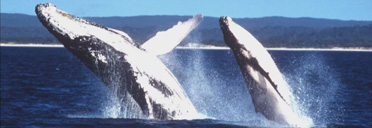
From late July to early November krill-munching humpback whales descend on Hervey Bay in Queensland, before returning south to their Antarctic feeding grounds. Humpbacks are very animated - you're more likely to see one of them breach the surface and perform pectoral fin slaps than any other whale species. Late July to early September is a good time to see the more inquisitive younger whales while mothers and calves accompanied by big bull whales arrive in September. Whale sightings are guaranteed in season, dolphins can be seen all year round. The 50-foot catamaran MV Whalesong, operated out of Hervey Bay by Jason and Virginia Brigden, has an underwater colour video camera, three TV monitors on board and can take up 70 passengers. Whale watchers can opt to view inside or outside the vessel.
· Whalesong (+61 7 4125 6233, whalesong.com.au). From late July to early November. Half-day cruises start from £32 for adults, £18 for children.
Auke Bay, Alaska
Orca Enterprises run trips out of the bay and along the shores of Admiralty Island to watch humpbacks feeding. Sightings of Stellar sea lions, harbor seals, Dall's porpoise and orcas are common. The boat, the Awesome Orca, has room for 23 passengers, and there are three tours daily, each taking 2 hours. Unlike many other operations in Alaska, this boat cannot be booked via one of the many cruise ships that pass through Alaska.
· Orca Enterprises (+1 907 789-6801, orcaenterprises.com). Adult £61, children £28.
Tonga and Niue, South Pacific
It's only possible to "swim" with whales in three locations in the world. Two of those places are the islands of Tonga and Niue. WhaleSwim Adventures offer the more serious whale watcher an extended stay with the giants of the deep. They run a variety of six-, seven- and nine-day tours to see humpbacks and other species around Tonga. Each tour is accompanied by a qualified marine researcher. One tour allows you to "swim with humpback whales, snorkel pristine reefs, and spend four nights on a beautiful paradise island of Vaka'eitu in Vava'u, Tonga". The whales migrate from Antarctica to Tonga each year to give birth and stay between July and October. Each day is spent over the whale nursery and lunch breaks are on an uninhabited island.
· Whaleswim Adventure (+64 (0)9 372 7073, whaleswim.com). From £1,108pp.
Scotland
Springtime sees the arrival of minkes, basking sharks and orcas off the northern shores, and whale watching in Scotland now attracts 250,000 tourists a year. Sea Life Surveys, the first whale tourism operator in Scotland with 22 years experience, runs full day trips (maximum 12 people) out of Tobermory on the Island of Mull. But what are the chances of actually encountering whales? Well, according to Sea Life, in 2002 96% of their trips were successful in spotting 33-foot minkes. Sightings of dolphins, porpoises and seals are all but guaranteed.
· Sea Life Surveys (01688 400 223, sealifesurveys.com). £45 for all day trips
Kaikoura, New Zealand
Head to the South Island for an excellent chance of seeing 66-foot sperm whales. Kaikoura also has humpback whales, killer whales (orca) and the small hectors dolphins, a native of New Zealand arriving during June and July. Local Maoris work in partnership with the company. The summer runs from December to February and can get as warm as 20 C, winter temperatures reach 11 C maximum. There are six tours daily and advance booking is recommended. Four boats run each day with seating for up to 48 passengers.
· Whale Watch (+64 3 319 6767, whalewatch.co.nz). Adults £40, children £22
Tysfjord, Norway
Schools of orca arrive in the Norwegian fjords around the small town of Tysfjord between October and January. They come to feed on the abundant herring, which they herd into a tight area before stunning them with tail slaps. Discovery Initiatives have teamed up with Norway's resident orca authority, researcher Tiu Simila, to offer the opportunity of getting close to orcas in Zodiac boats. If the conditions are right, the brave can don dry suits, snorkels and flippers and slip into the depths for a close encounter. Each visitor helps contribute to Tiu's ongoing research. Bring your woollies, Tysfjord is only 60 miles from the Arctic Circle and temperatures range between -14C and 6C.
· Discovery Initiatives (01285 643333, discoveryinitiatives.com). Four days from £965 (incl flights), year round. Maximum group size is 12.
Baja, Mexico
Baja is located in the Sonoran Desert which meets the blue Pacific waters of the Sea of Cortez. Twenty-three species of whales are known to pass through these waters, including the world's largest whales, the blue and fin whales. Baja Airventures runs whale watching tours from January to March with good chances of seeing Californian gray whales. Guests stay at La Unica Wilderness Retreat on the ocean front. The company also runs whale shark watching tours during July and August. Whale sharks are the largest fish in the sea, growing to a length of 60 feet, and are regular visitors to Bahia de Los Angles (Bay of the Angels) near Baja. Maximum of 11 guests at any one time.
· Naja Airventures (+1 800 221 9283, bajaairventures.com). Six-day whale watching trips £1,070 (incl private plane from San Diego). Four days whale shark watching, £664; six days, £886.
Earthwatch
For the serious whale watcher who wants to give as much as they get, Earthwatch offers a variety of whale and dolphin volunteer research "holidays" in Brazil, the Bahamas, Spain, Madagascar and South Africa. According to the website, these expeditions are not tours or ecotourism but short-term volunteer opportunities assisting scientists in their field research. The South African expedition departs in September and October. Visitors work alongside Dr Pete Best from the University of Pretoria to study southern right whales. Visitors spend up to nine hours a day in a 20-foot inflatable helping with identification data and logging whale behaviour. Guests stay in simple accommodation in single or shared rooms on a hill overlooking Saldanha Bay and are expected to muck in with dinner preparations.
· Earthwatch (01865 318838, earthwatch.org). Two weeks from £1,390. Excludes international flights.
Whale and Dolphin Conservation Society
WDCS has been operating its Out of the Blue holidays since 2000. It runs trips in Europe, North America, Antarctica and Patagonia. Patagonia is the only place where southern right whales breed and raise their calves. The waters off the coast are also home to elephant seals, Commerson's dolphin, sea lions and Megellanic penguins. Out of the Blue offers the chance to see whales and to visit the spot where orcas can be seen beaching themselves to catch sea lions. Visitors accompany WDCS researchers looking for Peale's dolphins and the black-and-white Commerson's dolphin. You also have a chance to visit a penguin colony, home to 150,000 penguins. The weather is usually sunny and temperatures are between 20 and 23 C, although it can get chilly in the evenings. Maximum group size is 10.
· WDCS Out of the Blue (0870 870 0027, wdcs.org). From £1,685 (excl flights to Buenos Aires).
