
Sometimes - usually when stuck on crowded trains with sweaty armpits an inch away from my face - I wonder how long I could survive in a tropical wilderness.
I don't mean as a contestant on TV shows like "I'm A Non-Entity Get Me In There" but proper jungle survival: on my own, not among a handful of dullard celebrities keen to relaunch their careers.
Two days, maybe three once all my cereal bars and bananas had run out. The trouble is, like everyone else, I have become reliant on supermarkets for my food supply, especially those idiot-proof salmon steaks that only need a few minutes under the grill.
Now, thanks to a wonderful Malaysian gentleman, my survival chances look considerably brighter. Captain Mok is quietly spoken with a slight build that belies the hidden strength of five tigers. He's the resident naturalist guide at Tanjong Jara, a tranquil, luxury hideaway eco-resort on the east coast of peninsular Malaysia.
I've never been keen on upmarket resort hotels in which you are cocooned like a holiday camp but Tanjong Jara is nothing like that. Its neighbours are all local fishing villages on an unspoilt, undeveloped coast. Better still, it actively encourages guests to experience local village life and learn about local Malay traditions.
Of course, you can stay in the resort and chill out, listening to the resident monkeys and varied bird life, but that seemed criminal to me especially when the heart of the Malaysian jungle was just an hour away. While others chose Malay cooking classes and spa treatments, I jumped at the chance to spend a day's jungle trekking through a 130m-year-old rainforest.
An ex-Sandhurst military cadet, Captain Mok has climbed Sabah's Mount Kinabalu on several occasions and even lived among one of Malaysia's aboriginal tribes for over six months. There's not an ounce of fat on him and he's just the sort of guy you need around you when you're unsure of the terrain.
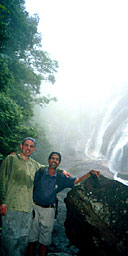
Armed with day packs and wearing lightweight waterproofs, we hiked to the foot of the awesome 200m Cemerung waterfall, one of the highest in south-east Asia. The hike followed a 2.5km path through dense jungle. It rained heavily (well, it's not called the rainforest for nothing). Cemerung means steep in the local aboriginal language - and they're not kidding. I was sweating within minutes.
Immediately the jungle swallowed us whole. There was an unforgiving, uncompromising atmosphere and I felt I was being watched: nothing malevolent, just thousands of hidden pairs of inquisitive eyes keeping tabs on us. When Captain Mok mentioned vipers and cobras roamed the jungle, suddenly every tree root or twig resembled a snake.
It's not about what car you drive in the sun-starved, primeval rainforest. I've always been into this back-to-nature, tree-hugging stuff but this jungle trek was cleaner, much more fun and you get to leave with your dignity intact.
Captain Mok was a wealth of knowledge and full of practical wisdom. It soon became evident that the jungle was a huge chemist and convenience store all rolled into one. "In the forest you have everything you need," he explained. "Know where to look and you won't go hungry."
Many of the trees had medicinal qualities, like the roots of the quinine tree, which was a good prophylactic against malaria. Likewise the white coloured resin of the Ipoh tree was used as a medicine for influenza and pneumonia. However, when this resin is heated up it turns black and very poisonous. Aborigine tribes use it to coat the tip of the darts of their blowpipes.
Everything you needed to survive in the jungle was literally at our fingertips. If it got cold we could keep warm with wood from the charcoal tree. This provides the perfect firewood as its bark is so tough it burns slowly. There's no frozen meat section in the jungle, but no matter. You can use the roots of the wild ginger plant to preserve fresh meat.
And it got better. To ensure they don't bump into each other in the dark highland aborigines attach the luminous tips of peacock plants to their heads so they can see each other at night.
I could have spent hours listening to Captain Mok and wanted to introduce him to my friends at my local. When we reached the base of the waterfall my new desire to live off the land was scuppered when I discovered a packed lunch and sports drink in my backpack.
Before embarking on the return journey, we plunged into the invitingly cool pools at the foot of the falls for a refreshing swim. The chilled water was heavenly.
We returned to the resort caked in mud and glowing with smiles as wide as our fellow guests, mostly loved-up honeymooners. I stood in the shower fully clothed and let the jungle drain away. Back in my suite I was unable to put my newly acquired survival skills to immediate use, as food was only a phone call away.
The following morning, I was spoilt for choice once again. I could go scuba diving and snorkelling at Tenggol Island, not far from the resort. But I was more interested in an eco-adventure river cruise along the Marang River - and not just because, once again, Captain Mok was the guide.
Up until now, pretty much the only wildlife I'd seen were the monkeys who cheerfully lobbed fruit at us each day at breakfast. From the town of Marang, we took to the river. We soon saw more monkeys but also a wide range of exotic birds along the riverbanks. I spotted some sea eagles, high up on trees and monitor lizards. The first we saw of these creatures was their imperious noses poking out of the water as they waded across the river.
"Don't worry, it's not a crocodile!" Captain Mok laughed. "We do have crocodiles but not on this river. They prefer smaller rivers." As the lizards came ashore they waddled like fat financiers returning from a long lunch at a swanky restaurant. They were well camouflaged and disappeared as quickly as they arrived.
We soon moored at a Kampong Jenang, a traditional Malay village whose way of life has remained unchanged for years. It's a rural community in which villagers share the main street with cattle and electricity and television were installed only fairly recently. We were met by laid-back elderly villagers and bright-eyed, inquisitive children. One wore a nearly new Tommy Hilfiger T-shirt.
A couple of days later back on the tarmac at Heathrow I was startled by an announcement over the aircraft intercom: "Captain Mok and his crew would like to thank you for flying Malaysia Airlines ... "
What? I knew Captain Mok was multi-skilled but was there no end to this man's talents? What a guy. I asked the stewardess but it transpired it was only a similar-sounding name and not the man himself. However, I wouldn't have been surprised. Often it's the quiet ones you have to watch.
Way to go
Accommodation at Tanjong Jara starts at RM 805 (approximately £132) per room per night on a room-only basis. The resort also offers a meal plan at RM 165 per (approximately £27 per person per day. The package includes all meals, snacks and beverages (excluding alcohol).
Malaysia Airlines (0870 607 9090) flies direct from Heathrow or Manchester to Kuala Lumpur. Economy flights from London Heathrow to Kuala Terengganu via Kuala Lumpur start at £598 plus tax. The airline also operates non-stop services from Heathrow to Penang and Langkawi.
For those who would like to use a tour operator, Scott Dunn (0208 682 5010) offers a twin centre package from £1,295 per person including seven nights at Tanjong Jara in a Bumbung room plus two nights at the Ritz-Carlton Kuala Lumpur (0800 234 000) in a deluxe double room including daily breakfast, economy flights with Malaysia Airlines and private airport transfers. Price is based on two sharing and valid for travel until November 2004.
