
What should I do there?
Spend a couple of days in the capital Warsaw, wandering the perfectly restored old town, rebuilt from scratch after it was razed to the ground by the Nazis. Admire the medieval architecture and impressive art collections of beautiful Krakow. Hike the magnificent Tatras mountains. Search for wolf and bison in the Bialowieza Forest.
Where should I stay?
Warsaw's first boutique hotel, the Art Deco-themed Hotel Rialto (00800 3746 8357, designhotels.com), features original furniture and accessories from the 1920s and 30s. Double rooms start from £108 per night in June including breakfast.
What should I eat?
Warsaw is one of the best and cheapest places to eat in Europe. Choose from Russian, Lithuanian, Ukrainian, German and Jewish cuisine. Cafe Blikle (Nowy Swiat 35) has a wonderful Art Nouveau interior and delicious ice creams and pastries.
What should I drink?
Vodka, natch.
Where's the best nightlife?
There's a a thriving cafe bar culture in Warsaw and some very groovy nightclubs. Jazz Cafe Helicon (45/47 Freta) in the Nowe Miasto district has regular jazz concerts. Clubbers should head to NoBo (Wilcza 58a) the city's sexiest late-night hangout with curved red walls, slash screens and low, maroon banquettes.
Those crazy Poles ...
A genteel, but still common, greeting is when a man kisses a woman's hand - but only after she's suggested the form with a slight lift of her hand. How do I get there? Fly to Warsaw from £98.20 return from Gatwick with British Airways (0870 850 9850; ba.com).
Postcard from ... Krakow
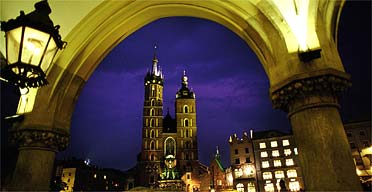
Although Warsaw has bustle and charisma, the country's jewel is its rival, Krakow, in the south. Varsovians boast that the fact that their old centre is a rebuilt fake is, itself, monument to their courage in uprising against the Nazis. Krakovians, meanwhile (who failed to arise), gloat that theirs is unarguably the most lyrical, beauteous and authentic city centre in the land - if not in all central Europe. It is to medieval architecture what Prague is to baroque.
And this - coupled with the effervescence of its university life - makes Krakow the prime tourist destination in a land with a population of 38 million, more than all the other new members of the European Union combined.
It is essential to know some history before visiting, because this is a city of restless ghosts. It was once the national capital and has been the pivot of recent events in a turbulent past. Most infamously, Krakow is the point of departure for pilgrims to Oswiecim, better known as Auschwitz-Birkenau. You can walk around the old ghetto of Krakow, which had been liquidated - after being home to six centuries of Jewry - by 1943.
Before the Nazis arrived, this was Lenin's revolutionary planning headquarters from 1912 to 1914 and was latterly the spring board for another, more joyous, revolution, thanks to the university and Nowa Huta steelworks - the Solidarnosc movement that overthrew Lenin's legacy.
Oddly, Krakow is the place where all this leaden history entwines with a breezy, hip feeling. Traditionally a bastion of conservative Catholicism (Pope John Paul II comes from here), it is now home for pony-tailed intellectuals, picturesque coffee shops and cavernous cellar bars in streets off the lovely Rynek Glowny, the largest square in medieval Europe, particularly those leading west towards the campus district, with quiet courtyards drenched in dappled sunlight at this time of year.
Behind heavy wooden doors and old ironwork, one can eat heartily (though more expensively than elsewhere in Poland), thanks to a restaurant business which has flourished along with exposure to the West. Don't, however, follow the habits of newly trendy Poles, eager to impress by eating sushi or other such nonsense. Stick with the pierogi ruski (dumplings filled with cheese and onion) or gypsy pie (potato pancakes with goulash) washed down with cheap vodka and/or extremely drinkable Zywiec lager.
· Ed Vulliamy
