
More pictures: dinosaur dig gallery Photograph: guardian.co.uk
The windswept, sparsely inhabited interior of Argentina, las pampas, has long attracted writers and explorers. The gauchos who work the land represent a traditional, unchanging and, above all, tough way of life that appeals to those who have lost their soul in the city.
But Argentina is also home to life that goes back far farther than the gauchos. Dr Duncan McIlroy, an English palaeontologist who works part of the year in the province of Neuquén, has offered to take me to see its numerous deposits of dinosaur bone.
Arriving at Neuquén airport, about an hour-and-a-half's flight west of Buenos Aires, I began to fear that I was going in way over my head. Lying on the dashboard of Duncan's 4x4 was a copy of his latest book, the Application of Ichnology to Stratigraphic and Palaeoenvironmental Analysis. What could that possibly mean? Painful memories of school field trips came flooding back.
Our first visit was to Lago Los Barreales, where Argentinian PhD students are excavating Sauropods (long-necked plant eaters) and Theropods (small, meat-eating beasts). The site itself has a slightly dishevelled visitor centre, where you can see the process of excavation, from detection to digging, via cleaning and labelling of the bones. For those with even a mild interest in these prehistoric animals, this is a wonderful opportunity. Nowhere else can you get so close to the action. The guided tours are very helpful, if a little too densely packed with information for the novice.
The terrain itself is rugged and uncompromising, the ideal location for a spaghetti western. Clint Eastwood would feel right at home. The connection with the US doesn't end there - this is oil territory, with wells as common a sight as old bones.
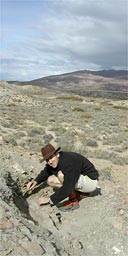
Watching other people dig is not what I was there for, however. Duncan, who worked on BBC's Live from Dinosaur Island, had promised that I would find plenty of bones for myself. So we drove to Añelo, Duncan scouring the landscape for a likely spot. Once he found a place he liked the look of, we set off on foot. He reassured me that "bone hunting is not a dark art" and that it only takes a couple of hours to get your eye in and to stop picking up bits of beetle shell. That doesn't prevent me from spending half an hour digging at what turns out to be a goat. Duncan can't help but smile at my enthusiasm, though I think he feared I would be the first to go home empty handed. (Not, as he points out, that you are allowed to take bones home with you - the Argentinian government fiercely defends its dinosaur heritage and it is illegal to trouser even the smallest bone.)
After an afternoon without success (for me, that is - Duncan calls out his discoveries at the rate of one every third minute, which is mildly disconcerting. Surely we're looking in the same places, so why can't I see anything other than rocks and shrubs?), we headed back to our hotel in Neuquén. The city is a fairly cosmopolitan place, and the Hotel del Comahue is modern and comfortable, with a stylish bar, offering much-needed refreshments. Indeed, a night on the town offers more attractions than might be expected - after a stroll along the main promenade, we dined at Deseado, which wouldn't look out of place in Buenos Aires.
But this trip was not about upmarket restaurants. The next day, an early start found us making two fairly quick-fire museum visits - first in El Choc ón, which holds the bones of what is claimed to be the largest theropod dinosaur in the world, the Giganotosaurus carolinii. The second is down the road in Plaza Huincul, where you'll find the bones and a reconstruction of the largest sauropod dinosaur (the rather patriotically named Argentinasaurus). Both are ideal museums, with just enough to keep you interested for an hour. We lunched at a roadside grill, where mustachioed old men prove that it's not just the dinosaurs that are famous for their meat eating.
Back in the field, I had my first bone success, and Duncan seemed as relieved as I was surprised. Only my second day, and I had come across a well-preserved bone from what he surmised to be an 80-million-year-old sauropod. Despite my initial scepticism, there is something strangely moving about holding these bones in your hands, enhanced by the fact that they are almost certainly the first to have done so. The land around here is among the most fertile in the world in terms of quantity and type of dinosaur bone, with very little having been excavated.
Walking through the channels and slot gullies that cut into the mountains, with strange green deposits lining their walls, there was the sense of being not just on another continent, but another planet. A key piece of advice: bring a hat. Or better still, for that true Indiana Jones look, buy one here. A good quality gaucho-style hat can be found for less than £15. And when the sun beats down, you'll be grateful.
In the early evening we drove into the town of Zapala, our base for exploring the countryside around. This is well off the tourist trail - our hotel was full of geologists and oil prospectors. It also doubles as the local casino, with one salon dedicated to slot machines and two roulette tables. The hotel is comfortable enough, but nothing more, though after a long day in the field, all you need is a cold beer and a good night's sleep. Just don't try to call another room - the internal system was obviously designed to confuse newcomers. To call room 101, you dial 115; for room 115, it's 127, and so on.
The main draw of the trip was the chance to participate in an excavation. In the Valley Los Molles, about an hour's drive out of Zapala, Duncan is working on a 150-million-year-old marine reptile (a 40ft-long pliosaur, given the evidence of the bones thus far excavated). He first came across a tailbone five-and-a-half years ago as he walked the area. Knowing that what he had found was in good condition, he couldn't get the creature out of his head, and just under a year ago decided to start excavating it properly, piece by piece.
Duncan and his friend Dr Phil Manning, both of whom are keen to make science accessible and enjoyable, bring groups of interested amateurs to help with the dig. They plan to donate the entire skeleton to the Zapala museum. Each person gets a bone attributed to them, and, for this confirmed amateur, there was a real sense of having contributed something. The process, while occasionally slow going, is never dull; the extracting, washing and cleaning of bones, combined with drawing and naming, makes for a full day.
Save for the sound of brush against bone, nothing disturbed us. This is truly isolated work, so when a sudden boom came across the valley, I was slightly shaken. Had we awoken some sleeping prehistoric beast? It turned out to be wild horses communicating with each other. We climbed a small hillock and watched some gauchos taming a herd of wild horses. This is the Argentinian interior as it has been for years, and offsets our dig perfectly. Unlike in more tourism-orientated parts of the country, where gauchos show off their skills to paying visitors, these men were oblivious to the foreign eyes staring down at them.
In the evening, we went out to Primeros Pinos. For those who saw the BBC series Walking with Dinosaurs (on which Phil was a scientific adviser), this landscape will be immediately familiar. The monkey puzzle trees are essentially the same as those past which the dinosaurs would have stridden. But, for the real walking-with-dinosaurs experience, nothing beats the tridactyl footprints in El Chocón. For years, local fishermen used the prints as fire holes for cooking trout until a visiting palaeontologist realised their significance. A guide is essential to understanding them because, to the untrained eye, they look like a random series of oversized fingerprints on a dirty window. But, once the various tracks have been made clear, I found myself placing my feet exactly where dinosaurs stepped 140 million years ago. You don't get that on television.
We stopped for coffee at a lakeside cafe. The owner moved here from Buenos Aires 15 years ago. "I can understand why you stayed," I said, "it's very tranquil." "Sometimes a little too tranquil," she replied, staring across the lake.
In the end, I found myself somewhat reluctant to return to Buenos Aires. The trip concluded with a night at the Sheraton Libertador and a visit to the excellent natural history museum, whose collection drew together many of the things I had learned over the past few days.
A visit to Neuquén is ideal for anyone with an interest in dinosaurs; for the beginner, there can be no better introduction to the world before mankind got its dirty hands on it.
Way to go
· A seven-night trip costs £2,649, including return flights to Buenos Aires from the UK, return flights to Neuquén from Buenos Aires, taxis, transport in the field in small off-road vehicle, all hotels, all meals with drinks (excluding evening meal on day seven in Buenos Aires), museum entry and expert palaeontologist guides.
· The next two trips will take place on December 3-11 2004 and February 20-28 2005.
· For further information, please visit: argentinedinosaurs.com
See more pictures in Paul's dinosaur dig gallery
