
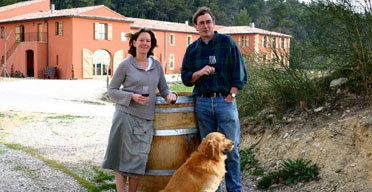
For 20 years Rupert Birch's mother never understood his job. And his children were even less impressed by the career of a middle-aged English investment banker.
'They just thought daddy went off into a tall tower and did something incredibly tedious. They'd come and visit - and, yes, there is an incredible view from the 45th floor of the OCBC Centre in Singapore - but they didn't actually have a clue what I did. Now even if I'm busy spraying at the weekend they can see me on the tractor and bring me a sandwich and a beer.'
Three years ago, Birch finally quit the rat race to follow his dream: setting up his own organic vineyard in Provence. The aim is to produce high quality wine and create a place for people to visit. According to Birch, a committed Francophile: 'It was something I'd wanted to do for the past eight years. And then one day I reckoned there was enough in the bank for me to push off and try something I really wanted to do.'
Giving up his job running the Singapore branch of Schroders to buy 40,000 vines sounds a dramatic mid-life crisis. But as Birch reveals: 'It is quite a common fantasy among London investment bankers - the standard topic of conversation at dinner parties is, "I can't face the stress and pressure any longer. I must get away and do something else!" But when push comes to shove very few do it. I was lucky because I had a very clear objective.'
The 10-hectare site that Birch purchased in southern Provence in 2001 is idyllic - deep in the heart of the French countryside opposite the Montagne Sainte Victoire, which inspired Cézanne, Van Gogh and Zola. From the house you have a limitless panorama of vines, green patchwork fields and acres of poppies. But in fact the vineyard is 7km (4.5 miles) from Aix-en-Provence, and 20 minutes from Marseille.
Magnificent vista aside, it hasn't all been easy. A handsome, engaging figure in his mid-forties, Birch is the first to admit he has led quite a full life (he has four children from two previous marriages to support), so there is little margin for error.
Birch had long coveted this area of Provence. It took him several years to persuade a local farmer to sell him 45 acres of land planted with vines.
'In 2001, we made our first wine in a nearby cellar borrowed from friends, and in February 2002, laid the foundations for a brand new cellar. Although building was still going on, by September of that year we were able to install vats, pumps, crusher and all the other paraphernalia necessary to deal with the forthcoming harvest.'
Today Birch and his partner Mary Mertens 'live above the shop' in a spacious new house (red ochre frontage, long low Provençal design) that he designed. And the guest wing of the house comprises five individually decorated en suite B & B rooms. Named after grape varieties ('Syrah', 'Grenache') the rooms are exquisitely decorated with white muslin, candles and prints. It's Provence for the Conran generation.
Domaine de La Brillane specialises in light, young red wines with enough body to age gracefully - a mix of Grenache, Cabernet Sauvignon, Carignan, Counoise and Cinsaut - and earlier this year they planted a further 1.5 hectares of Syrah and Mourvèdre. Birch sticks to red wine: 'I take the view that you should suit the wine to the climate, the area and the terroir, rather than deciding on the wine you want to make and then imposing it on the countryside.'
Birch and Mertens work the vineyard on an organic basis and they harvest laboriously by hand. The aim is to produce high quality red wine by limiting the yields of the vines. 'If we can produce healthy and ripe grapes, we believe the wine should follow naturally.'
Clearly after 20 years in an office, Birch relishes a job that is close to the land. The work is often back-breaking: he and Mertens rise every day at 6.30am and go to bed at 9pm. But, he insists: 'I've realised that making wine is incredibly intellectually challenging. At no stage are you ever faced with the same set of circumstances or climactic conditions.
'If, like me, you find that one of the real chillers about work is repetition, well it's impossible to get bored making wine ... And because it is so infinitely variable, in 20 years' time, you still won't have begun to master the business. So from that point of view it's far more satisfying than I ever imagined.'
Life at Domaine de La Brillane has had its ups and downs. The first harvest in 2001 was a great success and they sold all 35,000 bottles, but the following years were the wettest and hottest in living memory. And Birch won't sell wine that he thinks is below par. Fortunately their baby wine Cuvée de Printemps 2003 - a light, refreshing 'summer red' - is selling well.
Recently Birch and Mertens introduced short courses where B&B guests can explore the cellar and experience a day in the life of a vigneron.
As one who is woefully unsophisticated about wine, I found their enthusiasm infectious. Forget snooty descriptions of wine tasting like cigarette ash cut with American tan tights, they prefer to emphasise the human, emotional experience of wine drinking.
'Wine is very much a living animal,' enthuses Birch. 'It's not an inanimate object. Each wine will reflect the personality of the man or woman who has made it.'
Best of all the vineyard is a great base from which to explore Provence. Nearby Aix has a famous art and music festival - and of course it is Cézanne country.
You can follow the painter's trail from the Café des Deux Garçons on the Cours Mirabeau, once a place for writers and thinkers, to Cézanne's wonderfully ghostly atelier - filled with canvases, painting clothes and the giant stepladder he needed to paint The Bathers .
And the vineyard is only a 20-minute drive from Marseille, which even modish Parisians now regard as France's second city. A seaport founded by the Phoenicians, today it has numerous theatres and museums as well as a world-famous opera house. You can drive along the Corniche to the Pointe Rouge, a fantastic expanse of secluded rocky beaches, or just go shopping along the Canebière, Marseille's premier avenue.
A weekend at Domaine de La Brillane promises culture, tranquillity and fantastic weather. The only downside for lazy urbanites is that everyone works so hard on a vineyard. Before you know it, you are jettisoning your novel and lightly pruning some vines.
But, as Birch insists, wine making is its own reward. 'It's immensely satisfying to see someone smile and say, "how did you make this bottle of wine?" and actually be able to take them through the whole process from pruning to bottling. When someone buys a bottle of your wine and then asks for another, the pleasure is phenomenal.'
Factfile
A room at the Domaine de la Brillane (00 33 4 4254 2144; www.domainelabrillane.com), which is open all year, costs from €95 (£64) per night B&B.
The wine can be bought direct from the vineyard or from Whitebridge Wines Ltd (01785 817 229; www.whitebridgewines.co.uk). British Airways (0870 850 9850; www.britishairways.com) flies to Marseille from Gatwick from around £90 return.
