
The last time I visited the Costa Brava was in 1972. I was eight, Franco was still in power and a couple of years earlier my parents had impulsively bought a tumbledown house in the medieval village of Begur, 3km (1.8 miles) from the coast and crowned by a ruined 16th-century castle that, to a child's eyes, looked like a Christmas cracker party hat.
This beautiful little stretch of the Catalonian coast was still shielded from the influx of mass tourism that would soon blight the coastline further south at Lloret de Mar. There were a couple of fine hotels at nearby Aigua Blava, including an unashamedly modernist parador, and some elegant villas were nestled in the hillsides of densely wooded, heavily scented pines. But tucked away in their tiny bays and approached by hair-raisingly winding roads, the fishing villages of Sa Tuna, Fornells and the slightly bigger, bustling Llafranc, were not yet tourist hot spots.
The three of us had looked at several houses, all in various states of apparently terminal neglect, but it was No. 8 Carrer de Clos, Ipujol, Begur, that we all agreed was perfect. Or at least it had the potential to be perfect.
Factfile
Kathryn Flett stayed at the Castell d'Emporda in La Bisbal (00 34 972 646254. www.castelldemporda.com) Double rooms from €135 (£90) per night
Car rental was from Marius Rent A Car (00 34 972 220 906; www.mariusrentacar.com). prices start from €163 (£109) per week.
Flights were with Ryanair (08701 246 0000, www.ryanair.com) from Stansted to Girona, near Barcelona. Fares start from £41.88 each way including taxes.
For further information contact the Catalan Tourist Board (020 7583 8855; www.catalunyatourism.com).
Situated at a crossroads on the lower slopes of the village, it was a typical unpretentious Catalonian house: cool, dark and cavernous, with thick stone walls and numerous rooms of indeterminate function randomly scattered over two floors. There was no garden, but the building was topped by a couple of sunny roof terraces with oblique sea views. It cost my parents £4,000.
Once acquired, the project was entrusted to excellent local builders who were enthused by the idea of both restoring the house to its former modest glory and injecting a bit of contemporary local colour. The nearby towns of Palafrugell and La Bisbal are famous for their vivid pottery and ceramics, which is how the kitchen came to be tiled funky duck-egg yolk yellow and the bathroom dark pine-needle green. The floors were terracotta, the walls whitewashed, windows shuttered and a feature was made of the old sundial above the heavy front door.
There were no Ryanair flights to Girona, which would have made it easy to grab the occasional long weekend in Begur, so we visited only in the school holidays, driving from our home in north-west London through France and over the Pyrenees. The tedium of the journey meant that I appreciated arriving in Begur more than any other place I have ever visited.
When my parents split up in 1973, with the project almost completed, No. 8 was sold to a German Mercedes dealer. Amid the emotional ups and downs of the time, losing the house came as an additional blow, mostly because I felt I would be unlikely ever to return there.
I missed it for a long time but, eventually, my memories were distilled into perhaps half a dozen potent sights, sounds and smells: the sappy tang of pine logs burning in the fireplace at Christmas, the giant chocolate rabbits wrapped in Cellophane and pink paper bows displayed in a village shop window at Easter, the deadened thwump of galloping hooves as my mother and I rode on horseback through the shaded sandy trails in the pine-clad hills; long lunches of grilled sardines and calamares at beachside cafes, my first sips of wine (rosé: yuck) and, memorably, sampling the finest dessert I had yet tasted: Crema Catalana. This local version of creme brûlée - lemony and cinnamony, baked in terracotta ramekins and topped with a thick burnt crust - was, to my mind, far superior to the paler, subtler, altogether more effete stuff they served on the other side of the Pyrenees. The taste of this pudding has stayed with me for decades.
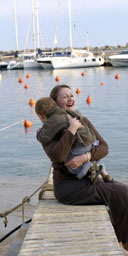
Thirty-two years after my family left Begur for good, I finally returned this year with my partner and our toddler son, another three some perhaps subconsciously searching for a tumbledown ruin of our own.
This time the journey was easy: a one hour, 40-minute Ryanair flight from Stansted to Girona and a 40-minute drive to the Hotel Castell d'Emporda, just outside the town of La Bisbal D'Emporda, 30 minutes inland from the coast. On the drive, the late May landscape was as lush and lovely as I had remembered it.
The Castell d'Emporda is a gracious castle conversion with extraordinary views across the Baix Emporda to the distant snow-capped Pyrenees. It is 21st-century Catalan-chic: sophisticated modern food (not a sardine or a Crema in sight), tasteful 'boutique' rooms with a Moorish flavour and service which occasionally errs on the side of frosty when confronted by a screaming toddler (the Spanish are not quite as beguiled by small people as, say, the Italians).
This is a stylish hotel for couples of all ages, but probably not those with small children who are having trouble adjusting to dining way past their British bedtimes. (However, tired and hungry toddlers will not find a warmer welcome than at the restaurant El Borinot in the almost absurdly pretty village of Peratallada, a 10-minute drive from La Bisbal.)
The Castell is perfectly sited for exploring a sizeable chunk of Catalonia. We made good use of our rented Mondeo. Between temper tantrums the three of us ranged south as far as Sant Feliu de Guixols, a seaside town still sleepy this early in the season, and as far north as Salvador Dali's birthplace, Cadaques, with its pebbled crescent beach (I can recommend a seafood lunch at the Can Rafa), and the artist's house at nearby Portlligat, now a charming museum, where he and his wife, Gala, spent their latter years.
The Dali trail is well trodden but if you haven't visited the area, 2004, the centenary of his birth, is the year in which to do it. There are more Dali-related events than I can list (find them at www.salvador-dali.org and www.dali2004.info) while numerous restaurants in the Girona region have organised Dali-inspired 'Art i Gastronomia' menus (www.art-gastronomia.com).
Dali loved his food and, not surprisingly, found some suitably surrealist inspiration from it (including decorating the roof of his Figueres theatre-museum with giant eggs and the external walls with reproductions of the local twisted, triangular bread rolls). We ate our way through a Dali-inspired but, happily, not surrealist menu (with rolls) at La Placa restaurant in Madremanya, a breathtaking medieval village surrounded by fields of poppies a few miles north-west of La Bisbal. Here a five-course feast of sweet Catalan sausage and quince, local lasagna, oven-roasted turbot, duck breast with redcurrants and raspberries and a wicked chocolate pudding, plus wine, was an exceptionally good-value €36 (£24) a head.
Though the museum at Figueres is unmissable, my favourite Dali-related sight was the 14th-century Pubol Castle, in the village of La Pera, just a few kilometres from our hotel. Dali bought it as a ruin in 1970 and restored it as a private retreat for Gala (he could visit only when she invited him) and one of the reasons I love it is that, at exactly the same time and just a few miles away, my parents were busy restoring their own rather more modest Catalan castle.
Pubol is not as busy as the other Dali attractions, and still feels like a home full of magic and the owner's personal quirkiness (the tiled bathroom is a treat), not to mention objets d'art, frescoes, sculpture and Gala's stunning collection of couture. My son preferred the garden, particularly the giant spindly-legged elephant sculptures, while we all appreciated the irresistible gift shop.
Pubol is also where Gala was buried after she died in 1982, and, poignantly, where Dali moved to be close to her shortly afterwards. It was here that the artist suffered the serious burns in a fire in his bedroom in 1984, from which he never really recovered. When Dali came out of hospital he moved to Figueres, where he died and was buried in 1989.
After several days reacquainting myself with Catalonia, it was, inevitably, time to go home. During the drive to Begur my memory played tricks, creating a semi-surrealist dreamscape full of oddities of perspective and scale. I'd vividly recall a particular view, for example, and be entirely thrown by the fact that it wasn't where I'd expected to find it.
But these Dali-esque moments were as nothing compared to the surprise of Begur itself. I'd decided to sniff out our house without the aid of a map and though it is a sizeable village (and these days the large 19th-century townhouses, originally built by wealthy Catalans who made fortunes in the Americas, are looking very chic indeed), I didn't expect to take long to find our house, once I'd orientated myself in the main square - or, rather, once I'd got over the shock of the main square barely resembling the one in my head. Admit tedly I've grown a few inches in every direction since 1972, but it wasn't just about perspective: how had my memory completely excised the very large church?
'Okay, the house is down this road, left at the end, and just to the left of the crossroads,' I instructed the troops with confidence. But walking the cobbled lanes was like downing the contents of a bottle labelled 'drink me' and drifting into my own private wonderland. Shrinking to my eight-year-old self, I discovered that I recalled many buildings as accurately as if I'd visited them a week ago, while others, such as the church, popped up and surprised me entirely. Happily, though, No. 8 Carrer de Clos Ipujol was immediately recognisable.
From the street I could see that the current owners had enclosed one of the roof terraces to create another room, acquired the house behind, which has given them a garden and a big garage (full of Mercedes, perhaps?) and where the road outside our front door had been rough and pitted, it now sports a smart set of steps.
I was, briefly, tempted to knock but emotion overcame any journalistic instincts and I lost my nerve. Moments later a paint-spattered workman emerged from the front door and I could have kicked myself for being such a wimp. Still, consolation came in the fact that not only did the house look lovely, it looked loved.
Much about the Costa Brava has changed over the last 32 years - villa developments crawl across the hillsides, fashionable boutiques and restaurants clog the immaculate villages and a Begur house similar to No. 8 can cost upwards of €500,000 (about £334,000) - and it is a long way from the insular Franco-era Catalonia described by Norman Lewis in his essential travel memoir, Voices Of The Old Sea, or even the sleepy costa of the early Seventies that I knew. Happily, however, a few important things remain exactly the same.
We spent the last two days introducing our son to the joys of the Spanish beaches that had given me so much pleasure as a child. Aiguablava may have a couple more cafes but at a tidy 75m long by 25m wide there will always be a limit to development.
Meanwhile, thanks to two seaside restaurants (Simpsons in the delightful village of Llafranch and Es Furio in tiny Sa Tuna) my son enjoyed his first grilled sardine and I tasted the stuff of so many of my Spanish dreams: a truly delectable and lightly cremated, lemony, cinnamony Crema Catalana.
Factfile
Kathryn Flett stayed at the Castell d'Emporda in La Bisbal (00 34 972 646254. www.castelldemporda.com) Double rooms from €135 (£90) per night
Car rental was from Marius Rent A Car (00 34 972 220 906; www.mariusrentacar.com). prices start from €163 (£109) per week.
Flights were with Ryanair (08701 246 0000, www.ryanair.com) from Stansted to Girona, near Barcelona. Fares start from £41.88 each way including taxes.
For further information contact the Catalan Tourist Board (020 7583 8855; www.catalunyatourism.com).
