
Merino sheep are much heavier than they look. I only know this because I got up close and personal with one a few months ago. There were a lot of grunts and shoves but no telephone numbers were exchanged.
It took all my strength to haul the dung-covered animal from the back of an old Land Rover up a flight of wooden steps and into a shed. It was especially tough because it was dark and my only source of light was the car headlights.
This was not a stag party dare but sheep shearing time at an outback station in New South Wales - and far more fun than any blokey weekend I've been on.
Shearing was one of my newly acquired skills at a five-day jackaroo school, where you learn about rural life and how to be a cowboy. It's an antipodean experience as far removed from beach and surf culture as you can imagine. Best of all, no one called you "dude" and there was not a celebrity in sight.
It is not for half-hearted city slickers who want a quick snapshot of cowboy chic: this is fun but also gruelling, and you are going to get covered in dirt. No matter how many showers I had, I never removed the thin layer of dust that got everywhere. Jackaroos and jillaroos are Australia's equivalents to the cowboys and cowgirls of America's Wild West, and these schools are increasingly popular after Prince Harry trained to be a farm hand in Queensland last year as part of his gap year.
I joined 25 young travellers much further south, at Australia's largest and longest running school for budding cowboys and girls in Leconfield, a 7,000-acre cattle ranch near Tamworth, Australia's country music capital, in New South Wales. The farm is located at the end of a 10-mile dirt track and is about as rural and isolated as you can get - a long way from all those sleek, glittery bars back in Sydney.
My fellow trainees were mostly backpackers, Aussie, British, Dutch and German, and all, like me, city dwellers hellbent me on a week's crash course in rural matters - though one lady's ambition was to become a vet. The school can't promise to transform you into jackaroo overnight, but it does teach you the fundamentals of farm life.
At the end of the week, you will feel rugged and invigorated, and it's likely you'll walk differently - though mostly because you are saddle-sore and exhausted. If you're used to luxury and sunning yourself by a pool or crave all-night drinking games in backpackers' hostels, this probably is not the break for you: there are washroom duties, washing-up rotas and accommodation is on the budget side of basic, on bunk beds in a corrugated iron shack. However, this rustic living just adds to the fun. If you can handle all that, you'll have a better time than the contestants on the new reality TV series The Farm, where celebrities swap the city for life on a working farm.
My jackaroo school was a bit like a celebrity free version of that - Big Brother without the misguided egos. We were just average Joes and Joannas without any desire to be famous, just to learn a bit about the bush.
It was early to bed and even earlier to rise. We were woken each morning at 6am with loud rock music - a similar tactic to the one used US Marines used to depose the Panamanian dictator General Noriega.
We were immediately thrown in at the deep end of the realities of life on a cattle station, from mustering and shearing sheep to horseshoeing, whip-cracking, lassoing and mending fences; oh, yes, and improving pasture, which involves dousing huge swaths of deadly blackberry bushes with gasoline and letting go with a match - a pyromaniacs dream.
While the jackaroo course is a practical introduction to country life, it is not all hard graft: we worked from 7.30am until 6.00pm but there was plenty of time to play up to the cowboy image. It was great to act the part in those leather chaps and Akubra hats.
While mustering sheep on horseback, we traversed steep-sided hills and winding creeks to round them into a herd. I didn't really pull my weight on this because I was frequently distracted by the stunning surrounding vistas, with kangaroos bouncing across distant hillsides. The blazing winter sunshine was fierce and bleached a lot of the sprawling cattle station.
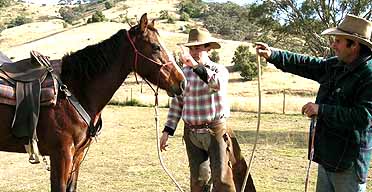
We were taught natural horsemanship by our mentor, Tim Skerrett, whose family has owned Leconfield ranch since 1914. The school started in 1983 with the idea of training young Australians, but the majority of students nowadays are backpackers wanting an authentic experience of the Australian bush. Apparently I needed to learn to dominate my horse. "Take charge - let them know who's boss," Tim said. "The sneakier you are around horses, the more spooked they get."
Until this moment my knowledge of equine matters had been limited to an annual flutter on the Grand National. But when it came to whip-cracking I finally found something I had a natural flair for.
Outdoors all day, we certainly earned our dinner. We devoured huge meals cooked al fresco over a campfire. We were bushed, but not too tired to enjoy amazing sunsets.
Afterwards, we remained huddled around the campfire, swapping stories from our respective countries and debating everything from the Iraq war to whether Vegemite was better than Marmite. I waited for a re-enactment of the flatulence scene from Blazing Saddles but it never came. The alternative was far better: above us were the clearest skies I had ever seen, a light show of shooting stars and satellites and a silence I had only dreamed of at home.
A mixture of hard work and good fun, the jackaroo school does not shy away from the hard realities of farm life. For many students the most challenging part of the course was when we were invited to watch a sheep being slaughtered. This was optional and only a handful stayed to watch. I peeked through a gap in my fingers.
Our teachers looked like Australia's Marlboro men, straight out of central casting: they looked like cowboys, spoke like cowboys; and even walked like cowboys. They were no-nonsense, grounded folk whose word was their bond. Rugged men such as Tim Skerrett and Steve Bokady had cowboys' names, big hands and firm handshakes, and looked like they had spent every day since they were infants doing manly activities outdoors. They were a great set of chaps, and good teachers.
And their lifestyle was infectious. The more I thought about it, the more I wanted to adopt the outback life. But just when I was getting on first-name terms with my favourite mount, it was time to leave.
You vow to live off the land when you get home, though in your heart you know you won't get any further than repeats of The Good Life. But that's not the point, as the best travel is about creating hopes and dreams - even if they only last for a week.
Back in south London I soon returned to the melee at Sainsbury's, but all is not lost: I'm definitely getting one of those great big bush hats. The boots and the whip can wait a while.
Way to go
Qantas (08457 747 767 or www.qantas.co.uk) flies daily from London to Sydney from £795 (inc tax). For more information visit Australia Jackaroo or call Tourism Australia on 09068 633 235 for a free Traveller's Guide (calls cost 60p a minute).
A week-long course at Leconfield Jackaroo and Jillaroo School costs £175. Price includes all meals, accommodation, tuition and transfers to and from Tamworth.
Closer to home
If you can't make it all the way to Australia here are a few options closer to home where you can muck-in. Whether you want to milk cows, learn sheep shearing or bottle-feed lambs in spring, all these are working farms where you are welcome to help out and get as muddy as you like.
Earsham Park Farm Harleston Road, Earsham, Bungay, Suffolk. An arable and pig farm with panoramic views over the Waveney Valley. It might take you a while to get going in the morning after their huge Norfolk breakfasts. Telephone: 01986 892 180, B&B from £26pp per night, evening meals from £20pp.
Laskill Grange, Hawnby, Nr Helmsley, North Yorkshire. A 243-hectare sheep and beef farm on the North Yorkshire Moors, so look out for tourists on James Herriot and Heartbeat pilgrimages. Telephone: 01439 798 268, B&B from £28.50pp a night.
Cockburn Mill, Duns, Berwickshire, Scotland. Arable farm with riverside farmhouse near the river Whiteadder. Nearby area is good for hill walking, bird watching and trout fishing, and the owners promise an "inspiring environment for artists" - and electric blankets in the roomsl. Telephone: 01361 882 811, or e-mail: amp@co-mill.freeserve.co.uk B&B from £24pp per night, evening meals from £14pp.
Oban Farm Park, near Oban, Argyll, Scotland. Small Highland farm overlooking the mountains of Argyll offering free accommodation and meals in return for working on the farm and learning about sheep,, chickens and ducks, mucking out and general farm life. Telephone: 01631 720 223, or e-mail: holiday@obanfarmpark.co.uk
Grange Farm, Maltby-Le-Marsh, Alford, Lincolnshire. A working beef, sheep and poultry farm. If the work gets too intense you can escape to the farm's own lake which offers carp, tench, rudd, and roach fishing free of charge. Telephone 01507 450 267, B&B from £22pp per night. Evening meals from £10pp.
New Pallyards farm, Hethersgill, Carlisle, Cumbria. A friendly beef farm set in peaceful Withnail and I countryside, close to the Scottish Borders. The modernised 18th-century farmhouse is surrounded by nature, so handy for peaceful walks when you crave a silence from the lambs. B&B from £25pp per night, evening meals from £13.50pp. Telephone: 01228 577 308
