
Try this: tell the object of your affections you're going for a surprise weekend abroad. Don't rise to their knowing looks when you board a flight to Treviso (or "Venice Treviso", as Ryanair calls it). Make them wait out of earshot while you buy the bus tickets in the tiny "Arrivals" hall, and then enjoy their mystified expression when you cross the road and board the local bus for Padua, leaving all the English speakers behind.
It's obvious that Padua doesn't get enough tourists. People still wait politely while you take a photograph, and patiently communicate using signs and odd words of English. It may be different in summer, but on an autumn weekday, the only other non-locals seem to be devout pilgrims visiting the relics of Saints Anthony, Justina, and Luke the Evangelist.
Padua is a mixture of Oxford and Venice. It has a university founded in the 13th century by Bolognese refuseniks and, like Oxford, the city is now populated by bicycling young things indulging in archaic pranks with no apparent sense of embarrassment.
While I am here, the University of Padua's finest are graduating, emerging from the ancient Palazzo del Bo to strains of "dottore, dottore!" [doctor, doctor!] sung to a tune suspiciously like the Blackadder theme, with accordion accompaniment. Caricatures of the graduands have been posted outside the building, and they are now dressed in ludicrous outfits and forced to give speeches while drinking wine from the bottle. I can't help picturing Nicolaus Copernicus being put through the same ordeal in 1503, before this courtyard was even built.
There's so much history here that I rapidly become blasé about the churches and colonnaded streets. The whole place looks like a Giotto painting, hardly surprising as he lived and worked here. In the Cappella degli Scrovegni, his recently restored frescoes glow as if the plaster had just dried.
After a 15-minute video in a sealed environment, designed to distract while the air around us is filtered and cleaned, we get only a few minutes in the chapel itself. It's breathtaking. Under a blue, starry heaven, panel after panel unfolds biblical narratives with such modern expression that it's amazing to think their creator preceded the Renaissance by 150 years. Above the Adoration of the Magi is the first depiction of the star of Bethlehem as a comet - painted in 1304 but probably based on Giotto's sighting of Halley's Comet in 1301.
The heavens are a recurring theme in Padua. Not only does it boast two huge basilicas (Santa Giustina is the ninth largest church in the world), a cathedral and many churches, but it has a key role in the history of astronomy. Galileo Galilei taught here for 18 years from 1592, during which time he used his self-built telescopes to observe craters on the moon, sunspots and four moons of Jupiter. He also landed in big trouble with the Pope for suggesting that the Earth was a mere satellite of the sun. His house can still be seen in Via Galileo Galilei, and his chair is on display at the University.
The 'chair' outside the Aula Magna turns out to be a huge pulpit made of rough timber, apparently built by Galileo's students to compensate for their master's shortness. The University also boasts the world's oldest permanent anatomical theatre, built in 1594 under Gabriele Falloppio, discoverer of the Fallopian tubes. Narrow wooden tiers rise high above the narrow oval where human corpses were dissected for the benefit of up to 200 medical students at a time.
The University of Padua benefited from academic freedom during the period of Venetian domination, and Jews and Protestants studied and taught here. A statue honours the world's first female graduate, Elena Lucrezia Piscopia, who emerged with her degree in Philosophy in 1678 through the same arch as today's laurel-wreathed students.
In the impressive hall of the Palazzo della Ragione, 15th-century wall paintings depict the zodiac and the seasons. This was the hall of judgement, and the judges' specialist areas were indicated by animal symbols. I wonder which field of law is represented by the pig. The timber roof is extraordinary, at 81m long and 35m high, and a golden sun on the southern wall has a hole that admits a ray of sun every day and marks the date on the calendar line on the floor.
Sadly today there is no sun. The weather is as grey as London, and the colonnades designed to protect from the summer heat instead do a fine job sheltering me from intermittent drizzle. Underneath the Palazzo della Ragione is the indoor market, an appetising series of meat, fish, cheese and bread stalls lit cheerfully against the gloom. The squares surrounding the Palazzo host outdoor markets, open till lunchtime and selling everything from fruit to clothes.
The Piazza dei Signori is dominated by the Torre dell'Orologio, named for the astronomical clock that dates from 1344. It is pre-Copernican astronomy, of course, with the earth at the centre and everything else revolving around it.
The city has a feel of Venice about it, albeit in an understated way. The lion of St. Mark snarls from the top of a pillar above the market stalls, while at weekends it's possible to do a canal boat tour of the medieval city walls. The narrow streets are half-pedestrianised and I hardly hear a car horn during my stay, although I become skilled at dodging cyclists and scooters.
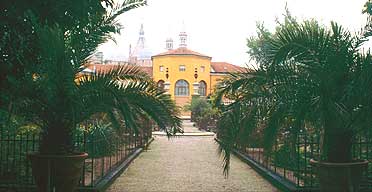
Resting my eyes from this feast of art and architecture, I retreat into the Botanical Gardens. Among the oldest in the world, they were founded by the University in 1545, mainly to study medicinal herbs. The gardens are charmingly simple, with plants laid out in beds according to themes: 'aquatic'; 'Mediterranean'; 'poisonous', and so on. The glasshouse has a comprehensive range of 'carnivorous' plants, alarmingly displayed under the shade of much larger specimens which I'm assured are vegetarian.
It's impressive to see how many plants were first introduced to Italy through this garden, including sunflowers, sesame and jasmine. The oldest tree here, dating from 1585, is known as Goethe's palm, having supposedly played a role in the German writer's work on the metamorphosis of plants. There's also an 18th-century Ginkgo Biloba tree.
My legs are starting to ache, but it's a wrench to stop for food or coffee, as there's so much still to see. Reflecting the large student population, there are plenty of cafés selling sandwiches and pizza, and service is invariably friendly and polite. The region is a major wine producer and many wine bars lurk under the colonnades, although the main gathering points for celebrating students seem to be the bars of the Piazza delle Erbe.
But I have yet to see the Specula, the Observatory Museum. Though I find my way to the square tower, once part of the old castle, that looms over a canal in a quiet side street, I find that individual visitors are only admitted at weekends. But the University Astronomy department is still housed in this building, so taking advantage once more of the Padovans' indulgence, I manage to get Professor Pigatto summoned to my aid.
The professor hurtles in on her bicycle, but she's en route to urgent preparation for tomorrow's lecture, so she can't let me into the museum. She gives me a copy of her comprehensive booklet, then cycles off again, yellow waterproof flapping. When you're the intellectual heir of Galileo, there's no time to waste.
Way to go
Ryanair operates three daily flights from London Stansted to Venice Treviso, with one way fares from £1.99 (exc tax).
The Tourist Information Office www.turismopadova.it, 0039 49 876 79 11, has offices at the railway station, Piazza del Santo and behind the Caffé Pedrocchi.
Timandra stayed at the Hotel Al Santo, Via del Santo 147, tel. 0039 49 875 21 31.
The Padova Card costs €14 and is valid for 48 hours (all weekend if issued on Friday). It gives free admission to museums including the Cappella degli Scrovegni, Palazzo della Ragione, and Botanical Gardens, free use of local buses and a range of other discounts and benefits.
