If Ernest Shackleton was picking a team to cross Antarctica, he'd know at first glance that a frostbitten, three-legged husky would be more use. I'm not a complete camping novice. I tried it once, in 1972. But in the 30-something intervening years, I can honestly say that I haven't had the faintest desire to try it again.
So when the idea of camping in Antarctica was suggested, I was more conscript than eager ging-gang-goolying volunteer. But it was only for one night. And there was one thing I knew would sustain me. No matter how cold the temperature, no matter how bad it got - at least there are no spiders in Antarctica.
I was prepared for jeers, but it was the stunned silence of friends and family that most unnerved me. So, when I set off, I put camping to the back of my mind. There was plenty to keep me occupied. Our small, sturdy boat, the Akademik Shokalskiy, made it across 600 miles of the Drake Passage, in heaving seas with 20-foot swells ... and I wasn't sick. At midnight on the first night, as we creaked and crashed through 60-knot winds, it was forced to change course - so we were actually heading towards Africa instead of Antarctica. Although I was heavily sedated on G-force-strength sea-sickness pills invented for astronauts, I got fond of that little blue boat.
It was the last expedition cruise of the season and the sea ice was already forming, the end of Antarctica's brief summer. In just two short days - it felt like weeks since we'd left home - I'd marvelled at all the blues in the icebergs, found my eyes filling with tears as I stepped on my first Antarctic beach to a welcoming committee of penguins, worried about the fate of a fluffy penguin chick who latched on to me. But camping night was looming ever closer. I wondered if the ship's doctor might give me a note meaning that I didn't have to do it after all.
We're planning to camp at Neko Harbour, discovered by Adrien de Gerlache's Belgian expedition of 1897-99. As we set out in zodiac boats for a recce, it's snowing lightly. A humpback whale leaps from the water. Icebergs look like crystals from a giant chemistry set. Ice is swishing around the boat. We land on a soft, sandy beach not far from the mouth of a glacier. Penguins are skittering and sliding on a snowy slope. Is this where I'm spending the night? All alone in my tent? But Shane, our burly Canadian expedition leader, changes his mind. "The wind was beyond that stupidity line," he explains. "I don't mind coming up to the stupidity line. It's the jumping over it I don't like. We'll wait until tomorrow."
Back on the Akademik Shokalskiy, our Russian captain Igor was looking worried - and he wasn't a man who worried just for the fun of it. "He was really agitated," confided a passenger who had stayed on the bridge. "That wind was blowing the ice in. But I don't think he was worried about you lot, he was bothered about his boat." We escaped from the bay before we get iced in. It's no exaggeration - another few weeks and the sea will have frozen completely.
Next day, Shane has his eye on me as a likely malingerer. He grabs my arm as I make a rocky landing at the British Antarctic station at Port Lockroy. Even if I sprain my ankle, do I still have to go camping? No excuses, though. It is a glorious Antarctic afternoon when we land at Dorian Bay to put our tents up. But there's no beach here, just bare rock - and we have to hack steps in a wall of ice so we can haul our kit up onto the flatter snow. Behind us is the snowy ice-cap that the scientists at Port Lockroy use for a runway. The campers scatter: Costa Rica guy and his mate from Toronto are disappearing up the hill. Everybody wants their own private Antarctican campsite.
But I'm camping right here. I've got my kit in a binbag and I'm trying not to let on that I've smuggled my pillow from the boat. And The Da Vinci Code for reading in bed. Later, of course, it transpires that my two fellow Brits have pillows too; Americans Tammy and Bill, who are seasoned campers, looked deeply shocked by our lack of backbone. Costa Rica guy, however, looks inspired and has nipped off to fetch his own.
My camping spot is within whimpering distance of a British refuge hut where Shane and our camp-master, Brandon, will be sleeping - if not in comfort, at least on bare wooden bunks with a roof over their heads. The happy campers are not allowed to join them; I'm not sure whether this rule comes under the Antarctic Treaty or whether they just want to make men of us. Brandon assembles the tent and digs a shallow wall of snow so I won't blow away in the night.
We zodiac back to the boat for a last hearty dinner. Nothing to drink, for me at least - I'm determined to keep my legs crossed until morning. For the record, we have a chemical loo with a view; no chemicals in it, of course, because we're keeping Antarctica pristine. It's all right for boys, but I'm having no Antarctic breezes on my nether regions in the night. And, anyway, I'd hate to frighten the penguins.
It's twilight by the time we return to our campsite. We apparently have enough emergency rations to keep us "comfortably" for a week. That means SOLAS biscuits - Safety of Life At Sea - and you get three a day, which doesn't sound very comfortable to me. And if the worst happens, would we make it through an Antarctic winter? "Hmmm, don't know." says Brandon, another tough-guy Canadian. "Just remember Shackleton, how long he survived. Y'all have a warm ship to go back to."
Dorian Bay has been explored before; an attempt at a snowman has been abandoned by previous campers. By now, the tide has come in, right up to our ice steps. By torchlight, I explore the green British refuge hut. There's an Argentinian equivalent next door, about as big a beach hut. Predictably, the Brits have pinned their neighbours' flag to the dartboard. On the shelves there's Bronco toilet rolls, big tins of Maggi soup and pressed cod roe and a washing line with two ancient socks. The mildewed reading matter includes that gripping bestseller, Notes And Instructions On How To Count A Penguin Colony. In the guestbook one man has written: "Just like my nan's house!"
There's a cartoon pinned to the wall depicting two polar bears chomping on an igloo: "I just love these things," says one bear to the other. "Crunchy on the outside - and a chewy centre." (You'd be surprised many people have asked if I saw polar bears in Antarctica.) But there's also one poignant, recent reminder that this place is no playground. Only last December, a sailing boat captain was killed, having fallen through a snow bridge on the glacier above us. The friends who tried to rescue him have left a sombre memorial in the book.
Darkness is falling as we climb the hill behind the hut, for a last view of the Akademik Shokalskiy discreetly at anchor in the next bay - and her sister ship, lights blazing like a gin palace. Though there are nine boats sailing the Peninsula, mostly they keep out of sight to preserve the illusion that this is still unexplored wilderness.
There's nothing for it now but to camp. The midnight sky is truly beautiful: I stand outside my tent, putting off the moment, watching the Milky Way. There's a growl of Antarctic thunder: an icefall across the water. It rumbles all through the night, this landscape constantly changing its shape.
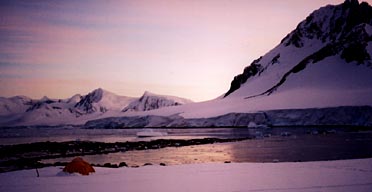
Was it cold? It was freezing. I thought the night would never end - particularly because the penguins never stop twittering. But, really, it was perfect. When I staggered out of my sleeping bag, knees creaking, it was into a mauve dawn, the sun tinting the ice-caps and a palest blue iceberg out in the bay. As I headed back to my zodiac, first in the queue, I reflected that I loved everything about camping out here. Apart from the cold, sleepless hours in a tent.
Getting there
Mar Greene travelled on a Quark voyage booked through Discover the World, their preferred UK tour operator. Prices for a 12-day Classic Antarctica voyage start from £1619 per person aboard the M/V Orlova (maximum 110 passengers), including all meals on-ship, one night's B&B pre-cruise at a hotel in Ushuaia, shore excursions by zodiac, naturalists' lectures and use of rubber boots during expedition.
Prices for the Akademik Shokalskiy (maximum 48 passengers) start at £2105, and also include an expedition parka and a tour of the Tierra del Fuego National Park on day of departure. There is no extra charge for the camping option, available on selected sailings on smaller boats only, for a limited number of participants. The cruising season runs from November to mid-March.
Return flights to and from Ushuaia are available from approximately £750pp with Aerolineas Argentinas. Flights with British Airways and Iberia Airlines are also available, as well as extensions throughout Argentina.
For further information, contact Discover the World (01737 214250).
