
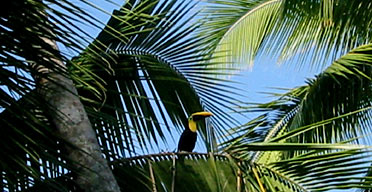
People in Costa Rica talk about animals like office workers in Britain gossip about one another. When two boats dock, their captains swap stories about dolphin sightings. Drivers stop on pitted roads through forests to identify a dead snake, and speculate how it perished. Children idly watch capuchin monkeys from their school bus stop, giggling at their tail-swinging antics.
I'd never considered myself much of a birder - or even vaguely curious about the daily routine of anything that can fly - but in Costa Rica I lost my heart to the game-playing flycatcher, the flocks of pelicans flying in formation and the regal tiptoeing of the Egyptian ibis. And it wasn't just the birds. I held my breath when a tyra, a black mink-like cat, wandered past, and felt absurdly lucky to glimpse a bundle of soggy fur high in the canopy (it turned out to be a sloth).
In Costa Rica it's sometimes hard to gauge where the animal kingdom ends and human habitat begins - in fact, as a homo sapiens, you can feel rather like you're on another species' patch most of the time. This is particularly true if you head to the south coast, where flimsy transport keeps the tourist influx in check, certainly compared to the central and north-west parts of the country, where direct flights from Miami and New York leave the beaches and jungle trails heaving.
The Osa peninsula, a nub of land not far from the Panama border, is a mass of humid rainforest shielding the Golfo Dulce (sweet bay) from the Pacific. The forest, heaving with life, spills onto cove after cove of deserted, sandy beach. The air is thick with birdsong and insects, and the sea as warm as bathwater. Tucked into some of the coves are lodges, accessible only by boat and habitable by only a handful of tourists at a time. At Rainforest Lodge, on Playa Cativo, we were the only guests: our hosts were toucans, howler monkeys, fer-de-lance snakes, croakily fornicating frogs, electric blue butterflies the size of your hand - and a friendly German family.
From Cativo you can hike up into the rainforest to swim under waterfalls and watch the leafcutter ants, hundreds of thousands of them stripping a tree leaf by leaf and trundling in roads 10 metres long back to their skip-sized anthills. Trails through the forests are lined by huge trees, weeping with humid vines and the elaborate seedpods that spread them about the forest floor. The hiking is hot and wet - you won't know where sweat stops and the humidity begins. With all the jumping in and out of boats in between, you can go whole days without getting dry once.
Or you can stroll through lovingly tended gardens to the beach, and snorkel through tepid water, watching ominous-looking stingrays circling below. Wherever you are in Costa Rica, you have to work your way carefully around the wildlife. You can't block out the monkeys' roaring at six in the morning when you're sleeping in an open-air pagoda-style room. Nor can you avoid the bats sweeping through the rooms from all angles when an evening shower passes. So you go to bed early, and wake with the monkeys to enjoy the morning show of red, yellow and blue tanagers battling to save their eggs from the overgrown beaks of scavenging toucans.
A couple of coves up is the mouth of the Esquinas, a vast and sprawling mangrove swamp. Time it right, during the brief high tide, and you'll be rewarded with a still, mirror-like river bursting with flying fish, pink-billed storks and crocodiles. The mangroves stand on their tall roots out of the brackish water, generously providing a nesting habitat for the birds, which just about keeps them out of reach of crocodiles' jaws. Jesus Christ lizards - named after their ability to walk on water - scamper across the path of the gently chugging boat.
A couple of coves down are the Osa Peninsula Botanical Gardens, painstakingly cultivated by an American family who settled on the coast two decades ago. The gardens showcase the best of Costa Rica's flowers, trees, fruit and vegetables, many of the saplings salvaged from the Costa Rica Fruit company, which moved out of the bay and left behind a rotting nursery. The place is now most famous for its orchid collection, and the vanilla plants from which the pods are painstakingly harvested. The juicy seeds of another tree are known as "miracle berries", because after eating one everything tastes sweet: lemons taste like oranges and pineapples like bubble gum.
Across the other side of the peninsula we visited Drakes Bay, where bug expert Tracy took us on a night walk to confront the insects which had been nibbling, gnawing and scaring us daily. But how do you find insects in the dark? By, it seems, holding a torch next to your head. If you get the angle just right, you'll suddenly see sparkling points of light - terrifying when you realise that each little diamond could be something lethal. Sure enough, we saw scorpions, hand-sized spiders and hundreds of praying mantises. We saw webs that take weeks to spin and spiders which spin silk ten times as strong as steel. We found trapdoor spiders, which dig a hole in the dirt and make a trapdoor on a spring fashioned out of silk to trap their prey.
From the Osa peninsula, it's a short but terrifying flight in a 12-seater plane to the capital city, San José, followed by a hectic taxi and a long, bumpy bus ride to get to the Caribbean. Once there, it's like you're in a different country. The coast south of Puerto Limon offers a stretch of impossibly white beaches, clear blue seas and palm after palm after palm. Puerto de Viejo Talamanca is a small coastal town and the centre of the area's tourist industry. Given that it was developed by enterprising surfers 30 years ago, it's little surprise to learn that it's a party place: a laid-back, friendly spot where cheesy reggae is played in bars and restaurants serving cold beer, fried chicken and Costa Rica's national dish, gallo pinto - rice and beans.
Up until 1949, Costa Rica's black population on the east coast wasn't allowed past a certain point on the inland road to San José. Many believe the area has been neglected ever since, while the Spanish-descended population looked after its own in the centre and west. But that is beginning to change. There are electricity and water systems now, and the coastal road was recently repaved, making it more accessible for visitors, some of whom are put off by the fact that it apparently rains more on the Caribbean coast. (We found the opposite.)
As a consequence, here the human impact on the land is far more apparent. Rather than scampering high up into the canopy and only coming down at night, monkeys laze around in the trees lining the road, keeping a half-wary eye out. Baby capuchins swing from their mothers' tails, performing like buskers waiting to be thrown a penny. Crystal-white cormorants play in the sea at your feet and schools of fish swing through your legs and around the coral. But though humankind's footprint is visible, this is no paradise lost; we haven't yet done enough damage to scare the animals off. So you still feel like a trespasser, a voyeur just about tolerated by the wildlife.
Way to go
American Airlines, Delta Airlines, KLM, Iberia and Martinair all fly from the UK to Costa Rica via the United States for around £500. Internal flights with Sansa/Natureair cost no more than US$90, but booking ahead is crucial.
Polly stayed at Rainbow Lodge (Golfo Dulce, Costa Rica; local tel. 831-5677; US tel. (503) 297-2682; email info@rainbowcostarica.com), which offers three levels of accommodation at US$355-95 per night for two sharing, including all meals plus various extras. The Lodge also offers jungle tours, boat tours, kayak rental and garden tours.
