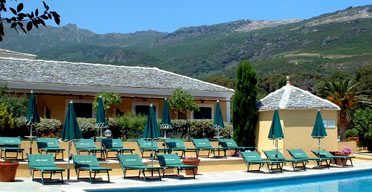
Six forty-five on Sunday morning, and Erbalunga is alive with clanging and bonging. How can a village of only a thousand people have so many bell towers? I threw open the shutters and had a look. Early-morning sunlight glinted on the hills; the sea was blue and sparkling. I grabbed a towel and headed down to the hotel pool for a swim and an early start.
I'd come to Erbalunga via Bastia, 15 minutes' drive along the coast. A new twice-weekly flight means that it's now possible to spend a long weekend in this overlooked part of northern Corsica. Bastia is actually no stranger to holidaymakers: after Calais, it's the busiest tourist port in France. The problem is that most visitors rush straight through on their way somewhere else. Now Bastia is trying to coax them to stay.
That may not prove too much of a problem. Expecting a sort of Corsican Dover, what I found was a sun-baked, buzzy little town with more than enough to occupy anyone for a weekend. It may be short on sights, but it's strong on atmosphere, with one of the prettiest harbours in the Med.
The Vieux Port looks as if it hasn't changed in centuries - which it probably hasn't. The harbour is framed by high granite hills and lined with patched and peeling houses which tumble down to the water in a blur of pastel colours. The twin bell towers of the 17th-century church of St John the Baptist peep above the skyline. At the water's edge, swish yachts sit cheek-by-jowl with beaten-up fishing boats, their nets and lobster pots stacked up on a quayside lined with cafes and restaurants.
At the Hotel Posta Vecchia, the blue shutters and salmon pink walls look out over the sea. Ferries high as houses glide past; down below, elderly ladies walk their poodles and a bunch of old boys play petanque. Washing hung from balconies; neighbours waving to one another and the smell of cooking wafted up from nearby kitchens. Perfect.
The Terra Vecchia is Bastia's oldest quarter, with narrow lanes crammed with high-sided stone houses and lined with shops and bars. I ducked out of the noonday brightness into the tiny baroque Chapelle St-Roch, where silver icons and a statue of the Virgin gleamed in the dim light.
The heart of modern Bastia is the Place St-Nicolas, a broad, sun-baked rectangle dotted with palm trees, with a small market down one side and row of cafes on the other. At the Café les Palmiers ("depuis 1898") the ornate interior resembles an opera house. The waiter took my order of Casanis with an approving nod. Casanis is a pastis made in Marseille but - crucially - by a Corsican manufacturer. Chauvinist Corsica is a stickler for things like that.
Likewise with food. You can taste the Italian and French influences on local cuisine, but don't try calling it anything but Corsican. Inside the ramparts of the citadel is A Casarella, a tiny, unpretentious restaurant with a dozen or so tables. The no-nonsense waitress wouldn't let me skip any courses on the fixed menu; so I worked my way through casgiate - grilled cheese served on giant chestnut leaves; a vast main course of veal and pasta; followed by salad, then fiadone cheesecake. Wine was local red from the Patrimonio region, and the meal began and ended with a glass of knockout home-made eau de vie. I picked my way carefully downhill feeling like a wine cask with legs.
Heading north from Bastia, the coast road enters Cap Corse, a wild, dramatic finger of land 20 miles long, pointing towards France. This is a place of ruined Genoese watchtowers and crumbling villages, with rugged hills blanketed by the maquis, the wild shrubs adopted as a general term for the Resistance across France in the second world war. Rock roses and asphodels formed splashes of colour against the scrubby landscape, and there was the aroma of wild mint and thyme. I spent the day driving on switchback roads, corkscrewing down to tiny fishing ports, then back up again into the mountains, and as night fell I pulled in to Erbalunga.
Like Bastia, it has a rough-around-the edges charm. There's a tiny stone port and watchtower; a cluster of honey-stone buildings and a few restaurants. The one hotel, the Castel Brando, is a former mansion with high ceilings and timeworn furniture. I dined outside at the harbour's edge as a yellow moon came up over the water and waves lapped at the stone jetty.
You wouldn't, in all honesty, come to Erbalunga - or even Bastia - for nightlife. At 11pm, much of the village was in darkness so I took myself off for an early night. Which was just as well, because a rude awakening from Erbalunga's bells, though I didn't know it then, was but a few hours away.
Way to go
Getting there: British Airways (0870 8509850) flies Gatwick-Bastia on Thursdays and Sundays from £129 return.
Getting around: Hertz (08708 448844) has offices at Bastia airport and town centre. Car hire from £32 per day.
Where to stay: The Hotel Posta Vecchia (+4 9532 3238) has doubles from £38, B&B. The Hotel Castel Brando in Erbalunga (+4 953 01030) has doubles from £94, B&B.
Where to eat: A Casarella, 6, rue Sainte Croix (+4 9532 0232) has excellent Corsican food. Three-course menu from £20 excluding wine. Evenings only. Lavezzi, 8 rue Saint-Jean (+4 9531 0573) has superb seafood and wonderful views across the Vieux Port. Around £50 for two with wine. La Petite Marie, 2, rue des Zéphyrs (+4 9532 4783) is a basic family-run place with sold home cooking. £20 for two. In Erbalunga, L'Esquinade (+4 9533 2273) serves excellent seafood right on the water. £50 for two.
Further information: Bastia Office of Tourism, Place Saint-Nicolas (+4 9554 2040). Maison de la France (09068 244123). Visit Corsica.
Country code: 0033.
Flight time: Gatwick-Bastia: 2hrs 35min.
Time difference: +1hr.
£1= 1.41 euros.
