
I don't have much in common with Prince Charles, but we agree on this: the Landmark Trust, which celebrates its 40th anniversary this month, is a fantastic idea.
This charity buys up crumbling, peculiar British buildings - tiny castles shaped like giant pineapples, basically pointless towers, follies in fields, miles from anywhere. These buildings were often constructed in moments of impractical eccentricity by aristocratic dilettantes of yore, presumably between trips to discover darkest Egypt or other crack-brained schemes, and have since been abandoned to the elements.
The Landmark Trust buys them, and then they do them up and rent them out. Prince Charles is their patron. Their founder is Sir John Smith. I must admit that when I first heard about this I didn't quite believe it. The British class system is so ingrained on my psyche that I fleetingly thought, "But surely they don't let people like me, the lower-middle classes, rent these places, do they?"
I can't be alone in asking this question, because the Trust clearly felt compelled to clarify this point in the very first line of their brochure: "All the Landmarks shown in this Handbook can be rented by anyone."
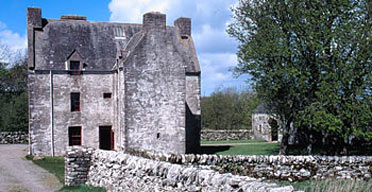
So we did. We rented the Old Place of Monreith, a tall, stone farmhouse-cum-mini-castle halfway between Dumfries and Stranraer on the South West coast of Scotland. It was a three-hour drive from Carlisle station, eight miles from the nearest town (the lovely Wigtown, Scotland's Hay-on-Wye), down a dirt track almost a mile from the road. It once belonged to Sir Herbert Maxwell, and then Gavin Maxwell, of Ring of Bright Water fame. When the Landmark Trust brought it, the roof and floors had fallen in. They rebuilt, using local craftspeople. So this is what the rent money goes on - preservation.
The guest logbook, which we found in the sitting room, is full of strange entries written by previous tenants. There is a poem:
"The Old Place of Monreith
Is not suitable for people called Sharon or Keith.
Keep the riff-raff out."
Underneath, someone has written: "Snob!"
Another entry assiduously, and somewhat anally, details - like something out of Mike Leigh's Nuts in May - the exact amount of time, to the minute, it takes to drive to nearby attractions such as St Ninian's Caves. "We did not exceed the speed-limit," the writer points out. "We drove legally at all times."
Then there is a long entry about the suspicious "association" between the Maxwells and the Percies of Northumberland, who have something to do with the Landmark Trust. The entry suggests that the covert "association" between these two powerful dynasties has somehow led to the Old Place of Monreith having better carpets and furnishings than other Landmark properties. Usually I am against secret cabals conspiring together, but if the result is comfy sofas, then I really don't mind.
And the Old Place of Monreith is very comfortable, with a huge wooden kitchen table resting on an old stone floor, a cosy sitting room, a beautiful and ancient stone spiral staircase, and no radio or TV, which I think is taking heritage a little too far. I had to listen to the radio in the car in the driveway.
And of course things went wrong. I was attacked by a cow and I screwed up the heating timer so it was freezing all day and boiling all night. But that is OK. There isn't much idiosyncrasy left in the Britain of Starbucks and Gap. Hotels are efficient. Travelodge plans to build 15,000 new rooms in the UK in the next six years. The rooms will all look identical, but travellers will be safe in the knowledge that nothing goes wrong inside a Travelodge. In this culture, the Landmark Trust is more welcome than ever.
Nowadays, wretched as it sounds, the Landmark Trust handbook sits next to my bed, and I leaf through it at night, wondering where we should go next. Maybe we'll try Clytha Castle, "this most affecting folly", where a tablet reads: "Erected in the year 1790 by William Jones ... it was undertaken with the purpose of relieving a mind afflicted by the loss of a most excellent wife." If I stay there perhaps I can pretend to be king.
· To celebrate 40 years, 40 Landmark Trust properties around the country will be open from 10.30am-4.30pm on Saturday and Sunday, May 14-15. Entry is free. For more information, see landmarktrust.org.uk.
