
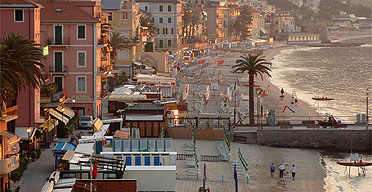
It's not just that it has a perfect climate. Or that the sight of the full moon rising out of the silky Mediterranean while you're sipping a last limoncello might just be the most romantic thing you've ever seen. Or that the Italians simply do warmth, cheerfulness and hospitality so very well. Or even that flowers blossom here all year round.
The Riviera di Ponente (the riviera of the setting sun), in north-western Italy, has it all. And Alassio, half way along, has it in buckets (and spades). The longest, widest, sandiest, beach. The best places to eat and drink and stay. A main road tucked three blocks back from the beach, leaving the historical centre traffic-free. And - with budget flights from the UK to both Genoa and Nice - it's all too easy to get to.
Ernest Hemingway spent lots of time in Alassio and even left his parrot here at the Caffè Roma - where it was famously sick on Judith Chalmers decades later, while she was wrapping up an episode of Wish You Were Here. Hemingway, Chalmers and the parrot have all moved on, but the Caffè Roma's still doing a fine trade in short espressos, long drinks and tall tales.
This stretch of the Riviera has always been popular with the British, who came in small numbers from the 18th-century on, and then arrived in droves with the opening of the railway in 1872. The wealthy British colony here had splendid villas built and extravagant gardens designed by the enterprising Hanbury brothers, who were quick to corner the local market; it's no coincidence that Alassio's main arterial road, the Viale Daniele Hanbury, is named after one of the siblings.
Daniel's father, Sir Thomas, made his fortune in Shanghai as a silk and tea merchant, and retired to the Riviera in 1867 at the ripe old age of 35, spending the rest of his life landscaping and planting the fabulous gardens at La Mortola, just outside Ventimiglia. Today, they're state-owned and somewhat overgrown, but they make for a compelling, atmospheric visit at any time of year.
The motorway above Alassio is known as the autostrada dei fiori; there are flowers everywhere. Not just the abundant local flora - jasmine, bougainvillea, oleanders, wisteria, hibiscus, mimosa - but also great fields of carnations and acres of greenhouses speed-growing Italy's most-treasured lilies.
The massive Ligurian hills provide shelter from the north and deliver an exceptionally mild climate to the coast - especially in the Baia del Sole (bay of the sun), which runs between Capo Mele to the west and Capo San Croce to the east, and includes Alassio's great four-kilometre sweep of sandy beach. There's something wonderfully unashamed, dedicated and decadent about the pursuit of pleasure here - which is perhaps why the guidebooks tend to be slightly snooty and dismissive.
The 1911 Encyclopaedia Britannica says Alassio is 'mainly noticeable as a health resort in winter and a bathing place in summer and has many hotels. The anchorage is safe and the bay full of fish.' It's all true. It's also true that there are no cultural gems here to distract you from your hedonistic quest - a couple of ruined towers here and a scattering of dull churches with dark, peeling interiors there are hardly going to keep you away from your next apertitivo or gelati, or the serious business of sun worshipping.
Running parallel to the beach, a block inland, is the long, narrow, shady pedestrian street known as il budello. It's lined with 16th- and 17th-century pastel-plastered houses, with boutiques at street level, so this is where you come to escape the heat - and to window-shop. The nightly passeggiata ebbs and flows along here in the endless search for the perfect gelato, the best in Italian fashion, the finest shoes - and the tackiest knick-knacks. Ever popular, and with a number of outlets along the budello, is the fabulously trashy Ciao Ciao, the fish and chip paper of the fashion world.
Alassio's other main attraction is il muretto, a kitsch welter of ceramic plaques lining one of the low walls of the public gardens on Via Cavour. It was started in 1951 - as a bit of a joke, you can't help feeling - by Mario Berrino, the owner of Caffè Roma, and Ernest Hemingway. Since then, hundreds of famous artists, showbiz types and sporting stars have left their mark here - from the Italian World Cup-winning team of 1982, to the surrealist Jean Cocteau and the Norwegian explorer Thor Heyerdahl, who lived just down the road until his death in 2002.
Beyond that, of course, there's the real reason everyone comes here: the beach. At the height of summer, Alassio's four kilometres of perfect sand are parcelled up into over 100 separate bathing areas, each the jealous domain of a particular hotel or pensione, and each providing an all-inclusive service including snacks, cold drinks, loungers and umbrellas - and of course access to the sea. Every night the extra-fine, crystalline sand is raked spotlessly clean and tidy again by the same ragazzi you'll see trying their luck along the beach in the daytime.
If you tire of the relentless lounging around, there are excursions. You can take a boat out to the Isola Gallinara nature reserve - the offshore island that's in all the postcards - or hike up into the hills on any one of 25 marked paths; you can cycle along the shore - many of the hotels have bikes for guests' use - or explore the Julia Augusta, the original Roman road running half way up the hills from Santa Croce to Albenga, complete with fragments of Roman ruins along the way.
Or you can eat. This being Italy, you're spoilt for choice, with the front boasting a whole slew of places where you can tuck in to pasta, pizza or mouth-wateringly fresh seafood, all washed down with palatable - and keenly-priced - Ligurian wines. The cuisine is heavily influenced by the local, lightly-flavoured olive oil, and freshly-made pesto is served here the way it always should be, with green beans and potatoes complementing spaghetti-like trenette or twists of trofie. Save a place, however, for a handful of Baci di Alassio (Alassio kisses), small macaroons with a heart of chocolate.
For something several notches further up the food chain there's Palma (tel: 39 0182 640314), though you'll need to reserve well ahead as the dining room is minuscule. This Michelin-starred restaurant has been popular, and in the same family, since the 1920s. By local standards it's eye-wateringly expensive - count on around 90 euros a head all in - but the food is fabulous. We had asparagus-filled pastries, sardine and tomato mousse, duck ravioli with foie gras, smoked-fish and shrimp sorbet, chestnut-based pasta with scallops, tiny filets of grey mullet with rosemary and olive oil, parcels of lamb with thyme, a spread of local cheeses, and saffron ice-cream to finish.
Perhaps, however, we did top it all off with one grappa more than was strictly necessary. Afterwards, on the seafront, in the soft night, we ended up purchasing a sweet (if scraggy-looking) kitten with small flashing eyes. It mewled pitiably at us as the street vendor took our money with a smile - and fitted a fresh set of batteries. We really should have haggled.
Way to go
Getting there: Alassio is 110 kilometres east of Nice Côte d'Azur and 90 kilometres west of Genoa Cristoforo Columbo - count on an hour by car from either airport on the motorway. The drive from Genoa is easier, with the airport on the right side of town for Alassio; but there are more flights to Nice. Ryanair flies direct to Genoa from London Stansted, and if you book far enough ahead flights can be had for £40 return including taxes. The other airlines serving Genoa (Air France, Alitalia, Lufthansa) require a flight change somewhere; prices start at around £200 return.
Easyjet has nine flights a day to Nice from a variety of London airports, as well as direct flights from Bristol, Liverpool and Newcastle. Book well ahead and tickets will set you back around £50 return. BA also offers eight flights a day to Nice, from about £80 return, if you plan far enough ahead.
Where to stay: There are around 100 hotels and pensione in Alassio, though many close from the end of October to Easter. Double rooms can be had from 50 euros out of season, or 100 euros in high summer - though don't necessarily expect a sea view at this price.
Personal favourites include the Savoia. It has 20-odd rooms right on the beach and does lovely doubles for 140-240 euros depending on the season. The Milano, right at the other end of town, is cheerful, unpretentious, all blue and white, and has wonderful views along the beach; you'll pay 105 euros for a double room overlooking the sea in winter, or 190 euros in summer.
alassio.net and alassio.info are both good for hotel bookings; or contact the tourist office; (Tel: 39 0182 647027) to find out what's open off-season.
When to go: Don't even think of coming in high summer unless you're looking for the Italian sardine experience. 80% of Italians go on holiday in August, and almost all of them go to the seaside. From mid-September to early June the beach is free, uncrowded and perfect - and even in the middle of winter it's usually fine and warm.
· Piers Letcher is the author of Croatia, Dubrovnik and Eccentric France, all published by Bradt Travel Guides.
