
'This is your captain speaking. We will shortly begin our descent to Newquay. If anyone needs a taxi, let me know and I'll radio ahead and book one.'
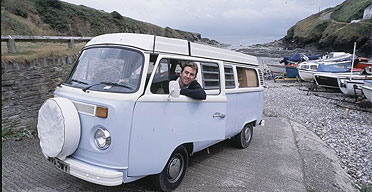
We hadn't even landed and already we were in a friendlier world. But I didn't need a taxi. In the far corner of the bleak airport car park, from where you can make out a distant sparkle of sea, a beautiful duck-egg blue 1973 VW Camper was waiting. There was petrol in the tank, raspberries and cream in the fridge, and fresh bread and organic local cheese in the cupboard.
It's the perfect way for time-poor city types to play hippy for the weekend. Driving a Camper (wind-behind, downhill top speed about 60mph) to Cornwall would be a motorway marathon. But new flights connect London, Manchester, Birmingham, Leeds and Durham with Newquay, Cornwall's surfing capital. Once there you could pick up a hire car from Europcar or Hertz, but why would you, when you can have a pristine classic Camper waiting.
Pete, owner of the hire company, smoked a roll-up as he ran through the controls, then by 9pm (three hours after Robin, the photographer, and I had left central London), we were cruising the Cornish lanes in our very own van.
Well, bunnyhopping, grinding and swerving down the lanes. Campervans don't have power steering, power-assisted brakes, or any of the safety aids of modern cars. Instead you get a huge steering wheel laid horizontal, trucker-style in front of you. From high speed you literally have to stand on the spongey brake pedal to stop.
In fact driving a Camper feels more like piloting a boat. The steering wheel doesn't really feel connected to the wheels, but a few heartbeats after steering left, the van begins to veer that way. It's disconcerting at first, but soon all part of the charm. You can't drive fast so you may as well relax. If the squares in the queue behind get rattled, that's their problem.
But very few do. No other vehicle has such an endearing personality. Other drivers slow to let you pull out, surf-dudes make VW signs with their fingers as you cruise into town, and fellow Campervanners wave or give a cheery flash of the lights as they pass.
One thing to note - drivers of modern motorhomes will try to wave and flash to get in the 'VDub' gang. The correct response is to look nonchalantly at your steering wheel until the arrivistes pass.
An hour after setting off we pulled up at our destination - a farmer's camping field near Polzeath on the north coast. 'Nice van lads,' he said, looking her up and down appreciatively - no suspicious grockel-greeting for us.
Of course, it bucketed down all weekend. We swam in the sea as fat raindrops plopped all around and ate numerous morale-boosting pasties. But the van didn't leak a drop, and our poor tent-bound neighbours came sheepishly round for cups of coffee.
Camping in the van is very comfortable. There's a sink with running water, a gas-powered cooker and fridge and electric lights. The roof flips up to provide one double bed and the back seat flips down to make another. (If possible always bag the upstairs bed - it's flatter and wider). For bigger families, there's a tent to attach alongside, and numerous tables and folding chairs stashed in the back.
In Polzeath we kept our eyes peeled for the warring gangs of 'toffs and chavs' we'd been reading about for weeks in the papers. But all we could see were happy families and hundreds of surfers. The coastal class war must have been rained off.
On Sunday afternoon we pottered north along the coast to Port Isaac, an impossibly pretty fishing village, where we caused a huge jam by getting stuck in the steep and narrow cobbled high street. In a Range Rover we'd probably have been lynched. In a Camper, everyone just smiled.
Factfile
Air Southwest (0870 241 8202; www.airsouthwest.com flies Gatwick to Newquay from £38 return. Hire from O'Connors Campers (01837 659599; www.oconnorscampers.co.uk) starts at £75 a day, or £400 a week (in busy periods vans may only be available for full week).
For more Cornish ideas see www.itsadventuresouthwest.co.uk.
