
It is the moment every driver dreads: the fuel gauge pointing to empty, not a petrol station in sight and the long, dusty road stretching into the distance. The only sign of life is an old man on a bicycle.
'Gasolina?' I ask. He dismounts, scratches his chin and, talking very slowly, gives me exact directions - of which I cannot understand a single word.
'Gracias,' I mutter, and drive on, hands sweating on the steering wheel. My 14-year-old daughter has an anxious air. She trusts daddy, but ... We make it to a petrol station - just - but the episode is a salient reminder of the perils of foreign travel. Even in 2005, driving a hire car from pre-booked hotel to pre-booked hotel, nothing can be taken for granted.
The romance of the unknown is all around us - just as it was 400 years ago, when Don Quixote plodded across this same plain on his ageing nag, Rocinante.
They are having quite a party in La Mancha. Cervantes' novel, first published in 1605, belongs in the mainstream of European literature. No character in Shakespeare - not Hamlet, not Falstaff, not Juliet - is as instantly recognisable as the Knight of the Sorrowful Countenance, with his faithful Sancho Panza by his side. A tall, thin man on a horse, a short, fat man on a donkey: one of those timeless, iconic compositions of which the imagination never tires.
As I am tall and fat, my daughter short and thin, we are not quite 'doing' Don Quixote as faithfully as I would like. But exploring La Mancha is still a wonderful adventure, if only because it is such an unfamiliar part of Spain, light years from the Costas and the cosmopolitan excitements of Barcelona and Madrid. After overnighting at Toledo, a fascinating city in its own right, we set off at first light into the Don Quixote heartland.
'Where are the windmills?' asks my daughter, scanning the flat, dreary horizon. That is the first and most obvious thing about La Mancha: its sheer physical monotony. Drive south from Toledo and the landscape is dry and featureless, as bland as the American Midwest.
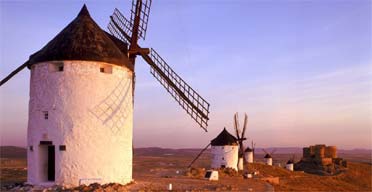
La Mancha does have hidden treasures, lovely old villages asleep in the sun, but it takes a while to find them. At least, in the anniversary year, the tourist board has done its best to help. There are 10 linked driving itineraries, covering more than 1,500 miles, which criss-cross La Mancha. So we find our windmills, ranged along the crest of a hill overlooking Consuegra, a nondescript town straddling the main Madrid-Cadiz highway.
There are about 10 of them, freshly white-washed but still sporting their 16th-century wooden sails. They are beautiful and I feel a sudden surge of affection for them. How much more romantic than a modern wind farm, silent witnesses to a better age.
'Did Don Quixote really think they were giants?' asks my daughter. 'He must have been mad.'
'He was mad. That's the whole point of the novel.'
'Or stupid.'
Sancho Panza could not have been blunter. Is there anything harder than trying to interest your children in the books you loved as a child? We drive on, following the trail of 'Ruta de Don Quijote' signs. Vignettes of Spanish life flash past: a hitch-hiker with a pony-tail; a woman selling tomatoes by the road. We even pass a field of ostriches. Don Quixote would probably have tried to decapitate them.
We see him everywhere: on postcards, on T-shirts, on tea-towels, on bottles of wine. Tourists pose beside statues of him, from the middle of Madrid to the little town of Puerto Lapice, where the Venta del Quijote, an atmospheric 16th-century inn, does a roaring trade. But where, if anywhere, did he originate?
Cervantes started his novel with a riddle: 'Somewhere in La Mancha, in a place whose name I do not care to remember, lived a gentleman ...' What a gift for Don Quixote buffs. The latest theory, put forward last year by a team of professors in Madrid, aided by number-crunchers from the University of Minnesota, is that the village Cervantes had in mind was Villanueva de los Infantes, some 140 miles south of Madrid.
Why? Because, according to the learned professors, if you work out how far an old horse and a fat donkey can reasonably be expected to travel in a day ...
Whether you buy the theory or not, Villanueva is a delightful little town. Nondescript from a distance, it boasts a Plaza Major to grace any city. Old wooden balconies look out across the cobblestones towards the splendid Iglesia de San Andres, with its soaring Renaissance facade, and gracious arcades offer shade from the fierce sun. It is almost too grand a setting for Don Quixote, whom one thinks of as essentially a provincial character, but it has a charm and a swagger that is pure Spain.
We head on to El Toboso for lunch, at which point the pulse really does quicken. For this, of all the towns in La Mancha claiming an association with Don Quixote, has the most impeccable pedigree. It is specifically mentioned in the novel and was the home of the lovely Dulcinea, the high-born lady to whom Don Quixote pledged his allegiance.
In reality, of course, Dulcinea was a plump peasant girl, Aldonza, blissfully unaware that an old lunatic was riding round La Mancha picking fights with anyone who impugned her honour (of which she had precious little). But her spirit lives on in El Toboso, a charming village with narrow streets, white-washed houses and a determined somnolence.
A ruined old farmhouse, the Casa Dulcinea has been restored in 16th-century style and there is an amusing statue in the town square of Quixote kneeling before his astonished lady love.
We lunch on Manchego cheese then head to the Museo Cervantino, which is mainly given over to different editions of the novel, from Russian and Japanese translations to an English version signed by Margaret Thatcher. 'Bet she never read it,' I think cynically, then correct myself: 'Who cares if she read it or not? She tilted at enough windmills in her time. Don Quixote is universal. He touches all of us.'
By nightfall, after a detour to the Lagunas de Ruidera, a cluster of lakes which Don Quixote, barmy as ever, thought were maidens who had been turned into lakes by a magician, we have reached Almagro, to the south-west of La Mancha, another beautiful old town, with a colonnaded plaza overlooked by green balconies. Our hotel, the Parador, is a serene 16th-century convent. We may be getting no closer to Don Quixote, but are certainly getting a sense of the medieval Spain - coarse in some ways, sophisticated in others - that Cervantes tried to evoke.
Next morning, we finally escape the flat plain, driving up into the hills to the south of Almagro. The landscape, featureless for so long, suddenly becomes curvaceous. It's now quite a different Spain, with romantic castles perched on craggy hillsides.
Calatrava la Nueva, approached by a steep dirt-track that would have had Rocinante digging in his heels, is simply magnificent - a 13th-century fortress which later doubled as a monastery. It is the sort of fairytale castle found in the books of chivalry that inflamed Don Quixote's imagination.
'So he just read all those books and went mad?' says my daughter. 'What a sad story.'
I suppress a smile. She seems, finally, to have got the point. Mad, sad, but never bad: that is Don Quixote, the repository of all our dreams, all our follies, all our flawed heroism. Wherever there are plains surrounded by mountains, wherever boredom thirsts for excitement, his spirit lives on.
Factfile
Max Davidson travelled to La Mancha with Magic of Spain (0870 888 0220; www.magictravelgroup.co.uk). Four-day fly-drive holidays in La Mancha cost from £467, staying two nights each at the Hotel Pintor El Greco in Toledo and the Parador de Turismo in Almagro. The price is based on two sharing and includes return BA flights from Gatwick to Madrid and class A car hire.
Details of the Ruta de Don Quijote, cultural itineraries through La Mancha and of special events to mark the 400th anniversary of the publication of Cervantes' novel, can be found on www.donquijotedelamancha2005.com
