
On a map, it seems no more than a chiselled flint arrowhead off the east coast of Africa, a fragment chipped off Mozambique - in turn dwarfed by the vast curving flank of Tanzania, Kenya and Somalia. From our nine-seater Cessna, however, Madagascar looks as vast as the guidebooks say: two-and-a-half times the size of Britain, the fourth largest island in the world, a scorched expanse of red earth, lunar bluffs and sculpted domes swathed in lime-green vegetation, stretching mile after endless mile to the horizon. As we fly north from the capital, Antananarivo, on a private transfer to Anjajavy resort (the hotel manager is our co-pilot), there are no roads, no towns, no houses - only this eerie, unpeopled landscape.
After an hour, angular boundaries suggest fields and there is the odd ribbon of road. Then we fly over a delta of tangerine water and emerald mangrove with edges so defined it looks like topiary. Fifteen minutes later, our plane banks west, shudders into a sea breeze and the ruffled, turquoise Indian Ocean appears beneath us before we sweep in over Anjajavy (its idyllic pool, villas and windsurfers tiny as toys) to land on a red earth airstrip in the middle of nowhere.
'Welcome to Anjajavy International Airport' reads the sign on a mahogany 'arrivals lounge' no bigger than a poolside cocktail bar - the first of several ironic indicators that this luxurious, fly-in resort is as far from mass tourism as it gets. 'The Marina', it transpires, is a beach with a solitary boathouse and a couple of water-skiing boats moored offshore. The postal address is given as 'Longitude 47 degrees east, latitude 18 degrees south', testimony to just how remote this place is. The nearest settlements are the fishing villages of Anjajavy and Ambondro-Ampassy, too small to appear on a map and without running water, electricity or roads, let alone foam discos or inflatable banana boats. We are asked to reset our watches to Anjajavy time ('an hour ahead of Madagascar time'), intended to wake guests early 'so they get up and do things', while making sure inebriated guests retire to bed at 10.30pm, allowing the staff to go home.
'This is our shuttle service,' says Jean-Marie Gras, the French hotel manager (and our aviator), introducing us to his wife, Marie Laure, and their two-year-old son, Matthieu. We climb a ladder into a pick-up truck and bump and jolt our way along a corrugated mud track through the rainforest, a 15-minute journey, before alighting in a clearing bright with bougainvillaea.
Passing through the hotel reception, we walk out on to a spongy lawn fringed by palms and thatched villas clustered around a perfect pool. The towels on the sun-loungers are explosions of fluorescent green against the matt-brown, eco-architecture; the showers in the louvred bathrooms are a force to be reckoned with; and each villa has a surprise beneath its decking: a retracting shower hose with a high-pressure nozzle, for blasting sandy feet. In the restaurant, I order the sweetest, freshest mangrove crab, each claw the size of a human hand - and this is only a starter.
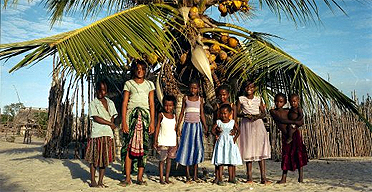
However, to dwell on its 'four-star-plus' status is to miss the point of Anjajavy. Not only is it the only employer within a 100-mile radius, but it sources all its fish, fruit and vegetables from neighbouring villages and supports local schools, a medical centre, agriculture and fishing projects through a charity called Friends of Anjajavy.
For guests who are interested, there are boat trips to these villages to see charity in action. Anjajavy is also set in a private reserve of baobab trees, deciduous forest and mangrove inhabited by an abundance of birds and lemurs.
Next day, we take a boat trip with Graham, the South African who supervises watersports. 'Those are fish eagles,' he says, pointing to the silhouettes perched in trees on the clifftop. 'There are 150 breeding pairs in the world and four are at Anjajavy.'
We stop at an island where bottle-shaped baobabs grow out of fissures in the rock. A giant baobab, 1,600 years old with a 45ft circumference, is used as a sacrificial site by tribesmen. Coins, the skull of a zebu (cow) and a pestle and mortar full of pigment are arranged around its base. In a cave, Graham shows us human remains covered by planks of driftwood. 'It's a taboo if a pig walks over someone's grave,' he says, 'so people are buried on islands with no pigs.'
We arrive back in Anjajavy in time for afternoon tea, taken in a lush garden - the Oasis - where you can sprawl in canvas chairs among the lawn sprinklers and attentive staff and wait for lemurs to descend from the trees and bound across the grass in their curious upright position. Stroll a few yards along the marked nature trails and you will glimpse more of them in the treetops.
It's an easy, lite version of what Madagascar is famous for - wildlife watching in the national parks. Fully recovered after the 10-hour flight from London via Milan, sublimely restored by Anjajavy, we charge along the runway in a two-seater Piper Cherokee - like a car with wings - and land an hour later on the island of Nosy Be, the closest thing Madagascar has to Ibiza, with hotels, beaches and bars. From Hell-Ville, the port and main town on Nosy Be, it's an exhilarating journey by water taxi and 4x4 to Ankarana Reserve or, more accurately, Chez Robert, a smallholding-cum-campsite where you stay in rudimentary reed huts, shower in a mugful or two of well water (albeit in a pristine, whitewashed cubicle), flush the hole-in-the-ground lavatory with a bucket and grope your way to the flower-decked restaurant by lantern light. The traditional cuisine, cooked by Robert, is as good as the rhum arrangé, industrial-strength liquor with ginger.
Ankarana makes any hardship worth it. Thirty yards into our guided walk, there are Sanford's brown lemurs everywhere, chirruping, eating from the ficus trees and scattering bark all around us. We see chameleons, vibrant green geckos and millipedes on our way to the tsingy (a surreal rock formation), then descend into a cave full of screeching bats darting between glittering stalagmites. Driving back to Chez Robert at night, through a wild landscape lit by blazing bonfires and villages loud with exuberant, running children, it does indeed seem like a fragment of Africa.
Factfile
Andrew Purvis travelled with Rainbow Tours (020 7226 1004; www.rainbowtours.co.uk) An eight-day private trip to Madagascar costs from £1,965 pp sharing, including Air Madagascar flights from London, pre-paid departure taxes, internal flights, three nights full board at Anjajavy, two nights full board in Ankarana National Park, two nights on Nosy Komba, reserve entry fees, excursions, transfers and transport in a private vehicle and an English-speaking guide.
Air Madagascar has four flights a week from London to Antananarivo from £760 including taxes.
