
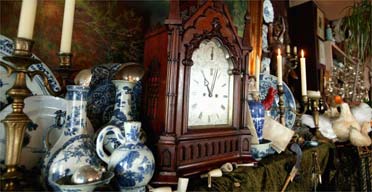
La Braderie, Lille
Claimed to be Europe's second biggest event after Oktoberfest, La Braderie sees two million bargain-hunters and thousands of bargain-and otherwise purveyors converging once a year upon the staid but pretty northern French city of Lille for a two-day orgy of secondhand exchange. A world music line-up of street players keeps the surging crowds entertained and pacified as they wend their way along the 200km of stalls. Moules et frîtes, the traditional Braderie repast, is available from every bar and brasserie, which compete with each other to build the biggest shell midden on the pavement outside by Sunday evening.
When: This weekend; some stalls stay open through the night.
Best buys: Unrestored vintage French furniture, from the stalls around the Saint Sauveur district; secondhand and antiquarian books, near the citadelle; and vintage clothes, in the centre of old Lille. Other goods are scattered throughout the market: someone else's old toys, enamelware, lamps, weaponry, glass items, lace and fixtures and fittings may be among your most serendipitous finds. The back street stalls represent the richest hunting grounds.
Where to stay: Hôtel Brueghel (+33 320 060 669, hotel-brueghel.com), with antique-furnished double rooms from €55 a night and meticulous service, is a good value two-star in the old town and a few minutes' walk from the Eurostar station.
Getting there: Eurostar (0870 5186186, hotel-brueghel.com) London Waterloo-Lille from £55.
Porte de Clignancourt & Porte de Vanves, Paris
"Flea market" is thought to be French in origin, marché aux puces, and two of the best in Paris, both of which could be taken in in a weekend, neatly exemplify the early and late stages of flea market evolution. Porte de Clignancourt has become dominated by pricey retro furniture and antiques, with the apparently inevitable French corollary of bouffant bourgeois women, yappy dogs at their ankles, and gay Americans. Nonetheless, three of the great sheds that make up this permanent market - Marché Varnaison, Marché Jules Vallès and Marché Lécuyer-Vallès - betray its curbside origins and amply satisfy flea market aficionados.
Porte de Vanves retains its primitive commercial form. Stallholders, many of whom look decidedly secondhand themselves, simply drive their vans up to the kerbside of the two long streets making up the market early on Saturday morning and depart, hopefully with a lighter load, on Sunday afternoon.
When: Clignancourt, weekends and Mondays, 7.30am-7pm; Vanves, weekends, 7.30am-1pm, times vary with the weather.
Best buys: At Clignancourt, keep an eye out for gracefully aged glassware (this is where a million 50s soda siphons come to be reborn), china, dated advertising posters and, if you can afford it, hip 20th-century furniture. Vanves, if you arrive early enough and look long enough, is more likely to throw up bargain basement treasures. Forlorn puppets, tarnished military medals, bird-free birdcages, antique jewellery looking for a neck, top hats and tatty teddy bears are among the objets that will spark an acquisitive glow in the buyer's breast according to inclination.
Where to stay: Hôtel Istria (0033 1432 09182, hotel.istria@wanadoo.fr), a healthy walk from Porte de Vanves, has tastefully decorated doubles from €75 and impeccable artistic credentials thrown in: Louis Aragon, Man Ray, Mayakovsky and Eric Satie all stayed in this Montparnasse establishment.
Getting there: Eurostar (0870 5186186, eurostar.com) London Waterloo-Paris from £59.
Tongeren Antique and Flea market, Belgium
The comparative advantages - to deploy some economics parlance - of this big Belgian brocante meet lie in its location and its range. Tongeren may be only an hour's drive south from Brussels but the town is not a tourist magnet like Paris or Rome, and so the competition and the prices are reduced. The market also handsomely represents the spectrum of flea market finds, the 350 dealers offering everything from just junk, through interesting junk, to fine antiques (but at interesting prices).
Tongeren is the oldest town in the country and has more attractions than just the market, making an overnight stay an easy proposition. There is a fine Gallo-Roman museum, its artefacts organised by theme to represent everyday life in Roman Atuatuca Tungrorum (hero: the Asterixian rebel Ambiorix) and you can watch ongoing excavations in the 13th- century basilica. Sadly, anything available at the flea market from either of these historical periods is probably not genuine.
When: Sundays, 6am-noon.
Best buys: Trunks and chests (are the Belgians running out of excess?) and stained glass are among covetable Tongeren commodities. Also look for art deco objects, crystalware, oil lamps, clocks, exotic statuary and ex-attic photographs and paintings.
Where to stay: The family-run four-star Ambiotel (0032 1226 2950), overlooking the market, has 22 doubles from €100.
Getting there: Eurostar to Brussels then train to Tongeren.
Porta Portese, Rome
Cinephiles will remember the Porta Portese flea market, in the Trastevere quarter, from the scene in the 1948 Vittorio de Sica classic Bicycle Thieves in which a father trawls the stalls with his son in search of the woebegone little boy's stolen bicycle. You will need to be vigilant to ensure your possessions do not travel in the opposite direction, as Rome's smoothest mani di velluto ("velvet hands": pickpockets) patrol the market at peak times.
The profusion of stands offering cheap imported clothing have, in recent years, swelled what was already an enormous market, but the rumoured good news is that the Rome authorities intend to whittle Porta Portese back to 500 stalls selling old furniture, antiques, used household items, second-hand books and the like - the stuff, in other words, of flea markets.
When: Sundays; stallholders' hours vary but a morning visit will reap rewards.
Best buys: Documents unearthed at Porta Portese in 2000 - typewritten summaries of allied radio broadcasts - were scandalous proof that Pope Pius XII had, contrary to the official account, received regular wartime reports about Nazi atrocities against the Jews. When not stumbling upon explosive pieces of historical evidence, Romans go to Porta Portese in search of things they would never find elsewhere: a near exact replacement for some missing crockery, a wind-up radio crank, that perfect antique brass doorknocker.
Where to stay: Hotel Trastevere (0039 6581 4713), a 16th-century former palace, is a legendarily good value three-star near the market. Doubles, depending on season, from €90.
Getting there: Ryanair (ryanair.com) flies to Rome Ciampino from six UK airports.
Cankarjevo Nabrezje flea market, Ljubljana
Ljubljana's weekly bosjak is the icing (or perhaps recycled bauble) on the cake of the Slovenian capital. Although thick with attractive baroque and Habsburg buildings, and boasting a youthful, prosperous population who congregate in the ever-proliferating riverside cafes, Ljubljana remains under-patronised. The Slovenians might bemoan the number of people who still confuse their country with Slovakia, but for the flea market fan such unfamiliarity can only be a good thing: the crowds are thinner and the bargain count is higher in Ljubljana. Moreover, the market setting, along the old town embankment of the Ljubljanica river, could hardly be more conducive to strolling, the natural form of flea market ambulation.
When: Sundays, 8am-2pm Best buys: Various reminders of bygone imperial glory in the form of Habsburg jewellery, crockery, furniture and paintings. (A friend has decorated the walls of his otherwise minimalist London pad with portraits of forgotten Europeans extracted from flea markets throughout the continent - to surprisingly satisfying effect.) Mementos from a later period of domination than the Austro-Hungarian empire include silver pocket watches stamped with the hammer and sickle and, for those of specialised tastes, fading framed photos of Marshall Tito.
Where to stay: The three-star City Hotel (0038 6123 49130), with doubles from €80, stands out for its central location, cleanliness and well regarded breakfasts in the admittedly lacklustre parade of mid-range Ljubljana hotels. For the flea marketeer, its reincarnation from the socialist-era Hotel Turist lends it a certain interest.
Getting there: EasyJet (easyjet.com) flies Stansted-Ljubljana from £40.98 rtn, inc taxes.
Top tips from a junk aficionado
· Genuine bargains are getting harder to find, but architectural antiques still tend to be cheaper on the continent. Keep an eye out for quirky bits of salvage such as enamel shop signs or small kitchen antiques (utensils, crockery, tins etc) which command high prices in the UK.
· For rustic antiques and country kitchen charm, go to eastern Europe. Naive furniture and agricultural salvage such as dairy implements, bread cupboards and old wooden tools make great decorators' pieces.
· Antique dealers arrive at the crack of dawn to bag the best bargains at flea markets. Beat them at their own game and get there as early as you dare.
· Remember that plumbing and electrical antiques often need professional alteration to work in UK homes. Bed sizes also differ abroad, so check your purchase will fit your mattress.
· Take measurements of every room in your house - you might be planning to buy a dining table but what if you see a French armoire you simply can't resist? Include doorway dimensions.
· Do a quick sweep of the flea market to get your bearings and suss out what's on offer. Then do a second, more thorough tour, taking time to browse. But if something really special catches your eye on the first circuit, get it. Leave it to later and it'll have been snapped up by someone else.
· Leave the credit card and travellers' cheques behind. Stallholders will want cash. Take small denomination notes as they don't carry lots of change. And keep your cash in a money-belt as flea markets are a favourite with pickpockets.
Sally Bevan
· Sally Bevan's Restored To Glory is published next month by BBC Books at £18,99, accompanying the BBC series of the same name.
