
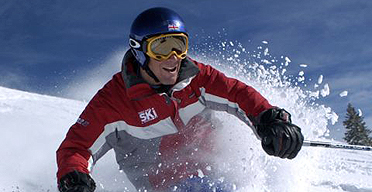
I'm a confident piste skier, and am keen to get off-piste more. However, my family and friends are all beginners, so if I hired a guide it would work out very expensive. Any compromise suggestions?
John Griffiths, Basingstoke
In Europe you leave the piste at your own risk. You should take a guide, full avalanche gear, a transceiver, probe and shovel. It's best not to compromise when lives are at stake.
However, a couple of European resorts have recently opened up off-piste areas which they make secure from avalanches by blasting and careful monitoring. Tignes has introduced an avalanche awareness centre and a secured area called Les Naturides, near the Col des Ves chairlift, where you can practise your off-piste technique in safety. The Swiss resort of Zinal has also opened up an avalanche-secured 'free ride zone', with a transceiver practice area nearby.
However, North America is still the best place to go if you want to practise off-piste in a secure environment. In every resort the philosophy is for the whole area within the ski boundary to be made safe, though in times of high avalanche danger some areas may be closed. Statistically, this policy seems to have worked. There was one in-bounds fatality at Arapahoe Basin last season. However, it was a freak spring slush slide in late May, when temperatures were unusually high. Moreover, it was the first in-bounds avalanche death in North America for more than 25 years.
If you want to learn to ski powder on gentle slopes, consider Big White, Brighton/Solitude, Grand Targhee, or Vail (especially the Mongolia Bowls). If you want some steep with your deep, try Crested Butte, Fernie, Jackson Hole, Snowbird, Alta, Sunshine Village or Taos. Resorts closer to the Pacific, such as Kirkwood, Mammoth, Squaw, or Whistler, also have some challenging terrain, and get huge quantities of snow. But because of the proximity of the ocean, that snow is often heavier and more difficult for inexperienced off-piste skiers.
· For information on Martin's coaching camps see www.skimartinbell.com
I'm always exhausted for the first half of a ski holiday, and my lower back gets sore. I know I should be doing fitness training before I go, but I'm not sure where to start. What do you recommend?
Pam Wright, via email
Many British skiers think that skiing doesn't count as a sport, because it is something they only do for one or two weeks a year. Of course that's wrong; as with any other sport, you'll get a lot more enjoyment out of a ski trip if you prepare for a while beforehand - ideally for three months, and at least for six weeks.
Skiing requires two different types of fitness, and you must prepare your body for both. First, the thin air at high altitude necessitates adequate cardiovascular endurance, so your heart and lungs can maximise the sparse oxygen available. This is improved by any steady activity: brisk walking, jogging, cycling, swimming, rowing and the like. Three half-hour sessions a week are the minimum required.
You'll also need strength, in your legs and the core muscles around your hips and trunk. The thighs can be strengthened with the 'leg press' machine at the gym or knee-bends in front of your mirror. Sit-ups and dorsal raises will tone the torso.
Flexibility is also important. Lower back stress is often due to a combination of weak stomach muscles and over-tight psoas, the muscles in the loin area. Regular stretching sessions before and during your trip will reduce the risk of injury. Contrary to popular belief, balance is a skill that anyone can enhance with practice. For balance training I recommend the Bosu balance trainer (www.bosu.co.uk or the Skier's Edge (www.skiersedge.co.uk).
If you're at a high-altitude resort (over 2,000m or 7,000ft), it will take you three or four days to adjust. Pace yourself, drink plenty of water, and be sure to go easy on the alcohol.
And don't stay in the hot tub too long: it can make your muscles too loose for skiing!
· Send your ski questions on resorts, technique, equipment and etiquette to Martin at travel.tips@ observer.co.uk
