
There can be few better feelings of accomplishment than getting off the train at Vladivostok. The delayed Virgin trains service to Newcastle? Long-haul flight to New Zealand via Los Angeles? Child's play. If you get on the train at Moscow and don't break your journey along the way, it will be a week before you are able to lay your head on a proper bed. Over 9,600 kilometres of Russian steppe, isolated villages, mighty rivers and industrial decay sweep by between Russia's capital and this far-flung outpost.
After a month spent landlocked and longing for sea air, the only 'must-do' we had for Vladivostok was a boat trip. After all, it's the proudest naval city in the world's biggest country, and a string of islands dot the Amursky Gulf. Many of them can be reached by ferry, including Russky island, a few miles offshore from the harbour. Granted, it was never going to be a day trip to Capri. As we approached the ferry, along with a motley band of shoppers, fishermen and Lada drivers, it appeared to be moonlighting from a day job transporting tanks on military exercises.
Being a missile's throw from one of the largest naval bases in the world, Russky's no rural idyll, though it looked perfectly pleasant from the middle of the harbour. Visions of a nice mid-afternoon hike finished with a plate of blini pancakes and tea by the seaside were ruined when we disembarked on a jetty that appeared to be part of a concrete freeway overpass lost at sea. A decrepit landing craft sat beached by the side of the jetty, looking like a torpedoed relic from a Soviet-era war game.
The island's interior was depressing in a way only post-Soviet Russian towns can be. Scrawny cows munched their way through rubbish from an over-filled skip next to squat tower blocks of blistered cement, while wheel-less Ladas rusted miserably in the salty air.
Salvation came from the unlikeliest direction, back at the pier. A teenage conscript, all close-shaven hair, loose-fitting combat fatigues and nervous smiles, came over to cadge a cigarette. We didn't smoke, though with our pidgin Russian this took some time to get across. He shrugged, smiled and squatted down opposite us, in a manner more Chinese peasant than Russian stormtrooper.
It turned out 17-year-old Sasha was based on the island. He was from Tomsk, a one of a dozen mid-sized Siberian cities we had rumbled past on our month-long journey. For a lad who could probably strip an AK-47 blindfold and kill us with the spare pieces, he was endearingly goofy.
The rusting landing craft was, in fact, Sasha's training ship, and his commander was supplementing rations with a spot of fishing. A pot-bellied bruiser in the archetypal blue-and-white striped military singlet, he slugged a beer with one meaty paw while tugging the line. We asked him when the ferry would be back. With a dismissive wave - the international sign language for "soon, soon" - he smiled, raised the beer and returned to the hunt.
Soon, soon turned out to be - surprise, surprise - quite a while. The irony of receiving third-degree sunburn in deepest Russia was not being lost on me. But as I walked to the side of the wreck, the portly commander yelled out that, since they were going back to the naval base themselves and the ferry was taking such a long time, would we like a ride?
At such moments, the Lonely Planet guidebook is useless. Were you waiting for a ferry back to the Scottish mainland from some windswept isle, it's highly unlikely a passing Royal Navy destroyer would send a motorboat out to provide a trip back to the pub. Yet this appeared to be what the Russian Pacific Fleet had just offered. We were still deliberating whether the ship was seaworthy enough, the captain over the legal limit, and Sasha tall enough to reach the pedals when the ferry went and ruined everything by turning up.
It's a very Vladivostok anecdote. Here, naval and military tradition are never far from the surface. Most of the tourist attractions are tied to the city's naval prowess, or the military complex built around it. One has been turned into a fortress museum, its tunnels a reminder of the city's secretive military days. It was once closed to all foreigners, mostly because of the several million tonnes of shipping slowly turning an attractive brown colour in the harbour.
Massive artillery guns still point out to sea, though these days the only invasion is likely to be from wealthy visitors, a prospect the locals welcome. On the main road, opposite hulking great cruisers in the harbour, is the submarine museum S56, a Soviet-era submersible claimed to have sunk ten ships in World War II. At the exit, former sailors will sell you Communist badges, navy pennants and anything else that hasn't been nailed down by their superiors
About 90% of the tourists that come to Russia come to St Petersburg, Moscow, and the 'Golden Ring' of monastery sites around the capital. Much of the other one-tenth get about as far as Ulan Ude on the Trans-Siberian before heading south towards Mongolia and Beijing. For some reason I felt my month-long Russian railway journey would not be complete without finishing here, in a city closed when I was born, and with a name that conjures up every Cold War cliché imaginable.
If you arrive via train, the Rossiya's terminus at the main train station is right in the heart of the city. You emerge out into sea air and, most likely, drizzle (Vladivostok's climate being much like Seattle's). A clutch of reasonably priced and clean hotels run the length of Posetskaya Ulitsa just north of the city square. There's great coffee at the homely Café Nostalgia, but it's not cheap. In fact, no cheaper than London.
Vladivostok has been likened by some to San Francisco, more for its hilly physique than any notion of hippie counter-culture cool. It can boast, however, one of the more attractive central city areas in Russia and has a raffish air - part seaside resort, part end-of-the-world metropolis. Personally, I loved it.
One night we tried one of the city's Chinese eateries, only to be served Russian fare, Chinese style - think deep fried Siberian ravioli with soy sauce. Vladivostok's seaside eating, however, is a delight. Seafood fans may think they have died and gone to heaven when they see the beer bar fridges heaving with king spider crabs big enough to cover dining room tables. Half a cooked crab, its leg armour thick enough to poke your fingers through, costs less than cod and chips in a tired London chippie.
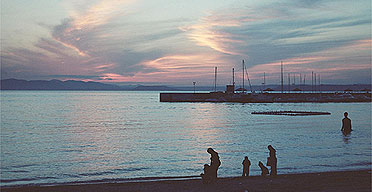
Washed down with Baltika beer, accompanied by a plate of steaming fried Central Asian rice called plov, and with the sun sinking into the Sea of Japan in front of us, it made the effort of Russian travel seem well worth it.
Getting there: Vladivostok is the final destination of Tran-Siberian services such as the Rossiya from Moscow - journeys take up to seven-and-a-half days. Aeroflot flies from London to Vladivostok, via Moscow. Travelling London to Moscow, then by train to Vladivostok, and a flight back to London via Moscow costs around £540. Train costs vary significantly.
Where to stay: The best hotel in Vladivostok is reputed to be the Vlad Motor Inn, but this is a 30-minute drive from town. Centrally, the cream of the crop is the Japanese-owned Versaille, where rooms can cost £125 a night. Japanese visitors tend to stay at the Hyundai, while The Primorye and the Moryak are two of the cheaper options close to the city. Expect to pay around £30 for a double per night.
Further information: Time difference: GMT +10 Currency: Russian rouble (46r = £1)
Related story
Homestays in Russia
