
The prince ran his fingers elegantly through his fringe, smoothing it back atop his brow. He took a drag on his Benson and Hedges and, gesturing with it, said in a quite irreproducible tone that bespoke five centuries of aristocratic discretion: "We keep in touch."
He and Charles, that was. Prince Carlo Alessandro had been showing us through his family snaps - quite similar to mine in their array of meat and potato heads against banal backgrounds, except that these ones mostly had crowns on - when a tiara-struck member of our party asked about his relations with his English namesake.
Alas, we were to be privy to no more about the Saxe-Coburg-Gothas (aka Windsors) but the connection hardly came as a surprise. The prince counted Bonapartes and the upper echelons of the Greek and Danish royal families - not to mention the Hofer-Valsassinas and Honelohes - among his nearest kin and he had the photographs, displayed in vitrines about his house, the Castello di Duino, now open to the - the - the public (gasp), to prove it.
There is a scene in the 1994 moped and illness Italian travelogue Caro Diario, when Nani Moretti, cursed with an apparently intractable skin disease, announces that he finally has an appointment to see the very best, "the prince of dermatologists!", and it was in this sense that Carlo stuck me as a sort of prince of Rotary club presidents. I subsequently saw a lot of men in Friuli Venezia Giulia, the northern Italian region we were visiting, dressed like him - navy blazer with brass buttons, soberly striped tie, tan slacks, brown shoes, luxuriant hair with an almost louche fringe - but they all seemed like more or less shabby imitations.
The prince's shoes, for one thing, virtually screamed "hand made", just as, I am sure, mine, to him, did not. And that haircut: it looked as if an extended family of spectacularly skilled elves had been at work on every follicle. He was no everyman but, in a peculiar way, he spoke for the region. Raised in France, educated in England (his accent, simultaneously poshest English and peripatetic central European, was disconcerting and at some point, somewhere, would probably have had him interned) and, since the 1980s, mainly resident in the 14th-century family pile in Italy, he said he felt no particular loyalty to any of those countries.
Friuli, if it could feel (it can't - it's a region), would probably feel similarly unattached. Trieste, the capital, was swapped last century like someone's lost suitcase between the Austro-Hungarian empire - the first world war its coup de grace - the Italians, the Nazis, Tito's Yugoslav army (who, in their former, communist partisan incarnation, came "this close" to taking Castello di Duino, the prince told us, and I imagined a shiver of horror running all the way along the family line) and the allies, before being finally handed back to Rome in 1954.
But this fraught recent history lends the city and the region, not an air of neurotic uncertainty, but rather one of layered mystery - a protean, unpredictable, subtly alluring quality. Sitting surrounded by racked newspapers and rows of books in a Trieste café, the atmosphere quiet, almost studious, you feel as if you might have been transported to a turn-of-the-century Kaffeehaus in Vienna and might bump into Sigmund Freud on your way to inspect the strudels on display at the counter. (Caffè San Marco is deservedly the most famous of many, its rows of dark-wood banquettes, softly lit from globular lamps above, themselves resembling, in the vast interior, a tray of cappuccini ready to be served.)
Similarly, the pork platters served up at the buffets (not smorgasbords, as we understand the term, but rather something closer to a brasserie) scattered about the city are resolutely Teutonic, of quite a different genus from a pasta dish but delicious washed down with a dry, full-bodied red wine from nearby Carso. The Triestines typically speak Triestino, a Venetian dialect, but most commonly spoken in the wider region is Friulan, a tongue owing something to Latin but more to German and Slovene.
Our own tongues were to owe something to Slovenes after we dined at La Subida, a hostelry run by a Slovenian minority family high in the Friulan hills. The proprietor was so proud of his achievement he had produced a sort of coffee table booklet, with extensive, quite artful black and white photographs, in which he describes the culinary and progenitive fecundity of at least three generations of his family. Of his wife, he writes: "The day we met, she was wearing white. I offered her a soft drink, but she refused and, without batting an eyelid, said to a mutual friend: 'Bik sutest zabit'," which apparently translates as "ignorant, blockheaded bull".
Never mind: the food, which was intriguingly delicious throughout, required no translation. We had the greedier of the two lunch menus, starting, under an arbour in the garden, with "frico", little lattices of fried Montasio cheese, and deep fried slivers of game and sage leaves - comparable, in one sense, to certain notorious Scottish delicacies but incomparable in all others.
Moving indoors (the decor flirted with faux rustic but did not become involved) we sat down to a salad of courgette flowers with apple and something called kren, followed by ravioli - hinting at the more substantial dish to come after we had swiftly cleansed our palates with sorbetto. Deer fillet with blueberry sauce was the pièce de résistance - the flavour of the meat full of character and its dressing completing the cheery, medieval quality of the dish. The desert, gnocchi filled with plums and dressed with butter, was not designed with compensatory lightness in mind but it still had to make way - was there a trace of sadism in the daughter-waitress Erika's smile? - for several cinnamon biscuits from a tray placed, finally, before us.
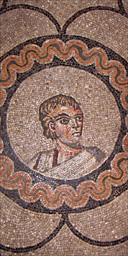
We drove, of course, so it did not matter, but I was glad that Aquileia was downhill from the restaurant. We had come to see the undisputed archaeological jewel of the region: a vast, fourth-century Christian mosaic, which, discovered only a century ago beneath the layered foundations of successive temples built upon the site, is in startlingly fresh condition.
Whether the Romans brought lions to proto-Friuli Venezia Giulia, I do not know, but Christians were still a fledgling sect when the mosaic was laid down and there is something in its sheer size - 750 sq metres - and in its bold depiction of Jonah's ill-fated fishing expedition, of the lamb on the shoulder of the good shepherd and of the battle between the brave cock and the sly turtle that bespeaks a flagrant defiance in the face of persecution.
Yet, enhanced by its remarkably well preserved state, it also feels peculiarly modern. The financial contributors to the mosaic were rewarded with a rendering, next to the fish and so on, of their likenesses in tile, complete with a careful noting of exactly how many square metres they had paid for: "we would like to thank our sponsors". One inscription reads, "Cyriace Vibas": "Long live Cyriace". Given the violence of the time, he probably didn't, which is a shame because it seems a rather pleasant region to live in.
Way to go
Caffè San Marco, Via C Battisti 18.
La Subida Trattoria, Loc. Monte 22, Cormons, +39 0481 60531. In Trieste, for moderately priced regional cuisine try the Ai Fiori restaurant, Piazza Hortis 7, +39 0403 00633.
In Trieste, Simon stayed at the Miramare Hotel, Viale Miramare 325/1, +39 040 224 7085, www.hotelmiramaretrieste.it; in Grado, at the Villa Bianchi Hotel, +39 0431 80169, www.villebianchi.it; and near Udine at Al Casale Agriturismo, Casali Loreto 3, +39 0432 909 600, www.agriturismoalcasale.it
Ryanair offers cheap flights to Trieste from Stansted.
