
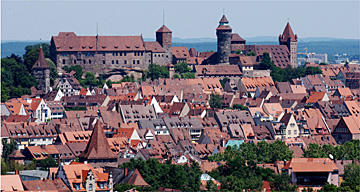
The first mention of the "Norenberc", or rocky mountain that gave the city its name, was in 1050. It soon grew into a great trade centre, and flourished during the 15th and 16th centuries as a hub of culture, art and innovation. The painter and printmaker Albrecht Dürer; sculptors Adam Kraft, Veit Stoss, and Peter Vischer; and the painter and woodcarver Michael Wolgemut, created famous works here, while inventive technicians gave the world the first pocket watches, known as Nuremburg eggs.
A darker era in the city's history came in the early 20th century, when Hitler chose Nuremberg as the seat of the Nazi party and made mesmerising speeches in great rallies at the Zeppelin stadium. After the war, 13 trials - presided over by judges from the major Allied powers - convicted 142 Germans and Austrians of war crimes.
Largely rebuilt after the second world war, Nuremberg today is half modern metropolis, half medieval hamlet. Part of the 14th to 17th century walls are still intact and one of the largest medieval castles in the country, Kaiser Castle, towers over the city. Don't leave without sampling Nuremberg's culinary speciality, Lebkuchen - gingerbread shaped into witches' houses of the Hansel and Gretel variety.
Sporting pedigree
Currently playing in Bundesliga, 1 FC Nuremberg, or "Der Club" was formed in 1900 in a local pub. For more than 60 years, Der Club held the record for winning the German title the most times (nine) but Bayern Munich took the record from them in 1987. In addition to football, Nuremberg is also known for its motor racing. The Norisring racetrack is famous for the Nuremberg 200-mile car race held there every year.
1966 and all that ...
During one 53-minute raid by the Allied forces during world war two, 521 RAF planes dropped over 6000 "blockbuster" high explosive bombs and over a million firebombs on Nuremberg.
Where to stay
· For a selection of two to four-star hotels in Nuremberg, try Hotels in Nuremberg.
· For information on hotels in various areas of Nuremberg, see Holidaysguide.yahoo.com.
· Rooms at more than 550 German hotels can be booked during the World Cup through Fifaworldcup.com. The hotels will be rated from two to five stars and all will be located close to match venues. Simply specify which team you want to follow and the period when you'd like to be in Germany.
· Soccerphile in partnership with tour company VIP Hanse Touring is offering World Cup tour packages including hospitality, hotel bookings, venue and match day transfers and city tours.
· Hotel.de offers a selection of hotels available in the 12 participating World Cup cities along with information on draw dates and venues.
· World Cup Trips organises accommodation and tours incorporating transport to and from matches.
· Find accommodation in each of the World Cup host cities at Walking-in-Germany.co.uk.
· Find people with rooms to rent in the host cities at ImmobilienScout24.
· Fanproject 2006 is offering accommodation at giant campsites around Germany during the World Cup.
Getting there
By air: Nuremberg Airport (NUE) is serviced by 14 airlines that fly throughout Europe. Search for cheap flights at Skyscanner.net.
By rail: From the Hauptbahnhof (Central Station) rail travel takes two hours to Frankfurt, 6 to Berlin, and 1 hour 40 minutes to Munich. European Rail offers transport to all the World Cup destinations. Also, check out special offers from Deutsch Bahn for World Cup travel.
By road: Eurolines, the overseas wing of National Express, offer return fares from the UK to all major German cities. Within Germany, Eurolines is represented by Deutsche Touring or tickets are available from Deutsche Bahn ticket agents in major railway stations.
By boat: It is possible to travel on the Rhine, Main, or Danube, via the Main-Danube Canal, to Nuremburg.
The stadium
After 17 months of construction work, Nuremberg's 44,308-seater Franken Stadium reopened in April 2005. Built in its original form in 1928, the stadium had an unusual octagonal shape which has been retained. Three newly built underground storage chambers on the stadium grounds collect 990 cubic metres of rainwater from a surface of 42,000 square metres and will save the €31,000 annually in fresh and wastewater bills. The stadium is located to the southeast of the city and forms part of a large municipal sports complex adjoining the former Nazi rally grounds. Home ground to Bundesliga club 1 FC N?rnberg, England will play their match against Trinidad and Tobago here on June 15.
· Where is it? From the main railway station (Hauptbahnhof), take the S2 urban train (S-Bahn) to Frankenstadion. Alternatively, catch bus no. 44 or 65, or tram no 6 or 9 from the city centre. Beware, though, that the buses and trams stop at the "Doku Zentrum" rather than the ground itself. The S-Bahn's Frankenstadion stop is closer.
Or watch it in a bar
The Hilton Nuremberg's Sportsbar has several extra-large TV screens and shows many live sporting fixtures and tournament. It's decorated with national sports teams' images and memorabilia, including football, handball, basketball, ice hockey and motor sports.
