
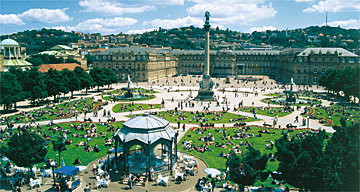
Stuttgart lies in the lush Neckar Valley, bounded by vineyards and the Black Forest. Its multiple parks make it one of Europe's greenest cities, but it is also one of Germany's biggest industrial centres. The Daimler-Benz factory began manufacturing here in 1926 and, a few years later, Ferdinand Porsche set up shop. Today, there are approximately 150,000 companies located in the Stuttgart region, including Bosch, IBM and Hewlett-Packard. Their presence has helped give Stuttgart residents the highest per-capita income of any city in Germany.
The city is not all work and no play, however. The area is also renowned for its mineral springs, which, with a daily output of more than 22m litres of water, are the most productive in western Europe. Eleven of the 19 springs have been officially declared health springs and are used to feed swimming pools, spa houses and drinking fountains. England's World Cup team will be hoping to make the most of the waters' health-giving powers, having set up their pre-Cup training camp in the nearby spa town of Baden-Baden.
Just before the World Cup gets under way, Stuttgart will host another World Championship - for field robots - at Hohenheim University. This competition will see teams from Japan, the USA and Europe compete to create the world's best self-built agricultural robot. To reflect the World Cup theme, the robots will have to mark lines, find holes in a football pitch and act as electronic groundsmen to ensure the surface is in perfect condition.
Sporting pedigree
Jürgen Klinsmann is one of Stuttgart's famous footballing sons. The former football manager-turned-coach was a striker during his playing days - the combination of his blond hair and his scoring ability earning him the nickname "Golden Bomber." Klinsmann's family manages a bakery in the Stuttgart suburbs so he's sometimes known as the "Baker's Son" too. Klinsmann made his final appearance as a player in the city on May 24 1999.
1966 and all that ...
In 2005, Stuttgart's botanical garden grew the largest ever Titan Arum. The Titan is the world's tallest flower and also the smelliest; it's nicknamed the corpse flower because it stinks of rotting animal flesh. The city's specimen reached 2.94 metres in height.
Where to stay
· Search the official Stuttgart Tourist Board site for info and accommodation.
· The Maxi Sporthotel will open ahead of the World Cup, in the VfB Event Centre at the Gottlieb Daimler Stadium. It will be operated by Golden Tulip and will offer 174 three- to four-star rooms.
· HotelRates.com shows a selection of discounted hotels in Stuttgart.
· At StuttgartInformation, you can find youth hostel, camping, and hotel accommodation. Type in your price category and tick the facilities you'd like and search for.
· Search for rooms within a specified number of kilometres from Stuttgart's Gottlieb-Daimler-Stadion at Immobilienscout24.de.
· Rooms at more than 550 German hotels can be booked during the World Cup through Fifaworldcup.com. The hotels will be rated from two to five stars and all will be located close to match venues. Simply specify which team you want to follow and the period when you'd like to be in Germany.
· Soccerphile in partnership with tour company VIP Hanse Touring is offering World Cup tour packages including hospitality, hotel bookings, venue and match day transfers and city tours.
· Hotel.de offers a selection of hotels available in the 12 participating World Cup cities along with information on draw dates and venues.
· World Cup Trips organises accommodation and tours incorporating transport to and from matches.
· Find accommodation in each of the World Cup host cities at Walking-in-Germany.co.uk.
· Find people with rooms to rent in the host cities at ImmobilienScout24.
· Fanproject 2006 is offering accommodation at giant campsites around Germany during the World Cup.
Getting there
By air: Stuttgart Airport is eight miles south of the city. Various airlines fly between Stuttgart and major German and European cities. Alternatively, you can fly to the major hub airports such as Frankfurt and Munich and get a connecting flight onwards. Once you've landed, be aware there is not much public transport after midnight and there are no connections to the airport between 1am and 5am. Taxis are expensive - €10 will buy a ride of about four minutes.
By rail: Timetables for trains and bookings are available at www.bahn.de. European Rail offers transport to all the World Cup destinations. Also, check out special offers from Deutsch Bahn for World Cup travel.
By road: Eurolines, the overseas wing of National Express, offer return fares from the UK to all major German cities. Within Germany, Eurolines is represented by Deutsche Touring or tickets are available from Deutsche Bahn ticket agents in major railway stations.
The stadium
Stuttgart's original Neckar Stadium was built in 1933. Its notable games have included the first international games on German soil following the end of the second world war (in 1950), and after reunification (1990). Both occasions saw the Germans taking on the Swiss. After several rounds of improvement, the stadium was recognised as being up to World Cup standard by 2001. A further modernisation programme, due for completion by the end of 2005, will see the capacity reach 53,200. The stadium's two new video screens, with viewable areas of 115 square metres and weighing 11 tonnes apiece, will be the biggest of their kind in Europe.
· Where is it? From the main station, take S-Bahn (S1) or bus 56 to Gottlieb-Daimler-Stadion. Stadium tours running for 45-60 minutes can be arranged but you'll need to book at least 14 days in advance by emailing poststelle.gottlieb-daimler-stadion@stuttgart.de
Or watch it in the streets
As the World Cup gets under way, a party will kick off in the city centre. Big screens in the Schlossplatz will broadcast all World Cup matches live around the Jubilee Column.
