
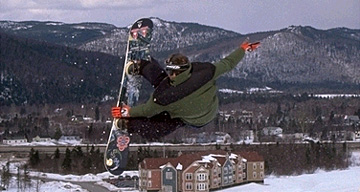
As I sat back in my seat at London's Gatwick Airport, and contemplated my flight across the Atlantic, there was one major difference between this journey and my normal flight-path to Denver. On this occasion we'd be touching down in just five-and-a-half hours, rather than the usual 10 hours. Our destination was not Colorado, but Deer Lake, Newfoundland - gateway to the closest ski area to the UK in North America: Marble Mountain, in the foothills of the Appalachians.
Newfoundland has not always had the best press, but I am here to tell you it deserves better - a lot better. In spite of such remarks as "we were washed up here and now we can't leave" (anon) and, in the acclaimed novel and movie, The Shipping News: "The people that came here came by accident," and, "Do they have summer here?"
When the sun does shine, it's "the first sunrise in America". And, in spite of all those "Newfie" jokes that the rest of Canada cracks about this ruggedly beautiful island (half the size of Britain) wedged between the Gulf of St Lawrence and the Atlantic, it's quite a magical place (depending on how you define magic) and certainly refreshing - well, bracing really. And the people couldn't be nicer.
Newfoundland, also known as "The Rock", juts out into the Atlantic and is the easternmost area of Canada. It was in Newfoundland in 1901 that Guglielmo Marconi received his first transatlantic wireless signal. It didn't have that far to travel. Newfoundland was one of the first parts of Canada to be settled by Europeans. In the area near St Anthony, on the Great Northern Peninsula, there is evidence of a Viking settlement that is now a Unesco World Heritage site. It dates back to five centuries before Columbus landed in the New World.
Skiing is a comparatively recent development. Fishing is the name of the game here. The whole culture is based on fish. Most Newfoundlanders' lives are tied to the sea in one way or another, whether it's the cod fisheries or offshore-oil drilling on the Grand Banks. Most people own boats, painted as brightly as their houses. And if you listen to the old fishermen speak you'll only be able to catch a couple of words. Examples: "I'se the b'y that builds the boat, and I'se the b'y that sails her. I'se the b'y that catches the fish, And takes 'em home to Lizer" (from a traditional Newfoundland song). Or how about "Boil up da moose b'y, an we'll have a scoff and scuff. Sing out to 'em for da feed or I'll get out me split an crack ya on da arse!" They're still speaking English, but the accent is strong and the slang unusual. Newfoundland was Britain's oldest colony until 1949, when the Newfoundlanders had to choose between Canada and the USA. But Ireland, France, Portugal and Spain, not to mention the Vikings, have all had a hand in its history.
One tradition is to initiate tourists as "honorary Newfies" by "screeching" them in. This ritual involves the visitor kissing a gigantic frozen cod, repeating the phrase "long may your big jib draw" and drinking large quantities of Screech Rum, which was traditionally imported from Jamaica in exchange for salt fish shipped to the West Indies. The fish became the national dish of Jamaicans and the rum became the traditional drink of Newfoundlanders. Why "Screech"? As the story goes, during an influx of American servicemen to Newfoundland during World War II, the commanding officer of the first detachment was taking advantage of Newfoundland hospitality for the first time and was offered a drop of rum as an after-dinner drink. Seeing his host toss back the liquor with abandon, the unsuspecting American also downed the drink in one gulp. The look of shock and the glorious shades of colour on the visitor's face were only overshadowed by the bloodcurdling howl he made as he managed to regain his breath. Word got around, and the potent rum became officially known as Screech.
Newfoundland has had a quirky history since Captain Cook passed this way in the 1760s during the first of his three epic voyages. (Where didn't he pass during his frenetic global tours?) Actually he did more than pass. He mapped - furiously - establishing the first accurate maps of the Newfoundland coast in a kind of dress rehearsal for his more exotic wanderings in the Pacific. As you stand on the windswept heights above the coastal town of Corner Brook, on the west coast of the island, you might notice, through eyes screwed up against the wind, the rain and the sleet, a plaque erected in his memory.
Peering into mist, I almost fancied I could even see the UK, or at least Ireland, although I was looking in entirely the wrong direction. After all, the time difference is a mere four hours. Three, if you count the French islands of St Pierre and Miquelon - the only area in North American that is still part of France.
One thing that sets all of Newfoundland apart though is its gender demographics. In Alaska, where there are far too many men, they are crying out for women. Here in Newfoundland it's the same scenario in reverse: too many women among the population of just over half a million. Perhaps Alaska and Newfoundland should twin.
Marble Mountain ski resort, opened in the 1960s, is six miles north-east of Corner Brook and a 10-minute drive from Humber Valley along the Trans-Canada Highway. With only 65,000 visitors a year - that equates to about 1,000 a day - the slopes are rarely busy. Marble Mountain's ski season usually opens on Boxing Day and runs until early or mid-April. The resort has 34 trails, including a terrain park and halfpipe, a vertical drop of 1700 feet down to the Humber River, three quad chairs, including the evocatively named Newfie Bullet and Black Mariah, and a brand new 5,000-square-metre base lodge with day-care facilities. Advanced skiers can also enjoy good cat skiing nearby in the Blomidon Mountains on the Bay of Islands, with almost 20 miles of trails and wonderful views across the ocean.
As I toured the Marble Mountain area with Anne Pinsent, the delightful general manager, I found some of the runs, like Ho Chi Minh, Kruncher, Hot Dog, Blow Me Down, Boomerang, Humber View and Autobahn, genuinely challenging and steep - especially in "Newfie hardpack" snow. But there are ample runs for beginners and lower intermediates, including Broadway, Crocker's Run and Little Hearts' Ease. In spite of its name, The Struggle, at the top of the mountain, is an easy green - with wonderful views of the ocean and the Bay of Islands. Above that is a spot on the mountain where Tony, the Mountain manager sometimes comes to unwind with a cup of coffee. "This is where you'll find me when things get frustrating - where no-one can find me," he says. "It's not just the view. It's the view of no people. And total, utter silence!"
As I prepare to leave, feeling I have discovered something of a treasure, more snow is on the way. As they in these parts, "if you don't like the weather, hold on five minutes!" Says Jim, the ski school director "We cope with the topsy-turvy weather. We have to. It's the only way we survive here."
Way to go
· Arnie Wilson was a guest of the Canadian Tourism Commission and the Newfoundland and Labrador Department of Tourism. He stayed at the Marble Villa, the resort's ski-in/ski-out inn, and at the Humber Valley Resort. Weekly charter flights to Humber Valley Resort and Marble Mountain operate from London Gatwick, through Barwell Travel (020 8786 3025; www.barwell.co.uk). Packages that include flights start at £530pp for seven nights.
· For more on Marble Mountain resort, visit www.skimarble.com.
