
We were sitting, waiting to see in the New Year, on the battlements of Fort Tiracol, a bona fide fort-turned-boutique hotel at the northern tip of Goa. My host was playing Sufi music, recorded in a Karachi bazaar, that sounded amazingly like raw Delta blues.
Suddenly, from across the estuary - you reach Tiracol via a rust-bucket ferry - came an explosion of trance music and fireworks to add to the plenitude of stars above us: a rave had begun on Kerim beach. Simultaneously, bells proclaimed the start of midnight mass in the church which forms part of the fort, the priest intoning prayers to a congregation of devout Goan Roman Catholics, the men sitting bolt upright in their double-breasted Sunday-best suits.
After midnight, my taxi took me home - via a Hindu village whose main square was full of serenely dancing local maidens - to my £4-a-night room in Mandrem. On the beach was a gaggle of E-generation Russians, piling driftwood on to a bonfire as the muted tones of more trance emanated from the decks of Sergei, a DJ flown in from St Petersburg for the night. Fifty yards down the beach, across a rickety bamboo bridge that crossed a swollen creek, was the O Saiba restaurant. Here, four Danes listened to the breaking waves and delighted in the warm - but not too warm - night air. Goa is still magical - as long as you go north.
But get it while you can. From Vagator southwards is, in season, as populous as Torremolinos on a torrid August day. Palolem, famously the most beautiful beach in the south, pullulates with people. Colva and Calangute are alive with the sound of package tours. But Morjim, Aswem, Mandrem and Arambol still preserve something of the tranquil emptiness and laid-back mood that made Goa a hippy heaven in the 1960s and a trance dancer's idyll in the 1990s. But as Prakash, a liquid-eyed barman at Antonio's Paradise, on Aswem beach, sadly told me: "The vibe is changing." He was referring specifically to the police shutting down all of north Goa's Christmas raves, but he could also have been talking about his own part of the scene.
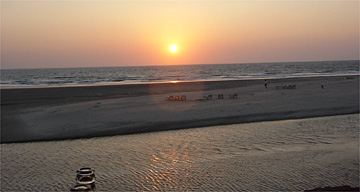
Certainly, the Morjim-Arambol strip is blissful: 10 or so miles of uninterrupted beach, whole swathes of it undotted by humanity. Occasionally, some fishermen will take their nets by hand into the sea. Occasionally, young Indians will play fiercely contested games of cricket on the firm sand. Very occasionally, some rather uninsistent hawkers will try to sell you coconuts or sarongs at risible prices. And even more occasionally, turtles will hatch their young.
Most often, the palms will stir in the pleasant breeze and the gentle breakers will offer the opportunity to body surf. There's even, on Aswem, La Plage, one of the most stylish beach restaurants on the globe - delicious caramelised tuna for £4.50; heavenly chocolate pudding for £2-10; immaculate ceviche for £2.50; and a clutch of elegant Italians and French patrons. There are, too, excellent cafes for the existentially-minded: the Here and Now stands only 50 yards from Change Your Mind, while two miles' walk away is the End of the World. All serve splendid grilled kingfish or red snapper for between £2.50 and £3.50. Simpler curries cost a pound. Accommodation? Basic Coco huts are priced from £4 to £10, rising to £20 on New Year's Eve.
And yet ... Well, in Morjim, there's an eyesore of a resort, and the Russian presence is large and rowdy - two sad-eyed ladies from Norway, who were seemingly born to tolerate, told me they found the noise intolerable. (The Russian mafia, incidentally, is said to be moving in on western-owned businesses in Goa; one restaurateur is alleged to have been slapped around; another had a gun shown to him on his premises. Let's hope they don't target the 3rd Eye, whose sign declares its owners to be Shiva and Sharon.) As for Arambol - for all the romance of its lagoon, it has a touch of the Costas about it.
Mandrem, though, is the real thing - for the moment. When I first went there a year ago, there was just one palm-roofed beach bar, the Oasis, at the southern end of the beach. Hidden behind the dunes was the Mandrem Beach Resort, a comfortable compound of bungalows mostly rented by either middle-aged or yoga-loving Germans. Closer to the Oasis was the area's chicest hotel, the Villa Rivercat. The Rivercat has a ravishing garden, hammocks, very good food and a marbled rotunda under a soaring cupola. Behind the palms that rose above the shoreline were houses for rent, Coco huts (Merrylands is by far the nicest) and simple rooms.
But now there are four of those palm-girt huts, all reached by rickety bridges, and very pretty they look at night, with their fairy lights twinkling. And smack in the middle is an imposing and attractive white building that serves as an emblem of the times. It was once a rich Goan's seaside retreat; in the early 1970s it became home to a Merry Pranksterish bus full of hippies whose nudity bemused the locals. There were unrealised plans to turn it into a prawn factory, and that's the name now given to its new incarnation as a grill and barbecue. (The food's very good, the wait for it, unbearable.) The co-owner is Robin, an Englishman who's "been in India more than 20 years. And I'm afraid I'm the face of progress," by which he means that he wants to make the Prawn Factory a nightclub.
Down at O Saiba (delightful restaurant, charming service) is Michelle, a fast-talking American who's turning the already pleasant quasi-hotel into a yoga and meditation centre on behalf of its proprietor, Guru Naik. She's not big on Robin: "I've lived in India for many years," she tells me, "and for many lives, and the way that man's behaving isn't ..." The scrap promises to be a good one - the Guru's sister, Michelle tells me, is married to the Chief Minister of the state.
What it means, however, is that the idyll has a time limit. Use that time to chill and to take a trip inland to Siolim, a smallish town (population 12,000) with two lively bazaars, a smart boutique hotel in a former governor's mansion and the attractive Silent restaurant. If you're there just after Christmas, check out an all-night pantheistic shindig called the festival of Zagor. There's a fairground atmosphere, folkloric sketches and palm-wine fuelled revelry. Fun, but it's perhaps more diverting to head to Mapusa, a small town with a terrific market, and more instructive to stroll around nearby Korona or Saligao, to see how Goan life is really led.
But let's face facts: most people go to Goa for a two-week holiday. And all of them want (like Alex Garland) to find The Beach. That concept doesn't exist in Goa any more - not at Mandrem, nor even at Kerim in the far north, where a blank-eyed ex-roadie sat in a lean-to cafe, chugging Kingfisher beer after Kingfisher beer as two gaunt Russians chopped onions and tomatoes to make their lunch.
No, for The Beach you have to firstly take the ferry across to Tiracol, then cross the Goan border into Maharashtra, drive past the ghastly cement works and the lunar-looking quarries, past the sari-clad women working in the salt pans, and plunge down a rutted road to Shiroda beach. Hawks hover. The sky is endless. Big waves crash on to the sand. Five fishing boats sit silent, their nets beside them. Two Maharashtran boys loaf in the shade. The beach curves for five miles or so; to the north is a bluff, to the south, scattered islets and palm trees. One guesthouse nestles behind the dunes. It is, for the moment, empty.
Way to go
Monarch has direct flights from Gatwick to Goa. Monarch flights from Manchester make a stop in Bahrain. Visit www.goaway.co.uk for cheap deals starting at £279 return.
Where to stay
Fort Tiracol
Can be reached by ferry, half-board accommodation £63/week, +91 (0) 832 227 6793, email nilaya@sancharnet.in.
Mandrem
Villa Rivercat, £20/night, +91 (0) 832 224 7928, email villarivercat@hotmail.com.
· Mandrem Beach Resort, £20/night, +91 (0) 832 224 7115 or 224 7609, email prazeres@satyam.net.in.
· House on beach, owned by Laurence D'Souza, £46/night, +91 (0) 832 224 7482 or mobile +91 942 331 6427.
· O Saiba, £7.50/night, +91 (0) 832 224 7162 or 224 7609 or 224 7930, email osaibagoa@yahoo.com.
· Merryland Coco huts, £7/night including breakfast, +91 942 306 0311, email www.manu_dewa@indianinfo.com
Aswem beach
· La Plage, huts or rooms for £20/night, +91 982 212 1712.
· Antonio's Paradise, £7-20/night, +91 982 210 0964.
· Yab Yum, upmarket hut encampment at £30/night, +91 (0) 832 224 7037 or mobile +91 942 332 0975.
