
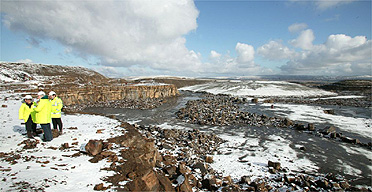
For years, men toiling for lead in Weardale, Co Durham, told of hot water seeping into mine workings below a moorland landscape now billed as England's last wilderness. A rural myth? The miners were not hallucinating. Late in 2004, teams from consultant PB Power and Newcastle University sank a bore hole and found water at a depth of 995 metres (3,264ft) and at a temperature of 46.2C - about as hot as the water that comes out of a bathroom tap.
The discovery gives a huge boost to plans to regenerate the economy of the villages along the valley, plans that now include not just homes and jobs but also hot springs, a funicular railway and Britain's longest dry toboggan run.
Weardale suffered badly during the 2001 outbreak of foot and mouth disease, and, less than a year later, Lafarge Cement (formerly Blue Circle) announced it was going to close its works at Eastgate. The industrial plant provided 147 much-needed jobs and contributed an estimated £7m annually to the local economy.
Potential disaster
The loss of the works was a potential disaster in an area with an ageing population, a dependence on declining industries and an absence of an entrepreneurial culture. Inevitably, a taskforce was set up, with representatives from the One North-East regional development agency, Lafarge, and Durham and Weardale Valley councils.
Aspirations went far beyond the usual solution of sticking up a few shed-like starter factories on the cement works' site. From consultations with local people in 2002 emerged a startling suggestion for regeneration based on renewable energy. At the same time, the taskforce's Eastgate project group began to think big.
"The rural economy tends to be dealt with in a piecemeal way. But we took the view that, by being bolder, we could provide a catalyst for reviving the economy of west Durham," says Bob Hope, the group's chairman.
What has emerged is a plan for a new village using five forms of renewable energy generated on site. There will be new homes and jobs. But the whole thing will also be a tourist attraction, with up to 400,000 visitors a year invited to plunge into Weardale's natural hot water. Lafarge appears to have accepted this idea with enthusiasm. "They could just have reclaimed the land, grassed it over and walked away without any thought for the local economy," Hope says. "But they have entered into the development of a scheme that can provide alternative employment in the dale for the next 40 years."
Lloyd McInally, Lafarge's project manager, says: "We have been allowed to work here since the 1960s and now we are leaving, there is going to be a hole in the local economy. Where possible, we try to do something innovative when we leave a site, and here we have a scheme that can answer some of the questions."
Lafarge began thinking about the site - whose ownership it will eventually give to a new project body - before the closure was announced and called in town planning and urban design consultant David Lock Associates. "We were not overawed by the site," says Jim Urwin, David Lock's planning director. "You don't look at the problems - you look at the opportunities.
"When we first came up, we were looking at it primarily as a leisure opportunity. But we were asked to join with the taskforce and found that Wear Valley council had latched on to this renewable energy possibility. We heard that there had been a record of water leaking out of walls in an old lead mine and I thought that if we could find that water on our site, we could make a national hot springs attraction that would be unique in the UK."
The plans, for which outline permission has yet to be sought, show a new village, with room for about 100 families and premises for new businesses, linked to Eastgate by a new village green. At the heart of the development is a dome covering the hot springs, a spa for visitors to relax "in either the open-air or covered warm-water pools while enjoying views of the hills to the south". To the west, there's a plant nursery and a farm that will use warm water to breed exotic fish.
Visitors will stay in a hotel or self-catering accommodation, and those coming for the day can arrive on the Weardale railway, a private line that hit the buffers in 2004 but now seems to be back on track.
At Eastgate, a funicular railway, on the site of the old conveyor that brought limestone down the hill, will take trippers to the fell tops, where they can transfer to a train hauled by the Green Dragon, a century-old wood-burning locomotive, for a trundle round the western quarries.
Here, they will see what man can do to geology when he puts his mind to it: rabbits scamper in front of rock pillars left behind by decades of blasting. Nearby will be a ramp offering a journey through geological time.
Small-scale quarrying work for aggregates will continue in the eastern quarries, with the funicular used out of season to transport rock down to the valley bottom. Visitors can take a look, then zoom down the hill on twin toboggan runs winding in and out of pine woods and, in season, go for a session in the ski-training area. Renewable energy will be evident across the site, sourced from the hot water below ground, from a turbine on the infant river Wear, from three wind turbines up on the hill, from solar panels, and from biomass - wood fuel for heating new buildings.
Once full planning permission is granted, the development could take about eight years to complete."I go to Weardale and think this is a real secret," says Unwin. "But I think it's going to be an even more fantastic place once our development is complete."
