
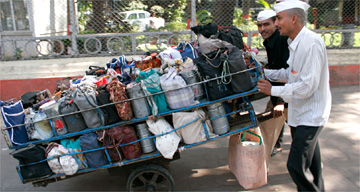
Where to find the best Indian takeaway
The Indian takeaway has long been a staple of the English diet. But where is the best place to order it? India, of course. Or more precisely, Mumbai. The city has a chaotic, but amazingly effective, network of 6,000 delivery men. Ask your hotel for the name and number of a dabbawallah - a 'dabba' is an insulated metal lunch box and 'wallah' means carrier. Order your home-cooked curry, with naan bread and rice. What happens next, Harvard scientists who have studied the service have concluded, is logistically impossible. But, somehow, without the use of computers or mobile phones, your dabbawallah will turn up at the right spot on time, with your meal swinging from the handlebars of his bicycle. Almost a million Mumbaians use the delivery service every day, making the dabbawallah service bigger than even McDonald's in India. Take out doesn't get any easier, tastier - or cheaper than this. It's the ultimate happy meal.
· For dabbawallah meals in Mumbai, see www.industours.co.uk Lunch from £4.
Why do small children get earache on planes?
Smaller children have narrower and more horizontal eustachian tubes (the passage in the middle ear that helps equalise air pressure on the eardrum) which are more prone to collapse with altitude changes on ascent and descent. As children age, the tube becomes wider and more vertical and the risk lessens. Pressure can be equalised by moving the jaw.
For babies, the pain can be reduced by feeding at take off and landing. Older children can suck sweets. If it gets too bad, ask the flight attendant for two Styrofoam cups stuffed with hot, moist paper towels to be held over each ear. The heat will expand the air in the middle ear relieving the negative pressure on the eardrum. Make sure your child is sitting upright during descent and encourage toddlers to blow through their nose while you hold the nostrils closed. This should pop the ears and relieve the pressure. If your child has a cold, ask your doctor to recommend or prescribe an oral decongestant. As a last resort, and at the risk of causing earache for all other passengers, the advice from family holiday company Siblu is to try screaming. 'Despite being annoying for others, screaming reduces the pressure on your toddler's eardrums and eases the pain,' its website advises. Happy flying!
How to survive an encounter with a lion
Should you find yourself face to face with a lion in the wild, there are some steps you could take to try to avoid being attacked. First, stand tall. Lions attack cattle while ignoring humans standing close by, because, it is thought, they do not recognise bipeds as a food. Second, don't run. Turning and running is most likely to arouse the lion's hunting instinct making it want to chase you. Finally, and this is for the very brave, approach the beast in a threatening manner. The theory behind this approach is that no other animal will threaten a lion and by doing so you'll awake its own survival instincts and make it run, leaving you an escape route.
