
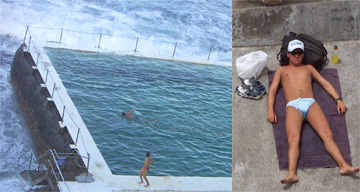
Is there a slack buttock in Bondi? It dare not show its face. They have all been toned to within an inch of their thighs. Where was the proud Aussie Ocker of my youth, with the obligatory latitudinal slice of his globular beer gut showing between his stubbies - those skimpy men's shorts - and his tight brown T-shirt?
He would not have survived long on the Bondi joggers' thoroughfare, skirting the great crescent of the beach from the paddling pool at the far north end to the cliffs leading to Tamarama and the other beaches beyond. He would have been pushed off on to the grass.
All of Sydney seemed to be jogging here. And all of Sydney had acquired an Olympian form - limber, lightly tanned and very taut - which it was frantically trying to keep up with on the track. Where, for that matter, were those other working-class regulars, the Bevans, aka the Westies: mullet-sporting patrollers of the beachfront in their dreaded panel vans, with spray-on jeans and hair-trigger attitudes?
The RSL was still there: the Returned Services League, as an organisation a sure source of true-blue chauvinism and in this, its local branch, to quote from Peter Carey's recent essay on his home town, "a typically Bondi institution of the old school. Barracks architecture, no airs, no charm, but a fabulous view out across the Pacific Ocean - here on Bondi you mix it with the hoi polloi. Or did."
That catch was right. The RSL has been ironised now; it has become trendy. The punters are still enjoined to face the war memorial every evening, at 6pm, but the crowd is thick with "tourists", real ones and their patronised equivalents from the suburbs, there to see who is there to be seen.
Misfits remain. Chrystal is one of them. He - "she" to be nice - promenades along the shorefront at dusk every day: in his baldness and his frocks a sort of would-be transvestite permanently stuck halfway. (He need only move a few train stops away to Darlinghurst, where like-minded denizens - those pinkish garments of indeterminate gender emerging from the rough wash of Australian sexuality - are in such great supply.)
But nor, despite appearing from the esplanade like some bland, fit army, were the beach creatures really so uniform. On my way to the safe-swimming flags, I found a fairly rigid segregation of the sand: first, the scalding Brits and chatty Yanks among the mainly young tourists on the south beach, then the familial clusters of Greek and Lebanese descendants of immigrant Australians and, last, the oiled gay gods of North Bondi, who gave my Londonised body barely a backward glance as I veered towards the water.
I had forgotten how oblivious was the Australian swell. When the waves pick you up and dump you, they are like a quick course in Buddhism - making you feel marvellously irrelevant in a second - and so unlike the lapping European tide as to seem a different element.
It is true that in Australia, perched as the population is on the coastline, you learn to swim almost as soon as you can walk. But it is only second nature, not the inborn skill of the shark, as I was forcibly reminded 50 metres out from the shore, trying to catch the waves where their foamy heads reared from the surface of the sea.
I had regressed, without five years of regular immersion, to a novice body surfer. Out there in the deep water, my limbs felt, all of a sudden, all rubbery and fatigued. The waves ignored my querulous entreaties to give me pause for breath and, as I turned quickly about and tacked to the beach, panic circled in a diminishing circumference.
Back, gasping, on my towel, I resolved to stay on dryish ground a while. I set off on the joggers' route, along the Eastern Beaches Coastal Walk, resuming my field trip in sandy anthropology.
The walk was extended a couple of years ago: you can now take it, with the odd diversion through suburban streets, all the way to the harbourside suburb of Watsons Bay. The beaches along the route are so numerous that, in Carey's words, "not only have the rich not bothered to claim the territory, but the dead have been allocated acres of absolute waterfront. The dead in Waverley Cemetery have the best view in the world."
Their graves are so close to the cliff edge you fear sending them finally tumbling over as you pass, on the way to Tamarama. Excitable locals dubbed the latter, a small c of a beach walled by weathered rock, "Glamourama" - but I am told the soap stars have left it in peace now.
Bronte, next along, is a kind of mini-Bondi but - less hectic than its more famous cousin - superior in the mind of a certain beachgoer. The lifeguards sometimes ban bathing here because of dangerous rips, in which case you can always dip in the saltwater pool where spray from smashing waves rains on the assiduous lap-swimmers. Or you could join the mildly bohemian crowd at one of the sextet of cafes over the road from the sprawling park backing the beach. With their simple, tasteful dishes and such a tempting view, these are transcendentally pleasant places at which to sit.
Little Clovelly, after Bronte, is rocky but good for snorkelling; Coogee, further along, has surf breaks serious enough to make the boardriders territorial. At Maroubra, the last of the ocean beaches along the walk, where fewer tourists stray, it gets more parochial. The Bra Boys - the gang's name a lopped-off version of the suburb's - tattoo their postcode on their arms, just in case you failed to notice they own the sand.
The water is gentler at the harbour beaches, and the residents more genteel. The rich did claim this waterfront, probably because it is so secluded and beautiful. You can sit among them at the century-old Doyle's fish restaurant, in Watsons Bay. There, between slurping Sydney rock oysters, you may even catch sight of what the venerable travel writer Jan Morris described, with one of her surgical sentences, as a "certain kind of Sydney face - which at first sight looks altogether straight, square and reliable, but which examined more carefully (surreptitiously if possible, over the edge of a newspaper from the next table) reveals a latent meanness or foxiness".
But there were no Bruces or Bevans here. Nor were they evident at Camp Cove, a still-water smidgen of a beach five minutes away through the salubrious streets. Its name hints at the distinction of the next sand strip along, nudist Lady Jane, whose portly, mustachioed habitues, glimpsed from the path through a discreet verdant screen, to me rather resembled bull walruses, but without the harem.
Manly, with its "democratic odour of tomato sauce", as Peter Carey characterises it, was more likely Bevan territory. You can get there from Watsons Bay by ferry, via Circular Quay: the unhurried ride across the harbour on the prow of one of these green and gold old iron workhorses is worth it alone. But even at Manly, on the boulevard between the wedding-cake beach houses and the great, soft curve of the beach itself - bodies scattered along its length as if a liner had gone down - the surf club was holding yoga and Pilates classes.
What about Cronulla, the southernmost metropolitan beach, exposed 25 years ago in Puberty Blues, Kathy Lette's bildungsroman of shaggin' wagons, bilious beach towels and meat pies, and infamous once again this year, across the world, for Anglo v Lebanese race riots?
There was clearly aggro here aplenty - but it had gone bling. The Bevans, the Westies, "they don't exist any more", said Kristina, my Sydney beach aficionada. Their panel vans - Lette's shaggin' wagons - had become collector's items, and their replacements were souped-up Hyundais driven by youths resplendent in gold chains and the rest of the gangsta rap armour.
Sydney "will probably get richer [and] it will certainly get more Asian", Jan Morris predicted in the 1980s. And she was right. The whole country is waking up to where it is, to where its financial destiny lies. In Sydney, you could still sometimes be forgiven for thinking you were somewhere else. More wealthy western Europeans and Americans are settling permanently in the city now. It is so exquisite in many ways, you can hardly blame them. But it only adds to a fleeting impression that you are not in Sydney at all, but some urban Interzone like LA.
Never mind. As I said, the waves don't.
WAY TO GO
For more information on the Eastern Beaches Coastal Walk, see this website. The path is well signposted along the way.
Simon Busch travelled to Australia with Travelocity.co.uk (0870 111 7073), which can arrange accommodation at the centrally located Clarion Suites Southern Cross on Harbour (Corner Harbour & Goulburn streets, Sydney; +61 2 9268 5888) from £132 per room, per night.
Where to stay
For budget and mid-range accommodation, one of the best located clusters of hotels - close to the city and a stroll from the harbour - is around Challis Ave, Victoria St and Macleay St in Pott's Point. Try Challis Lodge (21-23 Challis Ave, +61 2 9358 5422), the Highfield Private hotel (166 Victoria St, +61 2 9326 9539) or the DeVere Hotel (44-46 Macleay St, +61 2 9358 1211). Be wary of the establishments closer to, or in, King's Cross, some of which can be very seedy.
Where to eat
Doyles on the Beach: 11 Marine Parade, Watsons Bay; +61 2 9337 2007. The Sydney Cove Oyster Bar (1 East Circular Quay; +61 2 9247 2937), across the harbour, is another Sydney seafood institution deserving of its status. Prices are reasonable, especially considering the wonderful water view. For esteemed Thai-fusion food (Sydney probably does the best Thai in the world, outside Thailand), try Longrain Restaurant (85 Commonwealth St, Surry Hills; + 61 2 9280 2888).
Beaches
For relatively uncolonised beaches, the drive south of Sydney along the Sydney-Melbourne coastal drive, much of it through national parks, is rewarding. Immaculate and underpopulated beaches are particularly numerous around Jervis Bay, about three hours' drive from the city. Paperbark Camp (571 Woollamia Rd, Woollamia; 61 2 4441 6066), does a good job of combining the fun of camping with a little luxury. Look out, too, for tastefully restored B&Bs along the way, such as Green Gables (269 Corkhill Drive, Tilba Tilba; + 61 2 4473 7435).
