
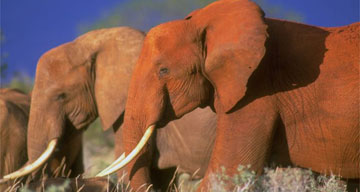
It turns out that elephants are red. At least they are at this time of year in southern Kenya's Tsavo ecosystem, when they are coloured a rich terracotta from the brilliantly henna-coloured mud they wallow in. They were waiting for our group of seven Earthwatch volunteers when we arrived at the wildlife lodge, our home for this 10-day project. Just beyond the veranda was the edge of the wildlife park, marked by an electric fence, and right there, no more than 25 feet away, was a waterhole and 15 glowing-red elephants drinking, showering and grazing on the grass around it. It might have been staged (perhaps it was, there were dark rumours of bananas scattered at night to attract the wildlife to the waterhole), but it was thrilling. None of us, from the UK, the US and Europe, was so familiar with wild animals just doing what they do right in front of us that we didn't gasp at the sight. A glorious gift after the six-hour road journey from Nairobi to Tsavo.
Two things had been troubling me. One was tourism and the effects it has on host countries. The other was how humans relate to and think about animals: in particular how we anthropomorphise them and read their behaviour as if they were us with all the thoughts and wishes but without the language.
I discovered the Earthwatch organisation neatly covered both concerns. Unlike the kind of eco-tourism offered by profit-making businesses, Earthwatch is a registered charity which offers individuals the chance, for a payment equivalent to the cost of an exotic holiday, to help fund and assist scientists with research projects all over the world. When you sign up with Earthwatch you are not a holiday-maker, or a paying customer, but a 'volunteer'; you've come to work and be of use to the project you choose. You may not have a PhD in zoology but you can look, count, and fill in vital data sheets - the kind of labour-intensive work that takes years for someone to do on their own. So here was an opportunity to watch people watching animals (as well as to watch them myself) and to sample a way of travelling that perhaps didn't involve being a tourist.
Their expedition guide has a question on the first page: 'Where do you want to go to make a difference?' followed by more than 130 answers. I could have studied Malaysian bats, Sri Lankan temple monkeys, Madagascan lemurs, koala ecology, Costa Rican sea turtles, Britain's basking sharks or the meerkats of the Kalahari. There were two limiting factors: I've got a foot problem and I am indolence personified. Elephants were the perfect answer. Not that they don't range far and move surprisingly fast, but the rules of the Tsavo Wildlife Park, and the common-sense requirement for staying alive in the bush, meant that all the surveying had to be done from a jeep.
People don't exactly identify with elephants as we do with meerkats; but they are indisputably large, and size is important in the human hierarchy of beloved animals. Very big and quite small are good; the very small (insects and bacteria) are generally excluded from the lovability list. People, of course, unless they are small children (ideally who speak another language), are also not very high on the adorability scale. The six-hour journey south by jeep from Nairobi along the Mombasa road to Tsavo was a startling introduction to the grinding poverty that is not the desperate crises of death by starvation we see on our televisions, but the regular, daily existence of the majority of human beings.
We passed one shanty town after another, planted alongside the road. For 100 or 200 yards, shacks made of corrugated tin, bits of sacking and timber offcuts advertised themselves as hotels ('Invitation to Happiness'), butcheries (in the manner of Sweeney Todd, usually attached to the hotels), general stores ('Strongest, longest, most lasting barbed wire available here'), bars ('Honeymoon Pub and Restaurant', 'Lifestyle Bar', 'Ghetto Heaven Bar'), medical centres and coffin makers ('Specialists in coffins of all sizes'). Potholes filled with fetid water after the first rains of the year were splashing pools for children, while the adults sat listlessly chatting or staring or lolling outside the shops that it was hard to imagine had much trade, apart from the drivers of the parked trucks lining the road, spewing diesel and making the bright Kenyan daylight grey-green with fumes.
It was a confrontation with a kind of impoverishment quite outside my experience. It felt unrelenting, unacceptable, but worse, it looked as if it was ordinary. When I asked Patrick Kodi, one of the Kenyan assistants on the project, where the people lived, he pointed to minimal earthen huts back in the bush. 'What you see by the road is the business centre,' he told me with a perfectly neutral expression.
As we drove slowly through the towns, children waved wildly at us and we waved back in a way I hoped was not regal but had to be under the circumstances, while the adults, if they noticed us at all, just glanced up for a moment and then looked away and got on with their own thoughts and conversations, knowing that we were not likely customers. Of course we were just passing through. I wasn't at all sure then that paying to collect data for a scientific study prevented me from being a first-worlder gawping safely from my expensive vehicle at the real world and throwing it a few quid I could easily afford to salve my conscience: a tourist, in other words.
But we were there to work. Dr Barbara McKnight, originally from Colorado, but now firmly Kenyan, started the training as soon as we had settled in our rooms. Sixteen years of being in Tsavo (two rooms in the bush and no electricity or plumbing), living, breathing and, for all I know, dreaming elephants have had their effect on her pronouns. 'When you observe elephants, one person needs to be looking in the other direction. Someone might be coming up behind.' It takes a moment for us novices to understand that the someone might be an elephant. It becomes increasingly clear that elephants people her world, and that people are generally what get in the way of her study of her chosen species. She was a delight. Single-minded, obsessed, passionate about elephants, but, once she had decided that we were going to be serious and useful assistants, she was in addition witty, considerate and good company. I whisper that last sentence. 'What are you gonna write about me?' she snarled when I was chatting politics or possibly frocks with my fellow volunteers, instead of silently, intently, monitoring the landscape. 'That you're a harridan, terrifying, a totalitarian monster who had us all cowering and weeping in the back of the jeep.' 'Good,' she beamed, entirely satisfied. 'Now stop talking and look for elephants.'
We had lessons in sexing elephants (occasionally extremely obvious but not always), understanding what kind of social groupings we were seeing, how to spot a calf under a year old, how to identify individuals by the holes or notches in their ears, to recognise bulls with massively raised testosterone levels during their period of 'musth' (weeping glands on its face, semen seeping down its hind legs, each ear flapping alternately instead of together - not unlike a Saturday night in any British town centre), and when to spot that it's time to get the hell out of the way - if he's trumpeting and running at you, it's getting a bit late.
In addition, we were to count and identify any other wildlife: giraffes, hippos, zebras, buffalos, gazelles, gerenuks and, my personal favourite, dik diks. Tsavo was a trophy-hunting game park before it was a wildlife park, and after the killing for fun was stopped, poaching for ivory and bushmeat was rife. Of the estimated minimum of 35,000 elephants in 1969 only 10,397 were counted in 2005. There is currently conflict between the human population, who are farming or keeping livestock, and the elephants who roam their traditional territories which now includes people's subsistence crops. The point of the Earthwatch survey to be conducted by teams of volunteers over several seasons is to understand the movements of the elephants in the area, to establish safe pathways and help to protect both the local communities and the elephants. Getting this clear gave us the sense that sitting all day long in a slow-moving jeep, on the lookout, counting, noting GPS coordinates and even seeing no wildlife at all in some places on some days, had a point to it and was to be done seriously. Apart, of course, from those times when Miss was distracted by her mapwork, and we became indistinguishable from a bunch of chattering schoolkids.
Our days began with a group breakfast at 6.30am, and we spent up to 10 hours in the field, jeep-bound with packed lunches. Bush-breaks for a pee were allowed only when we came across an acceptably safe arrangement of shrubbery. 'Make a noise, sing or something while you're at it,' we were advised.
A golden haze began to gather about the prospect of our one day off in the lodge, with its two swimming pools and a masseuse. But looking with a purpose is, like any intense activity, a powerful experience. Instead of speeding along the trail of the wildlife park taking holiday snaps and passing on rapidly to the next entertaining spectacle, we moved at a glacially slow pace, and once we spotted elephants we stopped, peered through our binoculars, whispered to each other trying to assess the composition and gender of the group and then waited and watched, sometimes for half an hour or more, to see what the elephants would do, to wait for them to cross the track, to finish eating inches from our window, to see if we could identify any known individuals and add them to the database. Just, really, to watch these extraordinary graceful, delicate creatures getting on with their lives. More of an elephant contemplation than a safari, and certainly, everyone agreed, much more gratifying.
Earthwatch uses some of its money to train local people. As well as Patrick, there was the preternaturally calm and knowledgeable Samuel Chege and passionate animal watcher Benedict Ndambuki, both working as Barbara's assistants, driving and helping us to identify elephants and know our lesser kudus from our Grant's gazelles. Benedict, 26, had grown up just outside Nairobi, but, interested though he was as a boy, he'd never been able to observe wildlife. I didn't understand why. 'Because it is in wildlife parks and I couldn't afford the entrance fees.' Another strange result of the power of tourism.
And anthropomorphism? The barely stifled cries of 'Oh look, a tiny baby, adorable, oh sweet, so cute...' echoed around the bush, to Barbara's disapproval, each time we saw a very young calf. Odd really when the smallest, month-old, infant elephant we saw was probably 20 times the size of any newborn human. But since the smallest elephants have no control over their trunks which wobble and droop about hilariously, and they tease their older siblings unmercifully, even the most hard-headed of us had to admit that they were in fact cute, adorable and sweet, even if it was acknowledged, by me, with gritted teeth.
At one waterhole a young male elephant of 10 or so was having a good time in the water, whacking it with his trunk and stomping the mud. So good a time that its two siblings aged about seven and three tried to join in. He wasn't sharing: he trumpeted threateningly, got out of the waterhole and chased them away. The littlest one disappeared and in a few moments returned (I swear, looking sneaky), walking behind its mother who marched purposefully down to the waterhole, bellowed at her oldest son, butted him out with her massive head, and gave him a final, serious wallop with her trunk.
The other two immediately jumped in while their mother stood guard. The 10-year-old stood behind a bush, concentratedly pulling up blades of grass with its trunk, pretending he wasn't in disgrace and standing in the corner. And no matter how much I want to remember Wittgenstein's vital statement that 'If a lion could talk, we would not understand him,' it was impossible not to see this episode in precisely the human familial way I have narrated it.
'Can we possibly know what an elephant thinks?' I asked Barbara when she commented on another interaction between two elephants in the language of human wishes and emotions. 'Of course not,' she answered, a serious and committed scientist. 'But how can we know or look at anything without bringing in our own experience? We have to interpret.' Our inescapable empathy can make us foolish and sentimental and sometimes wrongheaded about animals, perhaps to their detriment, but it can't be any other way. We only have our own eyes to look through.
My close-up experience of watching elephants with Barbara, Chege, Patrick and Benedict was one of the most valuable travelling experiences I've ever had. But there was more than that. It was suggested that future volunteers might fly to Mombasa rather than Nairobi, so that the drive to Tsavo would be shorter. Yet that six-hour journey along a Kenyan road on my way to a wildlife park was a crucial confrontation with a reality of the place in which I had put myself. I would not have wanted to miss it. However benign, fascinating, or even actively useful studying elephants may be, the human desolation on the road to Tsavo still burns on my eyelids.
Way to go
Places on Earthwatch's Elephants of Tsavo Expedition cost £1,550. This includes accommodation, food and all travel within Kenya, but not flights to Nairobi. Earthwatch is a non-profit organisation, and the fee part-funds the project. There are 10 volunteers on each trip, and usually one trip per month from May to November. For dates, and details of the numerous other expeditions, contact Earthwatch; (01865 318831).
More worthy ways to get close to nature
Sea turtles
Rescue sea turtles at a hatchery in Punta
Banco on the Pacific coast of Costa Rica
with Volunteer Adventures; (0800 028
8051). You'll patrol beaches at night, tagging and
measuring turtles and collecting eggs so
they can hatch in safety, away from poachers
and the potential damage of tourism. A
two-week project costs £589 per person,
excluding flights.
Big cats
Search for jaguars and
pumas in endangered
parts of Brazil's rainforest.
Participants walk along
jungle paths looking for
tracks and evidence of
the animals, and interview
local people about them.
Accommodation is in dome
tents. The project is booked through Responsibletravel; (0870 005 2836) from £1,150pp for 13
days, excluding flights.
Zebras and Rhinos
Monitor the impact of changes in climate and
the environment on zebras, giraffes, rhinos
and 12 other herbivores on a research trip
to the savannahs of the Hluhluwe-Imfolozi
National Park, South Africa. You'll work on
an ongoing 30-year-old research project,
spotting and recording
the animals' herd size
and location. A 16-day
trip is £1,295pp with
<a href="http://www.earth"
watch.org">Earthwatch; (01865
318831), excluding flights.
Seabirds
Christmas Island in the Indian
Ocean is hosting its first 'Bird Week'
between 31 August-7 September. Birdwatchers,
photographers and artists are
invited to join the island's wildlife experts
to track and mark seabirds including three
species of booby and frigate birds. It costs
from £799pp including flights from Singapore
to Christmas Island, with Wild Wings; (0117 965 8333).
Monkeys
At a wildlife sanctuary in southern
Thailand, 160km from Bangkok, gibbons,
monkeys, tigers and other cats that were
previously kept as pets or tourist attractions,
but were neglected, are now cared
for in enclosures and on islands. Volunteers
feed them, do maintenance work,
clean, and deal with behavioural problems .
Three-week projects cost £380pp, through
Ecovolunteerexcluding flights.
· Jenny Diski's latest book, On Trying to Keep Still, is published by Little, Brown. To order a copy at the discounted price of £14.99 with free UK p&p go to observer.co.uk/bookshop or call 0870 836 0885
