
Umbria - the green heart of Italy, or so the tourist pamphlet said. And that was all I knew: that it was somewhere right in the middle of the country, that I kept confusing it with the neighbouring region of Tuscany, and that it was, apparently, the "green heart of Italy".
One reason why Umbria is not as well known to holidaymakers as its neighbour, Tuscany, is that it doesn't have a major city. When British holidaymakers think of Italy, it's often in terms of cities and the countryside which surrounds them. You might use Bologna as a base to explore the north coast, or you might stay far away from it all in the Tuscan hills but travel to the bigger towns of Florence and Pisa. Rome, of course, is a popular city-break destination all by itself.
While Umbria has many small and perfectly formed towns, they don't necessarily spring to the British mind as destinations in their own right. But they should. Tiny Medieval towns, with the obligatory dozens of churches, cling to the sides of rolling hills, or perch perilously atop them, while rich countryside spreads out greenly at their feet.
A history of violence
The official line might be that it's "the new Tuscany", though it's not the "new" that will draw you to Umbria, but the old. Although a sense of calm pervades the region, you remain aware that you are enveloped in centuries of vibrant - often violent - history.
Umbrian architecture is testament to the many centuries during which the prevailing concern for most of Europe was sneaking up on neighbours and indiscriminately beating each other up. Towns aren't perched up on those hills for the nice views; they're there because from those hilltops you can see if anyone is starting on you. And then, with extensive medieval technology - possibly a rallying cry of 'FIIIIIIIIIIIIIIIIGHT!' - you can duff them up before you get duffed.
Or that's the theory. It didn't work in the case of Hannibal, of course. They saw him coming, they heard him coming (it was the elephants that gave it away), they planned, and yet, when push came to premeditated strategic onslaught, they were defeated. Legend has it that they fell on the shores of Lake Trasimeno, with most theories tracing the battle to a hollow by the relatively modern town of Tuomo.
As long as you don't arrive with a grudge and an elephant, you'll find the area around the lake is a perfect base for exploring or simply relaxing. Locals boast of how it has many moods. On calm days it is azure blue and mirror-like, at other times more wild and choppy like the sea. But always the water is clean and fresh, a source of the incredible fish dishes available in the area.
Lake Trasimeno
Several pretty little towns nestle on the shore, and you can reach them either by road or on the tiny ferry that pootles around the lake. The latter is well worth a day ticket, as it calls at some of the pretty little islands dotted around the shore.
In the gorgeous walled town of Castiglione de Lago we found a 12th-century fortress joined by secret passageway to a 16th-century palace, with frescoes and everything. A bargain for the 3 euro entry fee. The palace was built for a well-respected and much lauded mercenary soldier, and the busy walls and ceilings celebrating his life, times and feats were beautiful in that brown-nosing kind of way that frescoes always are. Even more stunning, to my mind, were the views from the fortress walls at sunset. The unusual five-sided structure sits on a promontory jutting into the lake, and the outlook is silently breathtaking. In the summer the building hosts concerts, and I can't imagine a more magical setting, although the walk from the palace to the fortress through a brick passageway eight-feet high and four-feet wide did rather tickle my claustrophobia bone.
Home of the kiss
Umbria is a vibrantly fertile place. In the valleys, in late spring, any slight breeze will raise a shower of fluffy white seed heads, swirling in the air like snow falling upwards. While in the main squares of hillside towns like Perugia, beautiful young people giggle and kiss and cast lustful glances at unobtainable demi-gods. It's difficult to walk through any town square at sunset without being pelted full force in the face with pheromones.
But then youthful displays are to be expected in Perugia, it being the home of Italian "Baci" or kisses. On a scorching morning, feeling like I might possibly melt, I toured the Perugina factory in the new part of town. It's the only place in the world to produce these perfect little bites of praline topped with a whole hazelnut and covered in dark chocolate. The history of Baci is to be found here, along with a model of the Guinness World Record-winning "Largest Baci Ever", an uncontested title, at 2.7m.
I toured the factory via a glass walkway suspended high above the floor. There were no Oompa Loompas - at least, not on the day I visited - but there were streams of melted chocolate and enough tiny pieces of heaven to have you dreaming candy dreams for weeks to follow. I think I may have put on 10 pounds from the smell alone. Or it may have been the sample basket on the way out, who knows.
Walking it off
Luckily, Umbria's rolling landscape provides a perfect way to walk off excess calories. Though it goes up and down a little too enthusiastically for my liking (not the world's greatest hiker, me) this is a boon rather than a defect, as otherwise the region wouldn't be nearly so pretty. In the hills around Lake Trasimeno, incredible views reward any over-strenuous trampage. And often when you walk through a town, the ground suddenly drops away in front of you, leaving you staring into another stunning valley.
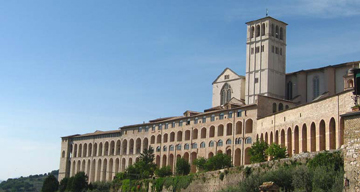
Nowhere did I notice this as much as in Assisi, where the land spreads out gloriously below, like a jewelled cloak. Though it draws many pilgrims to the Basilica di San Francesco, Assisi is one of the quietest towns it's possible to imagine. While thousands flock from church to church, silent passageways and tiny flights of steps draw you into the backstreets, where nothing can be heard but the sound of your own footsteps - until suddenly, turning a corner, you find yourself faced with one of those views again.
The Basilica di San Francesco is well worth seeing for the frescoes of the life of Saint Francis, painted by Giotto. They are located in the upper church, which was badly damaged during an earthquake in 1997. It was fully restored and opened to worshippers and tourists within two years, which just goes to show what happens when you have God on your side. Well, God and the Vatican, anyway.
The upper church is rich in detail. Standing at one end, your eyes gradually adjust to the wealth of colour and detail contained in the walls, ceilings and floors. And the sensation only deepens as you progress to the lower church, where the colours mingle with the candlelight.
In sharp contrast, the Basilica di Santa Chiara, whitewashed in preparation for redecoration many centuries ago but never actually repainted, is a much simpler, more affecting building. It's easy to sit in silence (fierce nuns roundly chastise any mumblers) and feel the peace of ages around you.
In the main square in Assisi, you will find the template from which the town's bricks were measured and the roof tiles moulded, all those centuries ago. That's the thing about walled cities, particularly those that have been continually inhabited for 900 years. While it's possible for the city to expand, things remain very much the same inside those walls. Apart from a few neon lights and a sprinking of glitter here and there ... this is Italy after all.
The "green heart of Italy", then, so they say. And it is. And not only is it a heart itself, but it has also taken mine. And I don't particularly want it back; I think it will be happy there.
WAY TO GO
Anna Pickard travelled to Italy with Inghams Lakes & Mountains (020 8780 4433) and British Airways staying at the 4-star Villa Paradiso in Passignano on Lake Trasimeno. A seven-night break with half board starts at £469pp, including Gatwick-Rome flights and transfers. Regional airport departures available at a supplement. Two-centre holidays are available including three nights in Rome.
