
Picture the perfect holiday. After a relaxing ride, you find yourself standing on a deserted beach before a sparkling sea. There's no sound, save the gentle whisper of palm leaves overhead. Cocktail in hand, you inhale and exhale, slowly. Life back home feels a long way off, and though it's only day one, you're well into holiday wind-down.
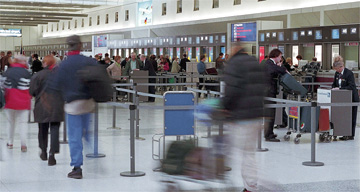
And now picture the reality. After a late night rummage for your passport, driving round in ever-decreasing circles at the airport car park, getting to Terminal 1 only to realise you should be at Terminal 2, you at last find yourself in the check-in queue. The family in front are arguing the toss about excess baggage, your kids are bickering and the Blackberry in your pocket keeps bleeping. As you pass through security, fiddling about with bags and belts and that damn Blackberry and the penknife you swear wasn't on your keyring this morning, you think you may have left the car unlocked, and did you remember to pack the factor 25?
If this scenario sounds familiar, take comfort from the fact that you're not alone. More of us are becoming hassled by our holiday experiences - so much so, that a recent survey by American Express revealed that 40% of British holidaymakers find the stress of travel unbearable, with the same number claiming a visit to the dentist is less stressful.
Count to 10 ...
Dr Aric Sigman, a Canadian psychologist with a 35-year history of travel to far-flung destinations, reckons economic equality is to blame. "Cheaper travel, affordable holidays and more cars on the road all mean we can take the holidays we want, but that also means there are more queues, more terminals at the airports, more traffic jams. The irony is that it now takes us longer to get from A to B."
Not only that, technology has conditioned us to expect instant gratification. "We are more time-poor," says Aric, "and anyone or anything that trespasses on our time is viewed as some kind of 'time bandit'. The difficulty is that travel is supposed to be time out, and we feel like we're paying for every second of it."
With frustration rocketing, and our expectations similarly on the rise, it's no wonder we're getting more impatient, or that tabloid headlines scream of road rage, trolley rage, air rage - even check-in rage.
"I used to be a card-carrying speedaholic," says Carl Honoré, author of In Praise of Slow and champion of the Slow Movement, a global group that demands a return to a more sensible - and enjoyable - pace of life. He argues that, presented with an alluring and affordable buffet of choice, we've become greedy. We speed up to cram in as much as possible. "We even want to slow down fast. People fly out for lunch in Barcelona just so that they can check a box and say they've 'done' Barcelona," says Carl. Apparently, the Germans have coined a word for our inability to relax beyond the confines of the office: Freizeitstresse, or "free time stress". "If society reaches a point when it even tries to relax fast, then we've lost the plot," says Carl.
Take a deep breath ...
Unsurprisingly, those on the front line - the airports and airlines - are taking action. "Passengers pack their brains in their suitcases," jokes Jacqui Neville, Manchester Airport's Product Development Manager, "and that's what makes things stressful."
Jacqui is overseeing an overhaul of the airport's visual environment, alongside a team of psychologists and ergonomists. "We realised that by bombarding people with too much information at the wrong time, we were adding to their stress. We've worked with retailers and stripped back advertising sites, so that the information passengers need at any point during their trip is more prominent."
Jacqui and her team have also introduced streamlined check-ins: passengers can check-in online at home, at automated "express check-in" pods inside the terminals or at traditional desks, reducing queues before frustration builds up. "It doesn't matter how much or how little someone has paid for their holiday, everyone has a greater sense of what they should be getting, and we just have to move with those times," says Jacqui.
First Choice is one of eight airlines that has signed up to Manchester Airport's self-service check-in scheme, and which itself is taking steps to get passengers to start their holiday before they reach their destination.
"We've introduced on-plane mood lighting that's in tune with your body clock," says Marie Wilson, Head of Long Haul Product Development. "Seats are air-filled and moulded to your body, and we've taken out a whole row of seats in all aircraft." With more leg room, four-course meals, individual TV screens and - best of all - air therapists on hand (easing aches and pains rather than offering in-flight counselling to stressed-out families, though the latter might not be a bad idea), First Choice has cottoned onto the fact that the more it reduces the stress of its time-poor, disorganised and demanding passengers, the better for all concerned.
Take advice ...
1. Give yourself more time. Pack early, gathering paperwork first (passports, e-tickets, emergency numbers) and check in online.
2. Sleep well. "You're far less able to cope with stress and what awaits you when you arrive if you haven't slept properly. Don't think you can catch up on sleep on the flight," warns Dr Aric Sigman.
3. Get smart. Check out the facilities on offer, and check your pocket plastic - American Express's Platinum Charge Card, for example, gets you free access into VIP lounges.
4. Turn off the technology. "If you take your mobile," says Aric, "remember that you control it. Decide when you're going to check it and only do it then.'
5. Daydream. If you live to work, view your holiday as an extended brainstorming session - often, the best ideas come when you're not thinking about work. "Even big corporations realise the need to slow down," says Carl Honoré. "A recent study by Hewlett Packard revealed that the constant barrage of information in the workplace caused people's IQ to drop by 10 points. Being always on isn't good for you."
6. Do less. "Get away from the museums," says Carl. "Prune your schedule."
7. Similarly, stay in one place. Avoid the temptation to check off the "must-see" sights of your destination, stay in a self-catering holiday home, and shop locally.
8. Carry less. Think hand luggage rather than excess baggage.
9. Consider a break in the UK. "The days of the seaside and the knotted hanky have much to recommend them," reckons Aric.
10. Ditch your watch.
And relax.
And if none of that works, consider a trip to Stradbroke Island, off the coast of Brisbane, which has declared itself the world's very first "Slow Island". Taking inspiration from the Slow Movement, islanders are attempting to preserve Stradbroke's natural beauty and delicate ecosystem. The initiative is headed up by a group of self-styled barefoot professionals, also known as the Stradbroke Slow Food Convivium. Co-founders Jackie Cooper and Haig Beck reckon this means Stradbroke offers "total relaxtion". "There's no retail therapy, fast food or cinema. This bewilders some visitors, which is hilarious because there is so much to do and see. At present we are watching the annual whale migration up the coast in slow-motion widescreen."
So, all together now: deep breath ... and ... relax.
Useful links
· Information on Stradbroke Island: slowislands.com and Tourism Queensland
· In Praise of Slow, by Carl Honoré is published by Orion, (£7.99): inpraiseofslow.com
· Manchester Airport: manchesterairport.co.uk
· First Choice: firstchoice.co.uk
