
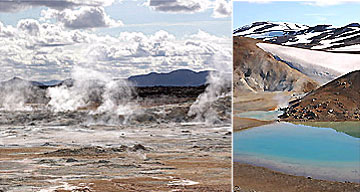
"The Earth's crust is very thin here," says Helmut, our guide, pointing at the ground beneath our feet. We gasp and step back, almost into the pit of another boiling mud pot. "Please. Do not fall in," he smiles, before hurrying off like an Icelandic Willy Wonka showing us the marvels of his geothermal factory.
In northern Iceland's Námafjall Hverir, the Earth hisses, spits and teases us. Like a will-o'-the-wisp, a swirling sulphur column draws a gaggle of visitors, only to change direction and shroud them in a putrid-smelling fog, while the squelching chorus of the hot springs stops at the exact moment a camera is pointed at it. Nearby, on a crater called Víti (meaning Hell), the silvery clear pools look inviting, but the water fizzes at skin-blistering temperatures.
And the reason for this awe-inspiring trickery? Iceland sits on the mid-Atlantic ridge, where, for millions of years, the Eurasian and American tectonic plates have been slowly drifting apart, allowing magma to well upwards towards the surface. Still moving apart at the astonishing rate of a centimetre a year, Iceland is actually growing in size and forming new land through volcanic eruptions, some as recent as 1984. At Grjótagjá the country is literally torn in two. Here you can stand astride two continents separated by a crevasse sometimes only a metre wide. But, as Helmut is quick to point out, if you slip "you could fall into the centre of the Earth".
Here lies Iceland's strange paradox. Walking through its lunar landscape of craters and jagged lava fields you feel like you've stepped back into a pre-Jurassic age, but on a geological timescale the country is relatively young. If the Earth were 24 hours old, Iceland's existence would be measured in mere seconds. In Reykjahlio, a tiny church looks like it has survived a shower of meteors - shards of black volcanic rock jut out like kryptonite in the surrounding fields - but, I wonder, did the lava or the church come first?
Whales and gales
Just two hours by air from England, the island's spectacular landscape is just one of its draws - for many, Iceland's biggest wonders are in the sea. The small town of Húsavík - home to 2,500 inhabitants, a church and a phallus museum - lies on a nourishing bay where 12 different species of whale come to feed during the summer months. Whale-watching was pioneered in Iceland two decades ago as an alternative to commercial whaling; sadly, the latter resumed - for scientific research - in 2003, but no whales are hunted in the waters of Skjálfandi Bay. Here, tour operators boast 95% sighting rates of minke whales, as well as some of the largest mammals on the planet, the fin and blue whales.
It's a beautiful, icy-clear day and we're hopeful of spotting the giant creatures. As we leave the colourful harbour our pocket-sized, wooden fishing boat becomes a mere speck in the shadow of the Viknarfjlöl mountains. Perhaps it's the sudden cold or the looming stillness of the water that makes 50 excited boat-trippers gaze quietly into the ocean. Nor is it long before the skipper cries "humpback, 12 o'clock", and the low, stubby dorsal fin of the 30-tonne whale becomes visible in the distance.
For three hours, we make hurried dashes across the deck as, unusually, half a dozen humpbacks the size of double-deckers surface at unpredictable angles around the boat. Although we don't see their renowned breaching (jumping) displays, they put on an impressive performance of slow dives, ending with a wave of their black and white flukes (tails), each as unique as a human fingerprint. Hot chocolate and pastries take the edge off the eye-watering chill, but it's a good idea to pack hats and gloves, however glorious it feels on land.
The open road
At Lake Mývatn, where flat-topped pseudo-craters line the horizon like giant Yorkshire puddings, we stop to watch some handsome harlequin ducks, but are chased away by the lake's infamous midges. I expect the sun to be dipping behind the shallow waters by now, but the clement summer evening is still disorientatingly bright. It is 11pm but, as Iceland lies just south of the Arctic Circle, it continues to feel like 4 o'clock in the afternoon. We're exhausted but the phenomenon has made us oddly excited: like children before Christmas, we take it in turns to get up from bed and peer outside. Another balmy day greets us at breakfast but, from all the grumbling, we can only deduce that night never actually fell.
Beautiful areas are not in short supply in this northern area of Iceland: we discover giants turned to stone at Dimmuborgir, waterfalls made by angry gods at Godafoss, rainbow-littered valleys and three million-year-old fjords. Our group tour takes in table mountains to rival South Africa and fairytale turf houses worthy of Tolkien. And all the while we see not one motorway.
Nor do we see any forest; as we drive through miles of ashy desert we learn about Iceland's battle with wind erosion, which has reduced 50% of the country to barren wasteland. Then we are treated to incongruous tales of monogamous puffins and hardy settlers with endearing names and stubborn natures.
Occasionally, I just want to turn down a road that looks like it might lead to the edge of the world (not necessarily advisable) or take in the spectacular views at my own pace. If this sounds more appealing, then hire a car and the empty roads are all yours. You don't even need a plan - Iceland's 1,500km coastal highway provides a ready-made itinerary around the island and there is no need for a four-wheel drive unless you are venturing into the interior. Nervy drivers be warned, though: hooting does not coax soporific sheep from the warm tarmac, and Iceland's notoriously unpredictable weather can make some of the narrow, gravel roads difficult to navigate.
Tranquillity
After the sunlit days - and nights - of the north, landing in unrelenting rain after the short flight from Akureyri is more Gatwick than Reykjavik. We pick up the car and head north to Iceland's western Snæfellsnes peninsula and the beautifully understated and informal Hotel Búdir. Built in the early 19th century but newly - and quirkily - restored, it is an impossibly relaxing place, suffused with the smell of freshly ground coffee and the muted tones of a country house hotel.
Book in hand, I take to the sofa in the glass-fronted lounge, the fierce Atlantic wind mingling with the sound of Johnny Cash. I am absolutely mesmerised: plucky ducks surf the current and mist rises like chimney smoke from the craggy black lava, where, legend has it, numerous leprechauns live. The hotel's only neighbour is a black timber church built in 1703 balanced atop a windswept hill like a scene from a gothic novel. The mighty Snæfellsjökull, a volcano capped by a glacier and the inspiration for Jules Verne's Journey to the Centre of the Earth, towers in the distance; the view is dramatic, bleak and wonderful.
"When is the weather best here?" I enquire.
"June," comes the matter-of-fact reply. This is June. There's only one thing to do: head out.
We return - soaked - to a comforting seafood broth, followed by blackened cod in soya with sake and beetroot barley, and delicate berry skyr cake (a traditional Icelandic fresh cheesecake).
A string of snow-dusted mountains separates the harbour towns of the peninsula's north coast from the rain-beaten south, where gale-force winds blow away our plan to go hiking. We drive to Helgafell (Holy Mountain), where Gudrún Ósvifsdóttir, the imperious heroine of the Laxdaela Saga who lies buried here, enigmatically revealed which of her four husbands she loved most. Then we head to Ólafsvík, another hotspot for whale-watching trips in the summer months.
By now the wind is making furrows in the velvety hills, rocking the car and making conversation in the open-air impossible. We ask whether the boat is heading out into the choppy waters. "Of course," comes the blithe reply. It seems that in this part of the world the weather is just a state of mind. The boat trip, however, requires a Herculean spirit that seems to be uniquely Icelandic.
In the otherworldly Blue Lagoon we soothe our weather-beaten limbs and seasick bodies in the milky white water. Half an hour outside Reykjavik, this popular outdoor bathing spot is actually an artificial spa, filled with water from the geothermal Svartsengi power station nearby. Its billowing steam can be seen across the lava fields beckoning holidaymakers on the way to Keflavík airport for a pre-departure dip. We coat our faces with the sugar-fine silt, said to be good for the skin, and bob along like Arctic monkeys. Utterly content in the soup-warm pool, I can understand why a recent survey found Icelanders, for all their want of sunshine, to be the happiest people in the world.
Way to go
Oginia's four-night 'Whales, Wings and Wonders' trip was organised by Discover the World. Also available is their nine-night 'Whale Watching Safari', which costs from £998 per person based on four sharing and including return Icelandair flights from Heathrow, Manchester or Glasgow. Departures are from May to September each year. Various whale-watching day-trips are also available and all itineraries can be tailored. For enquiries, call 01737 214 214 and for a copy of Discover the World's brochure, call 01737 218801 or visit discover-the-world.co.uk.
