
It's Friday afternoon on a summer beach in Spain, and for half a mile in each direction holidaymakers are soaking up the sun. Children are building sandcastles, families are picnicking, and an old man on a motorised tricycle is hawking ice-cream to anyone who'll buy. Only a low orange fence, placed along the length of the beach just yards from the water's edge, hints at the spectacle to come.
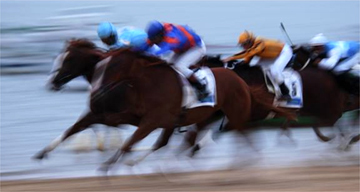
Suddenly, at the far end of the beach, a bell rings and the sunseekers rise to their feet as one. A wayward child is dragged away from the shore and back over the fence; seconds later, a group of racehorses appears from round a headland. The crowd surges forward as the horses approach in a blur of colour, the sound of hooves in the water drowned out by shouting. The instant the last animal has passed, spectators leap over the fence to see who's in front. Further up the beach, a cry goes up from a grandstand. The news is relayed back: "cuatro, cuatro": horse number four has won by three lengths.
This is race day at Sanlúcar de Barrameda, home of the Carreras de Caballos de Sanlúcar, one of the oldest and strangest flat race meetings in the world.
Surf 'n' turf
For most of the year, Sanlúcar, situated at the Guadalquivir river delta not far from Jerez, is a windswept sherry-producing town with whitewashed summerhouses and broad, palm-lined avenues. People come here to eat freshly landed Atlantic fish, drink the local manzanilla sherry, and take tours of the Cota Doñana, one of Europe's most important wetland natural parks.
But during the Carreras, it's party time for Sanlúcar. Beaches, cafes and tapas bars are filled with local horsey folk and holidaymakers from Seville, an hour's drive upriver. At one end of the beach, it's a family picnic day out; up at the enclosure by the finishing line, it's a small-scale Ascot-on-Sea.
If you want to place a bet on the races, the trick is to look down. All along the sand, child bookmakers set up tiny stalls offering a 1 maximum bet - learning valuable lessons in how to lighten the wallets of English tourists fresh off the plane. In an effort to stop the event becoming too elitist, there is a prize for the most creatively decked-out stall.
The English taste for sherry is the cause of the region's prosperity. England has been the biggest international sherry market for generations - though the manzanilla produced in Sanlúcar is famous as the signature drink of Seville. A kind of fino, or dry sherry, manzanilla tastes faintly of Sanlúcar's salty sea air, and is a natural partner for tapas of all kinds.
Javier Hidalgo, riding as an amateur jockey in the opening race of the meeting, is seventh in a family line of sherry producers. He tells me how the first races were organised by bodega owners in 1845, in the days when sherry barrels were exported by boat from Sanlúcar for bottling in Bristol. Both his father and grandfather also took part in the races.
Javier reckons wet sand is the "best turf there is" for racing horses. "I just love it," he says. "When you dismount after a race, you only think of getting back on and doing it again. It's like a drug."
But he warns me not to bet on him. "If you look for the oldest jockey in the field, that's me," he says. "I don't care if I come last - I do it for the sport." Impressed by his recent form, I disregard the advice and watch him come a respectable fourth - of four.
A mug's gain
Like most of the local vinocracy inside the grandstand enclosure, Javier wouldn't look out of place in west London. Many of the men are wearing open-necked shirts, chinos, and deck shoes; a sign warns that a cordoned-off area is for the exclusive use of the local jockey club. But, overall, there is little of the pretension you might expect at a similar event back home.
As the shadows lengthen and the final race approaches, the anticipation builds. At the parade ring, I confidently predict that any horse bar number 10 will win since, despite its favourable handicap, it looks smaller and less feisty than the rest. Following a family tradition that has led to an Alden backing every Grand National winner since Aldaniti, I bet on about a third of the rest of the field. A few minutes later, I watch in disbelief as number 10 romps home by several lengths.
But that setback is soon forgotten as, only minutes after the end of the last race, the sun starts to set over the Atlantic. Sitting up on the grandstand, a few of us watch as the beach empties, then reddens, and finally slips into darkness as a tractor pulls the stalls along the sand. In town, the tapas bars are starting to fill. Street hawkers are selling necklaces for a few euros a go; in the main square, children are running round the fountain as parents keep an idle watch. In Bar Juanito's on San Roque square, people sit at outside tables and eat coquinas - tiny clams soaked in oil and onions - by clutching the shells and sucking out the flesh.
Back at the enclosure, a sherry party is in full swing. Each of around 40 bodegas has opened up a stall offering samples of local produce - including Javier's "La Gitana" manzanilla. As midnight approaches, people are caught between making conversation and flitting from drink to drink. Catching up with Javier, I confess to having had a memorable but luckless day. He has no sympathy. "I told you not to bet on me," he smiles.
Way to go
Fly to Seville (Iberia, Ryanair), Jerez (Ryanair) or Gibraltar (GB Airways). By train, take the Eurostar to Paris and an overnight Trenotel to Madrid, then connect to Jerez. Chris stayed as a guest of the Sherry Institute of Spain at the Hotel Jandalos, Jerez, a converted former bodega with doubles from 93 to 250 excluding tax and breakfast. In Sanlúcar, the restored Hospedería Duques de Medina Sidonia (+34 956 360161) has fine gardens and views of the town; doubles are 65 to 105.
Il Palio, Siena, Italy
Perhaps the world's most famous horse race sees ten jockeys - each representing a contrada, or district, of Siena - sprinting round the Piazza del Campo in the centre of the city. Head to the winning contrada after the race for a street party to remember. Held on July 2 and August 16 each year.
Entenrennen "duck race", Tübingen, Germany
A race for 7,000 ducks - each one of them yellow and plastic. Buy your ticket before the race and watch your duck bob to victory or obscurity. Held in October.
Cheese Rolling, Gloucestershire, UK
More "cheese-following" than "cheese-rolling": a Gloucester cheese is hurled down a steep hill, and groups of men and women tear after it in turn. The person who gets to the bottom first wins the cheese. Every May.
Wife Carrying, Sonkajärvi, Finland
In this summer race, male competitors race to carry wives along a 250m course - including dry obstacles and one-metre deep water. Drop your wife and incur a 15-second penalty; finish first, and win your weight in beer. Happily for singletons, competitors are allowed to carry someone else's wife.
"Viking run" ice-skating marathon, Stockholm, Sweden
Held every February, this 50-mile race sees thousands of competitors skate from Uppsala to Stockholm, using poles and specially converted cross-country skates.
