John Gielgud, Peter Ustinov, Lauren Bacall ... The film adaptation of Agatha Christie's Appointment with Death certain had an impressive cast, but for me there was just one star: Petra. Even on our early-90s TV set, the ancient Jordanian city that provided a backdrop to the action looked stunning. In real life, as I finally discovered this autumn, it is truly magical.
Carved out of pink sandstone hills in the first century BC, Petra has proved a draw for tourists since it was first "discovered" in the 19th century. But the city, regarded by some as the eighth wonder of the world, has been quiet in recent months. Visitor numbers for September were just half those for the previous year, a statistic the Jordanian tourist board blames on the war in nearby Lebanon. And when we visited in October there were only a handful of other tourists around.
That was a shame because mid-autumn turned out to be the perfect time of year to visit the city without either melting (temperatures can reach 40 degrees in July) or shivering (winter averages are in the mid-teens). The trek down through the siq - a natural gorge which is the only route into Petra - took about 30 minutes and would have been hard work had it been any hotter.
Ancient wonder
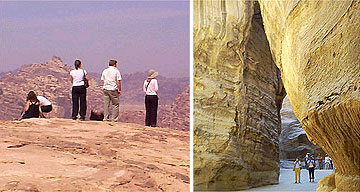
You can also opt to enter Petra by horse, donkey, camel or cart, but walking allows you to appreciate how beautiful the place would be even if the ancient Nabateans hadn't chosen to create a city there. We were constantly confronted by views that were even better than the previous ones, as the light shone down from the top of the gorge and highlighted different colours and contours in the rock.
Most spectacular of all was the first glimpse of the Treasury - one of the grandest buildings in the town. Hewn out of a solid piece of rock, this famous Petra site is thought to have been a place of ritual, where bodies were washed before burial. I had seen pictures of it before, of course, but nothing prepared me for the sheer scale of it (over 40 metres high and 30 metres wide), or for the way its sandstone façade glowed in the sunlight.
From the Treasury we walked down into the heart of the city, past more grand facades thought to have housed tombs. Some people take days to explore Petra - it spreads out for miles and to make it to sites like the Monastery you need to allow several hours. Sadly, our guide was keen to get us back on the bus, so we were forced to choose just one direction to explore.
We chose to go up to the Higher Place of Sacrifice. After a 30-minute climb, most of it up steps, you walk out onto a long platform with an altar and a basin. From here there are stunning views of the city and the mountains beyond, but there is also a strange eeriness, even on a sunny day. No one knows whether this was a place for human as well as animal sacrifice, but it is easy to imagine ancient and terrifying rituals taking place here. No wonder it made the perfect backdrop for a murder mystery.
Petra boasts six of the Rough Guide's 32 things not to miss in Jordan, and although our whistlestop tour meant we missed some of them, the two-and-a-half hour drive from our hotel on the edge of the Dead Sea was thoroughly worthwhile. However, there are plenty of places to stay in the nearby town of Wadi Musa, which would have provided a good base for a longer visit.
Peace by piece
Still, the new Kempinski Ishtar was well located for visiting some of Jordan's other great sights. Nearby was Mount Nebo, where Moses first looked out on the promised land and where he is thought to have died. This is regarded as one of the most holy sites in Jordan, whose mostly Muslim population consider Moses an important prophet.
From the lowest point in the world (400 metres below sea level), it took the bus half an hour to climb up the side of the mountain, taking us through a barren and beautiful landscape dotted with Bedouin moving their flocks uphill. At the top, we looked down on the world as Moses might have seen it, only a few modern additions breaking up the undulating white desert sparsely populated with olive trees.
This area is famous for its mosaics and a church on top of the mountain, rebuilt and renovated over the years, contains some from the sixth century. But you need to go 10km down the road, to the town of Madaba, if you want to see the most important and impressive example. Here, in a Greek Orthodox Church, is the oldest known map of the Middle East, originally measuring over 15x6 metres and made up of 2m tiny stones.
Although much of the mosaic is now missing you can pick out Jerusalem with its six gates, Gaza and the Nile delta. You can also see the Dead Sea, where a boat is depicted carrying salt, and fish are shown swimming back upstream to waters where they can live.
Taking the waters
The place where Jesus is believed to have been baptised is also shown and, using a more modern map, we discovered that the spot, 8km north of the Dead Sea and 7km from Jericho, was just 20 minutes' drive from the hotel. Hence, a small group of us decided to book a car to take us to there, so that we could see for ourselves the dry basin joined by a tributary to the River Jordan matching the accounts of ancient pilgrims.
The site also contains the remains of a church with elaborate mosaics and marble decoration suggesting it was once a very important place. However, the site was not officially identified as the biblical Bethany-beyond-the-Jordan until 2000, having lain within a military zone for almost 50 years. And it was only after the Pope's announcement that modern-day pilgrims began to visit.
All of this and more we learned from our excellent guide as he took us around the site and down to the river. Although its name derives from the Aramaic word 'yardeen', meaning fast-flowing, the Jordan has lost its grandeur these days and, as we reach its bank, all we see is a narrow, almost-still, strip of greenish water. Yet that is enough to bring dense greenery to the surrounding area, making for a vista that is somewhat at odds with the rest of the site, where the earth looks even more parched than the rest of the country. Those striking landscapes, combined with the Baptism Site's historical and biblical significance, made our trip there a real highlight of my stay in Jordan.
Another memorable moment occurred right on our doorstep. Nothing can prepare you for your first dip in the Dead Sea, which is around ten times saltier than normal seawater. It seems to coat you as you step in, as though you're entering a salty oil slick. Every nick and cut begins to sting and you have to be really careful not to get water in your eyes or mouth. Even though you know you can't sink, you feel slightly vulnerable - it is almost impossible to swim, and getting yourself back to shore involves a kind of rowing movement with your arms.
As well as salt, the sea contains a unique brand of mud, which the hotel collected in a pot for guests to slap on as they wished. You may feel like a swamp thing as you stand covered head-to-toe in grey sludge, waiting for it to dry before getting back in the sea, but everyone's at it and it makes your skin feel great. This may be the lowest place on Earth, but I, for one, left on a considerable high.
Way to go
Hilary Osborne travelled courtesy of British Airways franchise partner BMED and the Kempinski Ishtar Dead Sea Hotel.
Doubles at the Kempinski Ishtar (+962 5356 8888) cost from £125 on weeknights and £140 at weekends per room per night on a B&B basis. Accommodation rates are subject to a 10% service charge and 7% government taxes.
BMED flies daily to Amman from Heathrow. For further information or to book a trip, visit ba.com or call 0870 850 9 850.
