
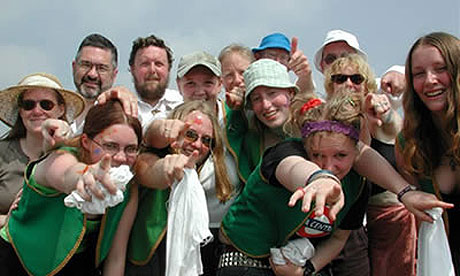
A combination of the words "folk music" and "camping" is enough to send a chill through the heart of most Britons, but not so Liz and Robin Middleton, 35 and 37, from Hayward's Heath in Sussex.
A primary schoolteacher and city asset manager respectively, the couple are two of the unlikely attendees of Folk Camp, a series of summer festivals for all ages based around music, performance and dance. It's where the pair met and fell in love. Now married, they returned to Folk Camp this year with five-week old son, Barnaby.
"When people hear the word 'folk' they think of weird men with beards and bells," Liz admits, "and between the combined associations of morris dancing, country and western and line-dancing, the appeal is sometimes difficult to get across …"
For all this, the couple have been die-hard attendees of the little-known holiday phenomenon since they were kids. First drawn to the camps for the music and the chance to hang out with other children, the couple explain that they keep on coming for Folk Camp's unbeatable sense of intimacy.
"After dinner we have a sing around where you might have a stunningly talented musician followed by a small child who will play their first piece in public, shaking with nerves ... and it's all appreciated," says Liz.
Image consultant Nancy Stevens, 40, from Milton Keynes, doesn't even like folk. Which is not a problem, she explains, as Folk Camp is about far more than just the music.
"My friends said, 'You're so high maintenance, how will you cope without your hair straighteners?' But I love it now. I come for the sense of community, which is what society has lost these days."
Conceived in the early 1960s as a holiday for those in pursuit of what they saw as England's lost cultural heritage, the Folk Camp phenomenon has quietly flourished, spawning 16 events a year in Britain, plus two in France.
A typical day begins at a businesslike 9am with (optional) workshops that range from singing to dance and craft. Occasionally they stretch to African drumming, yoga and even urban street dance, depending on the skills possessed by the volunteer workshop leaders. Others spend the day out walking in the countryside, napping or practicing their instruments.
Though newcomers are warmly welcomed, many of the 120-odd participants at each event have long Folk Camp histories, and share everything from memories to music sheets and homemade sloe gin. ("I can see why some people think we're a weird cult," Liz Middleton admits.)
Yet while as many as three generations of folk campers can be found on site, the festival is about far more than just wholesome family fun. Once the kids are safely tucked up in their sleeping bags, the adults break out the moonshine and let the good times roll. Forget nettle tea - this lot can drink Glastonbury under the table and still be up at nine for the clog-dancing workshop.
"The first night of this camp we were up 'til 3.30am - singing mostly, but also messing about," says grandmother Sue Malleson. "I worked my way through two-thirds of a bottle of Jamesons, and that was just from midnight."
Widely recognised as the Folk Camp matriarch, Sue has been a regular since first coming in the 1960s with her parents.
Folk campers "were quite evangelical about it" back in the early days, she says. Dressed in traditional garb (white blouses, felt skirts and boleros for the ladies, knee britches and waistcoats for the gents), busking and morris dancing were core to the experience.
Mercifully, 21st-century Folk Camp is a more low-key affair - the nearest thing to a costume is the occasional Aran sweater, and morris dancing is an end-of-the-evening thing for the old guard after the last of the Jamesons.
Dancing is by no means off the agenda, however, and the post-dinner sing-along is followed by a fullscale ho-down.
"There's a dance where you can really find out what people actually feel about each other," Sue reveals, "who hates who, who fancies who and so on. When someone can't stand another person, they really hold them at arm's length."
Molly Malleson, 12, from Cardiff, is already looking forward to next year's festival. "There's this place in one of the camps that we call mushroom village where all the teenagers put up their tents," she says. "I'm old enough to go there now!"
Meanwhile, Roisin Callaghan, 15, from Milton Keynes, is unfazed by what people think. "I admit some of my friends do think Folk Camp is weird, but some also think it's cool," she says. "I'll keep doing it though, because I've made lots of friends who I stay in touch with through emails."
Ironically, it is not a lack of support for their achingly unfashionable music scene that worries the older folk campers, but rather that an unexpected spike in popularity might endanger the camp's precious intimacy.
"If there were suddenly thousands of new people turning up every bank holiday, it would break that magic formula," says Brighton-based IT consultant Doug Jewartt, 31, who has been coming to Folk Camp since he was four.
"There are always just a few people who are new, and they get welcomed by the rest. I prefer Folk Camps to normal folk festivals because you tend to be a big fish in a small pond. Instead of just being a punter, you're part of making the weekend work. If you sit in your tent and are miserable that has an effect on everyone else – it's about taking part."
Getting there
Jon and Sarah went on a self-catering three-night camp, costing £42 per person. Folk Camps take place across England and vary from self-catered camping weekends to week long fully-catered camps and residential breaks. Vegetarian nut-allergies and other diets are catered for. For more information about Folk Camp, visit folkcamps.co.uk or call +44 (0) 208 12321 36.
