
Ideas for where to go for the summer can come from anywhere; the National Gallery is as good a place as any. Claude Monet's The Beach At Trouville was painted at the once hyper-fashionable Normandy resort, and grains of sand are famously mixed into the paint, testifying — along with the picture's boldness and immediacy — to the fact that Monet painted it en situation while in Trouville on his honeymoon.
In 1870, Trouville was the last word in smart; it has long been overtaken in chic by the glitzier, ritzier Deauville just next door, where there is a sleek film festival, and oodles of designer stores policed by tanned men and women who look as if they will step outside their premises and ask to see your credit card if you wish to keep on window-shopping for any length of time.
The gentleness and understated charm of Trouville-sur-Mer certainly seemed nicer to me. The town is often described as Nice to Deauville's Cannes. It is perhaps Torquay to Deauville's Brighton, or maybe Kate Middleton to Deauville's Kate Moss. The famous beach itself was evidently painted by Monet facing west, towards the casino — which, like so many such places of illicit pleasure on the French coasts, is not a sleazy little underground club but a grand, separate building.
Sadly, Monet's prospect has been marred by an ugly-looking property development. But the beach really is a wonderful expanse, a great sandy reach which extends miles uninterruptedly up the coast in the other direction, sometimes sparsely populated or even dreamily empty even on the sunniest days. In many ways, it is like an old-fashioned bucket-and-spade English seaside town, and in the 19th century it was credited with having imported to France the English fad for "sea-bathing". There are pony rides on the sand and at high summer actual donkey races, the courses des ânes.
The beach has other claims to fame, incidentally. It is where the young Gustave Flaubert fell in love in 1836, walking behind a beautiful married woman, Elisa Schlesinger, and gallantly picking up her cape which had fallen on to the sand. Marcel Proust stayed in one of the villas overlooking the beach, making it the model for La Raspelière in Remembrance Of Things Past, and stayed also in the Hotel Des Roches Noires, whose breezy glamour Monet also painted. That is now an apartment block of faded, muted grandeur.
Swimming in Trouville for me meant a long, purposeful march out into the surf even when the tide was in; a geographical peculiarity in the form of a long trough parallel to the shoreline means that the water gets deep and then suddenly, disconcertingly, shallow again, quite far out. It is probably dangerous, which is why a coast guard actually stands watchfully in the water with his trousers rolled up to his knees, arms folded, a walkie-talkie at the ready. When we retreated from a swim one afternoon, my three-year-old son discovered the dead body of a shark, three feet in length, in the sand. (What happens is that they get caught by fishing boats and then thrown back, to be washed up later.) There was a great temptation to grab the shark, carry it up to my wife — sunbathing and generally chillaxing — and treat her to a playful jape. But touching a shark carries a powerful taboo, especially if you are afraid that some final beyond-the-grave muscle reflex will make it snap its jaws round your hand one last time. It was left well alone.
We had come to Trouville without pain and without fuss via Eurostar to Paris Nord and then by train from St Lazare out to the station of Trouville-Deauville where a salty haze in the air seems to finely granulate the light. A house high on the hilltop overlooking the coastline was where we stayed — sharing with my sister-in-law, her husband and their two children — and where there is a remarkable line of villas all with this same tremendous prospect: we took a boat ride out to sea a little way precisely to appreciate this remarkable stretch of property. (Marguerite Duras called it the greatest "tracking shot" in France.)
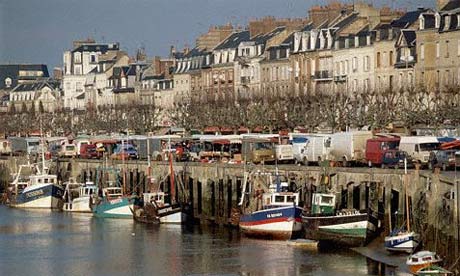
One of the great things to do in Trouville is make a morning visit to the fish market, whose stalls extend the length of the port behind the Casino, and will stay open as long as that morning's catch remains unsold. Short of actually scrambling aboard the fishing boat as it comes into harbour and haggling with the captain there and then, this is the best way to get fresh fish. The fish auction house, a modest, pavilion-like structure designed in the 1930s is now a listed building.
While I snoozed in a hammock in the garden of our rented villa one afternoon, my wife and niece nonetheless took an urgent stroll to Deauville for some shopping — an area in which Trouville is obviously outclassed. Weirdly, this means taking the ferry across the inlet when the tide is in, but when it is out, walking back with one's carrier-bags across a kind of impromptu slatted wooden walkway which rests on the muddy river bed.
Going out in the evening, the restaurants are quietly great, though none of us tried the lobster à la Trouville, which is adorned with mushrooms, oysters and even truffle, and very much the priciest thing on the menu. A very un-Trouville-ish thing to want to eat — out of keeping with this discreet, charming and tremendous little place.
Getting there
Travel by Eurostar from London St Pancras to Paris Nord and then from Paris St Lazare to Trouville-Deauville through www.raileurope.com
We rented our villa directly from the owner via:
homelidays.com/trouville-sur-mer
