
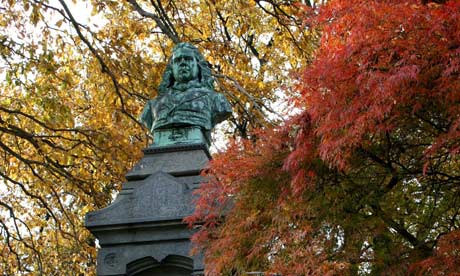
For decades, Green-Wood Cemetery in Brooklyn was one of New York's great tourist attractions. At the height of its popularity during the 1800s, half a million people visited annually to picnic among its manicured grounds. A letter in Green-Wood's archives from a 19th-century Englishwoman recounts how she would love to visit America one day "to see Niagara Falls and Green-Wood Cemetery".
If the meandering paths and genteel lawns of Central Park represent New York's romantic side, then the hulking mausoleums and Gothic stonework of Green-Wood capture Gotham in all its brooding glory. But the cemetery slipped into obscurity in the 1970s after its trustees decided they could no longer afford to keep the grounds open to visitors. They reversed that decision in the 1980s, yet it has remained one of the city's hidden treasures: a delight for historians and bird watchers, but rarely visited by the majority of New Yorkers.
It's a pity because, if anything, Green-Wood Cemetery is even more fascinating today. Its collection of famous graves, including Henry Steinway, Samuel Morse, and the Tiffany family, has increased in recent decades to include artist Jean Michel Basquiat and composer/conductor Leonard Bernstein. Meanwhile, its importance as a civil war resting ground has grown following the discovery of hundreds of hitherto unmarked Union and Confederate graves.
But the primary reason for visiting Green-Wood remains unchanged — almost 500 acres of stunning, tree-lined hills and valleys, carved by a glacier that slipped into New York harbour about 17,000 years ago.
Even the entrance to Green-Wood is spectacular, framed by three 100ft Gothic Revival arches. Today, they are home to a squawking colony of bright green monk parakeets which, according to local folklore, escaped from a crate at JFK in the 1960s and have lived at Green-Wood ever since.
Passing beneath the arches, most visitors head for Battle Hill, one of the highest points in Brooklyn. From the top, a bronze statue of the goddess of battle, Minerva, looks out towards New York harbor, raising her arm in greeting towards the Statue of Liberty. Liberty, of course, is waving back.
One of the most spectacular memorials is an elegant, Victorian monument to Charlotte Canda, who died in a horse-drawn carriage accident on her 17th birthday. To commemorate her tender age, her father ordered the elaborate memorial to measure 17 feet wide and 17 feet tall, and to be decorated with a shield bearing 17 roses.
But, with burial space now running short, Green-Wood's trustees are looking increasingly towards catering for the living to guarantee the cemetery's future.
Nowadays, the chapel is just as likely to host weddings, concerts and theatre productions as funeral services. Meanwhile, the cemetery runs dozens of events a year commemorating the lives of its authors, artists, musicians and soldiers. Kids particularly enjoy the flash-lit Halloween walks.
In the past five years visitor numbers have almost doubled, from 140,000 in 2002 to 270,000 in 2007. It's still a far cry from the half a million visitors of 150 years ago. But if numbers continue to grow at this rate, Green-Wood may once again become one of New York's premier tourist attractions.
· Green-Wood Cemetery is open daily from 8am until 4pm. Entrance is free. The cemetery occasionally runs guided tours. More regular tours are offered by companies like Big Onion Walking Tours and Brooklyn Center for the Urban Environment. For more information call Green-Wood Cemetery on +1 718 768 7300.
