
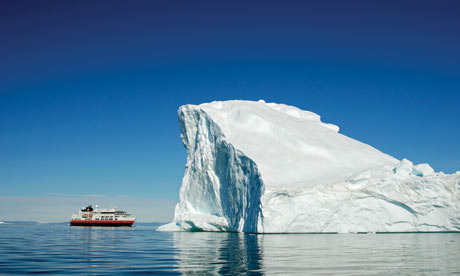
Almost as thrilling as going to New York for the first time was discovering that the flightpath went over Greenland. I’d never seen anywhere so mystically desolate, and have thought of it often since. Nothing but white: a vast, unknowable island of ice – the snowfall of millennia – weighing heavy and melting fast. Hanging on around the edges of what I now know is the 13th-biggest country in the world is a population of just 58,000. More people live in Torquay. There are no trees, few roads. In this harsh terrain, where nothing grows, anything that moves is fair game.
In early September the nightless days are over, the endless nights still to come, and home for me for a few otherworldly days is a sleek Norwegian cruise liner heading north up the west coast and bound for Disko Bay, which in my dreams at least is full of mirror balls.
Sisimiut, just inside the Arctic Circle, is our first port of call. It’s raining and a balmy 0C. Roughly 5,400 people live here, making it the Birmingham of Greenland; only the capital, Nuuk, is bigger. A whaling town once, Sisimiut has downsized considerably, to shrimps – one of the country’s main earners, along with cod, salmon and Danish subsidies. Wooden houses bought flatpacked by mail order clash badly in one of three colours: royal blue, oxblood and saffron; swirling through the drizzle, the Hammer Horror cry of huskies in their hundreds, howling for food, or because they’re going mad, possibly, chained up for months in readiness for the snowy season. (Like everywhere else along this frayed coastline, Sisimiut is cut off entirely by fjords. There are no roads out of town. Instead, people drive around in circles until snowmobiles and sleds come into their own, and sad dogs get to run and run.)
Back on board, it’s announced that a couple of kayakers from the local club are on our starboard side. “Actually, they’re now on the port side.” Down in the grey water, two brothers roll over in 36 different ways, faces dripping, looking cold in their wetsuits. I can’t tell one move from another, but a man from Sweden who knows says the skill involved made the hairs stand up on the back of his neck.
At eight decks, the Fram isn’t so big you can’t find your cabin, but there is always some windswept deck where no one else is, for those Now, Voyager moments, plus hot tubs, sauna, gym, internet and regular announcements in four languages that gave things a Eurovision feel.
The name Fram is in honour of the three-masted wooden schooner that in 1893 took Norway’s beloved Fridtjof Nansen to the far north, his trick being not to break through the ice but, as the briny froze and groaned into earthquake slabs all around, to drift along with it. Nansen and his crew lived like kings amid the carnage. Tuesday 31 October: “Chicken soup, boiled mackerel, reindeer ribs with baked cauliflower and potatoes, macaroni pudding, and stewed pears with milk – Ringnes ale to wash it down.”
Day three, and brilliant sunlight and ice on the horizon makes for a festive approach to Qeqertarsuaq (I wonder how many Scrabble points a “q” is worth up here; they’re everywhere). Like Sisimiut, Qeqertarsuaq was big on whales too a century ago; now it’s a quiet hunting-fishing community where you can buy a new rifle at the supermarket. Otherwise, it’s a hiker’s paradise. I walk along a burnished bay, glistening high-rise bergs gathered in an apparent stand-off with little clapboard houses along the shore. Further on, you’ll find wild west basalt mountains, waterfalls of icemelt, luxurious hillsides of russet, copper and yellow lichens and shimmering cotton grass. Back towards the harbour, lines of drying laundry waving out to sea. Bergs loom at the end of the street; they glide past at dinner, and cronk against the hull at night.
As Greenlanders lurch from light to dark each year, so we have our own extremes to negotiate. Nature in all its glory by day, followed by the evening’s onboard entertainment. Karaoke with only one participant, Elmer, the Filipino barman, working his foot-tapping way through Classic Crooners, just shy of the note all night. A fashion show hosted by the suitably windswept Cecilia Malström – Sweden’s first female polar driller, our ice lecturer – in pyjamas. Her screwball delivery is compelling. “They come in many sizes and you will only look elegant,” she declares, over cheesy sax and polite applause as the captain and chief engineer parade in bobble hats and Christmas jumpers with the labels still on, not looking quite so reliable now. “If I were not married I would run my legs off for these guys…”
Elsewhere, the going gets wilder, weirder and more beautiful. Uummannaq is a small, sunny island with a heart-shaped mountain rearing up behind a scattering of Crayola-coloured houses on its rocky lower slopes. Here I meet Malik Løvstrøm (roughly translated: Crashing Wave Love Storm), 19, hiding behind a long, dark fringe, his eyes heavily underlined with black, his head full of Rancid, the Used, Funeral for a Friend, Bullet for My Valentine. He may be an authority on Welsh metalcore bands, but Malik has been away from Uummannaq just twice in his life, down the coast to Nuuk and Ilulissat.
He’s eating chips in front of the fine local museum with Tukummeq Danielsen, a formidably switched-on 15-year-old who is a great-granddaughter of the African-American polar explorer Matthew Henson and reads “95% of the day – fantasy, what I can’t experience here”. Tukummeq wants to be an actress or a pilot, and is unusual in still going hunting with her dad – “Most of my friends think most about alcohol, sex and boys.” Smoking, too, is all the rage. “The children smoke behind the school on one side,” says Tukummeq (who doesn’t), “the teachers on the other side.”
I imagine this generation craves an independent Greenland but Malik thinks it’s impossible, given the government’s continued reliance on Danish money. Tukummeq, however, says bring it on: “We can learn by our mistakes.”
It’s not as if the country is short of natural resources, either. While most Greenlanders struggle to make a living, they’re sitting on an estimated quarter of the world’s undiscovered gas and oil, locked beneath the ice together with uranium, platinum, gold, diamonds and rubies. How long before they untap the lot? In the meantime, winter approaches, the sea will freeze, and for two months the sun will disappear. “But it can be lovely,” says Malik, “walking at midnight in the snow, listening to music. I miss it.”
Twenty-five miles up the coast, Uummannaq’s young dreamers a world away, the Fram drops anchor at Ukkusissat, a tiny settlement on fire at sunset. It’s our furthest point north, at 71°05’N, and unforgettable. I try to imagine how I’d survive out here on the edge of nowhere, while marvelling at the magical clarity of light, which may be the answer. There’s a house on every rocky promontory, an unlit path weaving between them; snow-dusted mountains disappear into a sliver of low cloud and a lilac sky. Look the other way and herring and washing hang out to dry against a Technicolor backdrop from Gone With the Wind, the graveyard all gothic silhouettes, the only sound at dusk the chink of dog chains.
Back on board it’s all go: an engine-room tour; a safety drill involving real smoke; many lectures (in Greenlandic you can count up to 12; after that, “many” is the only available word). And there are more evenings to remember (“Tonight, Brian, Marlow and Leo will show you what they can do with a single block of ice and a piece of fruit…”). I’m alone out on deck one morning when I see a waterspout, then an arched black back sliding out of and into the sea, five or six times, just me and the whale.
After a long day’s sail there’s an exhilarating trek at Eqip Sermia, a glacier that’s “calving like crazy”, according to our onboard geologist, the tundra so bouncy with lichen and moss it’s as if you’re walking on miles of mattress, and unexpectedly beautiful against a grey sky in shades of russet, orange, pink and flaky charcoal. Across the bay and glowing turquoise, the leading edge of a tidal glacier at full tilt, freeze-framed; all this and the first snow flurries (nittaalaq nalliuttiqattaartuq) of winter.
Further south, Ilulissat emerges from an early-morning blizzard into dazzling sun, its gleaming roads and everyday bustle something of a shock after all the craggy islands. But we aren’t there for the gift shop, or even the Irish pub. Ilulissat is Greenlandic for icebergs, and outside Antarctica this is the best place to see them up close. The town sits at the mouth of a Unesco-protected ice fjord where a glacier 34 miles inland, moving at a rate of 19 metres a day, tumbles out bergs into the inky sea. The beast that sank the Titanic probably came from here.
On a local boat we take a bone-chilling trip around an empire of frozen palaces, towers and, well, chunks: hard-edged, soft-flanked, white in the sun, blue on their shady side, luminous green at the water’s edge. In the mind’s eye only, the vertiginous seven-eighths that lie beneath.
If Ilulissat is picture-postcard Greenland, Itilleq is its grunge look. If anything it’s more photogenic: a fishing village at the head of a fjord with an alpine mountain range to the east. The houses here are fetchingly weather-beaten, and then there’s the stuff left lying around outside them: on one porch an entire reindeer, freshly butchered; next door, assorted antlers and the skull of a musk ox doing battle with one big red rubber glove, old radio parts and a bag of compost; over the way, two sawn-off reindeer legs (crossed), an egg cup, a fishing rod and a bicycle wheel.
About 130 people live in Itilleq and we’re each invited to a kaffemik – special-occasion coffee and cake – with one of them. Sofie-Marie’s home is warm and welcoming and, because neither of us had a clue what the other was saying, we hug a lot. A football game between crew, passengers and villagers is a regular fixture here too. Everyone joins in; sometimes there’s more than one ball.
Day seven concludes with an all too brief walk out on to lustrous miles of fondant ice cap, though not before a German gentleman gets there first, slips, cuts his nose and bleeds all over it. But nothing could take away from the night before when, as the Fram powered up the long, narrow fjord back to Kangerlussuaq in a buffeting wind, mountains silhouetted on either side, the miracle happened: milky yellow streamers of light rippling directly overhead, turning pink, pulsing and dancing across a starry sky.
Essentials
Hurtigruten (020 8846 2666; hurtigruten.co.uk) offers a range of itineraries in Greenland. The eight-night Glaciers and Icebergs of Greenland trip is available on 29 July and 5 and 12 August 2010. The tour costs from £3,501, including full board on the ship, return flights from Copenhagen to Kangerlussuaq, a selection of excursions, transfers and taxes. Flights from the UK to Copenhagen can be booked through Hurtigruten from £285.
