
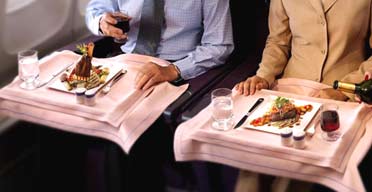
It's a lovely morning in Slough, but the first sign of clouds are appearing as Hermann Freidanck, in-flight services manager for Singapore Airlines, spots some tiny holes in a crucial item of airline inventory - a ham steak.
"Frozen," says Hermann Freidanck suspiciously, poking at it with his fork.
"Just chilled," retorts the London catering chief, Henrik Jensen.
"Look at the holes. Freezer holes," asserts Hermann. But Jensen is unbending; no one has frozen this meat on his watch.
Jensen's team at International Catering Limited have been working through much of the night and previous day to roll out a plastic-trayed banquet of fine food ready for the verdict of the visiting airline bigwigs. This quarterly inspection is part of a process that has seen airline food shedding its reputation as something to be endured rather than enjoyed.
These days, in-flight service is a key battleground to sway passenger loyalties: menus can change monthly, and airlines enlist the endorsement and ideas of top chefs. It's a particular selling point on the competitive routes to the far east, home of several of the airlines now frequently considered the best in the world.
Off the plane from Amsterdam a mere hour ago, Freidanck makes his way magisterially down the eight long tables of food. With his approval, each of these meals, the tangible result of a recipe already passed by Singapore, will be recorded, photographed and reproduced thousands of times in the coming months. Each spoonful holds a moment of silent apprehension from the caterers and assembled airline execs. The crab needs more seasoning; the fish korma isn't spicy enough; the tournedos is so rare it's pulsating; Freidanck can even, apparently, tell when something called bonito has been flaked the wrong way.
He's stopped short by a sausage - a huge veal bratwurst. "Remember last time, you wanted something bigger," prompts one of the caterers. Freidanck considers. "It looks a bit obscene." He swaps it for a smaller, nearby sausage, and looks satisfied. A woman silently slaps a post-it note on the tray and whisks the offending items away.
Passengers in first class may benefit most from the full range of Hermann's palate (the economy meals take up but a small strip at the very end of the row). While the ingredients can't add up to anything like the £3,500 or so it costs to fly to Singapore and back - even what goes into pricey Dover sole, cooked according to Gordon Ramsay's dictates, tots up to a mere £8.26 - getting eminent taste buds on the case must be reassuringly expensive.
Ramsay is one of an international panel of chefs that the airline has consulted for their various routes. He flew out to Singapore to cook up at a corporate event where the hapless hosts, in an effort to please, had brought spanking new equipment. "They were trying very hard," says Freidanck, "but the last thing you want when cooking is a new pot." The chef, he says diplomatically, is a "passionate" man, who gets upset - and did. "We have some video footage that has never been released."
Mishaps aside, the chefs' endorsement is quite a statement, even if one suspects they might want to limit their responsibility for what ends up on your plate at 30,000 feet. Freidanck doesn't say exactly what Ramsay thinks of the results, but says: "He has not called me up and called me an arsehole yet." A man clearly not to be intimidated, he goes on to tell the caterers to tone down Ramsay's recipe for caper sauce. (Ramsay has since been, sadly, unavailable to comment).
But then taste is still only one minor factor for the menu planners. Primarily, the issue is space and weight. Three kilos of payload ("stuff that flies, but payload sounds cooler") requires one litre of fuel, explains Freidanck. And that expensive fuel weighs another kilo, so the costs just build up. Such considerations are perhaps what finish for the third piece of seafood ravioli. "It's far too much. In fact, two is almost too much," he mutters. "Even two, whoof!"
The visits of the likes of Freidanck are, it soon becomes clear, not always a pleasure for everyone involved. "About two weeks before, you start wondering why you do it," says Adam Grove, one of the ICL chefs. "It is quite a struggle."
Quality controller Sisira Weerasinghe concurs: "Sometimes we think it's all very nice, and then he comes, and, well... we have our own opinion."
As the ICL kitchens cater for a range of different airlines, especially those requiring Asian cuisine, the inspections are something of a regular stress. "Everyone's got a Herman, but they're not all quite as strict," says Grove (though another, nameless, airline's taster is a "right little Hitler", one of the chefs lets on).
But all agree that such regimes have made a difference. "People think airline food is... well, a bit crap really," says Grove, "but here you can see the amount of effort." There has been a shift to the kind of practices associated with restaurants rather than mass catering - not buying ready-made sauces, for example, and boiling up their own stock instead. "There are huge piles of cows' bones downstairs, it's quite frightening sometimes." You can taste the difference straight away, he says.
Six thousand meals leave the factory doors daily, each one six hours before the designated flight takes off, ready to be reheated on board. About 100 of these will be special meals: gluten-free, Muslim, and when Stephen Hawking flew out first class, a liquidised version.
The meals look impressive and prove, for a hungry journalist, extremely tasty - and Freidanck by and large approves. But as he warns, you can't guarantee it'll all turn out the same in the air. Even their honed technique for delivering the perfect garlic bread needs the right loaf, right ovens, right crew.
The simple egg remains, by common consent, the airline meal nightmare; but Singapore Airlines reckon that with free-range versions supplied in London, some cream and a steam oven, they can now just about knock up some decent scrambled eggs in the air.
Passengers beware: this is only in first class. For the rest of us, the egg will have come via a different route: cooked up in Germany before being slipped onto a tray in Slough. "They do travel very well," says Grove. As an omelette? Yes, he nods; they just fish them out of the bag, frozen.
