
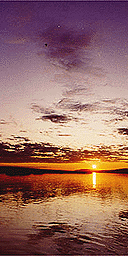
If Finland's head is located in the cool aesthetics of Helsinki and its heart in the deep forests and never-ending lakes of Savu and Karelia, then its soul can be found in the intense geography and climate of its Arctic north: Lapland, the home of the Sami.
The largest wilderness in Europe - almost the size of England with a population little more than Gloucester - Finnish Lapland has an intensity that makes city life seem tame. This is strongest during the harsh winter when the sun doesn't rise for seven weeks, temperatures sink to a body-numbing -30C, and life seemingly hangs in the balance - frozen in space and time. Yet this Arctic climate, even during the darkest months, produces an astounding natural phenomenon - the winter-night colours of the Northern Lights.
The bright tones of Ruska, the Lapland autumn, provides the most popular time for trekking. The trees and plants produce a larger quantity of the reddening chemical - anthocyanine - than anywhere else in Europe, and the whole place explodes with colour - pinks, reds, purples, violets, greens and oranges.
At Inari, a small village in Finnish Lapland, the air was startlingly clean. Here, nature dominates. The forested shores of the lake were bathed in the dreamy, milky autumn light. But you don't just watch the skies for their beauty. The summer heat can turn to freezing blizzard in minutes. The locals stress that if you aren't living and working with nature, then you are in danger of losing your mind or your life.
Inari itself doesn't hold a great deal of interest apart from a smattering of high-quality Sami craft shops, a couple of hotels, a tourist office and an excellent museum dedicated to Sami culture. What Inari does offer is a base from which to explore the surrounding wilderness.
I was heading for the deep forests of the Lemmonjoki National Park - a large sweep of land bisected by the Lemmonjoki river containing a number of well-worn trekking paths and a ragtag army of bearded gold prospectors.
A local bus decanted me in the late afternoon with my heaving rucksack at a staging post by the freezing Lemmonjoki. There, I met my Sami guide, Heikki Palto. Our camp for the night was an hour's journey up river by a fast, almost flat-bottomed boat which Heikki skilfully wove through the shallow rock-strewn rapids. The bright colours of the Ruska on the tree-lined shore reflected on the water. Far in the distance, we could see the high tundra.
We clambered off at a tiny jetty and took a steep 20-minute walk to Heikki's kota, the Sami equivalent of the native American tipi. The kota was sited next to a small, quick-moving stream, and after a snack of smoked fish and wild blueberries washed down with steaming coffee, Heikki pushed a shovel into my hands and beckoned me to the nearby stream.
Bemused at first, I soon grasped the purpose when Heikki, with eyes as bright as the stuff itself, spoke the Finnish word " kulta " - gold. We began digging at the side of the stream, pouring the muck into a long grate that separated mud from stone. Heikki carefully drained the residue, then painstakingly began panning. We did find gold, although the amount was pathetic, about the size of three pinheads. Nevertheless it was the real thing, and I had dug it with my own straining muscle from the ground.
We trudged back to the kota; it was getting dark and cold. Heikki lit a massive fire and prepared a meal of sautéed reindeer - freshly culled from his own herd. The Sami are traditionally a nomadic people, and many still tend the large herds of reindeer that roam the Arctic north. During the harshest part of winter, some Sami still disappear for weeks deep into the vast uninhabited tract of land equipped with a kota or a laavu - a light lean-to - and a high-speed snow scooter, rounding up and sometimes rustling reindeer. Either way, the reindeer on my plate tasted great, and with full stomachs we bedded down on the fresh pine and birch that Heikki had cut and lain for a sweet-smelling mattress.
The kota was large enough for Heikki to build a massive fire in the middle, and its chimney hole kept us free from smoke. The fire - and our huge downy sleeping bags - kept us warm throughout the night. The next morning, I set off on the next leg of my journey, a 20-mile hike through forest and tundra.
My new guide, Tuija, explained that anyone who trekked here alone needed a well of psychological resources to draw on in order to maintain a degree of sanity in such isolation. But she added that you have to be pretty stupid to be in danger physically as there are a number of easily-found free cabins complete with wood-burning stoves, piles of firewood and sleeping places (you'll need a sleeping bag) - some even have saunas.
This sense of seclusion away from the pollution, stress and frustration of city life was why I was here. And here, deep in the forest and across the high Arctic tundra, the Ruska began to reveal itself.
The birches varied from yellow and orange to a light pink and a startling red that seemed almost unnatural. On the ground were splashes of sharp, intense colour. The sky changed continually - dramatic cloud formations, squally rainstorms and bright sunshine. Once, just as we rounded into a dazzling forest clearing, a rainbow suddenly appeared, almost as if on cue.
We walked on for several hours, each turn of the path revealing the raw natural power of the Ruska until we reached a gorge and a high waterfall that fell into the Lemmonjoki river. A boat picked us up from a nearby pier. I climbed aboard exhausted, sad to be leaving behind a place of such beauty.
But later that night, which I spent on top of high tundra at an open cabin, the magic increased. As the full moon rose across a star-filled sky, the green gaseous illuminations of the Northern Lights whisped across the Arctic night, billowing and twirling. It was cold, but armed with a super-warm sleeping bag I ventured out alone to lay a few yards from the cabin so as not to miss a moment of the light show. I drifted into a deep sleep and awoke just as the sun was creeping up.
Way to go
Buzz (www.buzzaway.com) flies Stansted to Helsinki from £99 return. Finnair (020-7408 1222) flies from Manchester from £177 return and Gatwick and Heathrow from £159 return. From Helsinki, take a sleeper train to Rovaniemi then a five-hour bus journey to Inari, or a Finnair flight to Ivalo, 25 miles south of Inari. Eurocar car hire at Ivalo airport costs about £250 a week. The Inarin Kultahovi, Inari (+358 16 671 221, www.saariselka.fi/kultahovi/en), has rooms from £25, Kakslauttanen Hotel and Igloo Village (+358 16 667 100, www.travel.fi/int/Kakslauttanen/) has cabins from £15; and Uruniemi Camping (+358 16 671 331, www.saariselka.fi/uruniemi/indexeng.html ) has cabins from £15. Tapani Lappalainen (www.eccotravel.com/destinations/arctic/North Cape/lake_snow_inari ) runs fishing trips and snow-scooter safaris. Heikki Palto runs overnight trips from around £40pp and also rents cabins (£25 a night). The Inari Tourist Office (+358 16 661 666) speak good English and can also provide information on local transport, guiding and accommodation. Other information from the Finnish Tourist Board (020-736 52512).
