
Most young men travelling alone in Russia are looking either to make money or have sex. I went for neither. I wanted political memorabilia. My friends thought I was raving, but I was desperate to visit what remains of the world's biggest political experiment before it disappeared for ever.
As is always the case in politics, coming up with the idea was easy, but delivering it was much more difficult. Visa, currency and transport were a nightmare, but the hassles were all forgotten the moment I landed at St Petersburg's Pulkova 2 airport and saw the crumbling 1950s terminal building, covered in garish yellow paint and still decked out with Soviet hammers and sickles. The dramatic Soviet municipal buildings across the suburbs were vivid reminders of the hopes and failings of the last regime, while the Tsarist boulevards in the centre of town spoke volumes about the grandeur and ambitions of pre-revolutionary Russia. It doesn't take much to get this political hack excited, and I was, seriously.
As I thumbed my Lonely Planet in a hot and shabby taxi I realised that, with less than three days in St Petersburg, I was going to have to pass on the culture if I wanted to see the history. Given that the Hermitage houses one of the finest art collections in the world this was, to paraphrase our own prime minister, a tough choice.
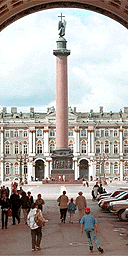
I started my field trip with a long stroll up Nevsky Prospekt, St Petersburg's main thoroughfare, to the Winter Palace: the venue for the defining moment of the October revolution. Even if Soviet history books and films subsequently exaggerated the importance of the storming of the Winter Palace, standing in its vast piazza still left me in a daze, muttering "Oh my God, that's the Winter Palace" to myself, over and over.
Flashbacks from Russian history lessons at school followed in quick succession. Behind the Palace, overlooking the Neva River, was the Admiralty, home of the Imperial Navy from 1771 until the fall of the Romanovs. Power and glory ooze out of every stone, knocking London's Admiralty Arch into a cocked hat.
Facing the Admiralty is the Peter and Paul Fortress, the oldest building in the city. Originally built as a defence against the Swedes, the fortress was turned into a political prison which housed Tsarist dissidents including Dostoevsky, Gorky and even Peter's son Alexy. The fortress also includes an orthodox cathedral, where all but two Russian monarchs from Peter the Great onwards have been laid to rest - including Nicholas II and his wife, who were exhumed from the Urals and buried there controversially in 1998.
Crossing the Kamennoostrovsky Prospekt on my way to the Museum of Political History, I spotted a motorcade coming straight for me, complete with cars with blacked out windows, Russian flags on the bonnet and motorcycle outriders. It was President Putin leaving the city after a summit with President Chirac of France. Things don't get much better than this for political train spotters such as myself.
The museum is housed in three pre-revolutionary mansions which were taken over by the Bolsheviks and used as their headquarters. Lenin used one building as his base before leaving Russia in the summer of 1917, returning in October to oversee the revolution. His office has been restored, complete with maps, desk toys and notepaper. The office's balcony, overlooking the park, was his podium to address the masses. I looked wistfully at the balcony. The babushka supervising the room could clearly read my mind, because she opened the door and let me stand where Vladimir Ilyich had stood. Another "Oh my God" moment.
The museum's exhibits were fantastic: I was surprised and impressed by the frankness with which they dealt with a century of political upheaval. One of the English explanations said simply "attention to the visitor is drawn to the violent extermination of non-Bolshevik parties in 1918-1920 and the development of the one party system". Despite Russia's relative political immaturity, the museum also held signs of hope for the future. Gorbachev's fall and Yeltsin's rise to power were treated in a considered and dispassionate way; there was no adulation and little attempt to hide the past. It was in many ways the perfect museum: a serious and intelligent take on history; fascinating exhibits, and beautiful Art Nouveau architecture.
I had planned to take a romantic (well - as romantic as you can be on your own) trip on the night train to Moscow, but during the White Nights of late June all the compartments were taken. I took the easy option and bought a plane ticket.
Arriving in Moscow was as exhilarating as landing in St Petersburg. The taxi ride (which saw me cough up $45 for a journey which should have cost $20) took me past the first political landmark. Halfway between the airport and the city there are tank traps by the roadside, showing the closest point that the Nazis got to Moscow. They were within sight of the matropolis; a sobering spectacle which made me appreciate fully just how important the Great Patriotic War was to the Russians.
Unlike in St Petersburg, there is little pre-revolutionary political action to be seen. Moscow may not have given birth to Bolshevism but it quickly became the centre of the Soviet Union, and the remnants of the old regime are much in evidence. The city is surrounded by a series of eight or ten-lane urban motorways, treacherous to cross and clearly built with military and industrial, rather than aesthetic, priorities in mind.
First stop had to be Lenin's tomb in Red Square. To get in, briefly: don't carry a bag, don't carry a camera, go between 10am and 1pm on any weekday except Friday, and when you finally get in, keep moving.
As I approached the tomb, memories of TV news bulletins I saw as a child came flooding back: John Craven explaining that the Soviets were commemorating May Day with a massive military procession; footage of Politburo members standing on Lenin's mausoleum. Here it was: a small, two-storey building at the heart of the 500m-long square next to the Kremlin, red marble on the outside, black marble inside, with air conditioning as good as any Manhattan restaurant.
And inside was the body of the man who created the political movement which dominated the 20th century. Here he was, dead but here, and I was overwhelmed.
During Soviet times thousands of people would visit the body, the idea being that they would "process" paying their respects. Since the fall of communism visitor numbers have also fallen, and there is less need to move swiftly round the body. But the teenage guards still want punters to maintain a swift pace. On my way out of the door I turned around to stand and stare, but within a minute a hand grabbed me and pushed me down the stairs and out of the building. I had been thrown out of Lenin's tomb.
At the back of the tomb, set into the walls of the Kremlin, visitors can pay homage to the heroes of the revolution: former general secretaries sit alongside cosmonauts in a sombre rogues' gallery. All the gravestones, even Stalin's, were adorned with fresh red carnations.
Given the supposed hostility to the Soviets by the new regime, I was surprised at the respect with which these monuments to the past were preserved. Perhaps Russian nationalism still took pride in the power and might of the Soviet Union; after all, how could they possibly erase their memories of a nation for which 26m people died in the second world war? The Kremlin itself was a little disappointing: the government buildings were out of bounds. Most of these mid-19th century buildings are as dramatic as any of St Petersburg's finest, and the churches inside the walls were beautiful, though to be honest, it seemed to me that once you've seen a couple of Russian orthodox churches you have seen them all. The huge Palace of Congresses, completed in the 1960s, is the most modern of the buildings; once again, memories of news bulletins skipped through my head as the venue of so many bizarre politburo speeches and rigged votes came into view.
A 10-minute walk north of the Kremlin is Lubyanka Square, the original home of the KGB and still the offices of the Russian intelligence services. Its cells extend right under the square and I felt very odd walking past the building.
I also made a visit to the White House, which Boris Yeltsin defended against the coup in 1991 and then, as President himself, ordered tanks to fire on just three years later. Despite the associations, however, the building itself was distinctly underwhelming.
More impressive was the Triumphal Victory Arch, which commemorates the defeat of Napoleon in 1812. And next door, in the Museum to the Great Patriotic War, the original table and chairs used at the Tehran conference in 1943 can be seen. Simply to see the furniture which Stalin, Roosevelt and Churchill all used was moving.
Even more impressive was the document which ended the second world war in Europe, headed "the statement of unconditional surrender of the German troops". Just a modest piece of paper - but one that set up the cold war and dominated the next 50 years of international relations. And there it was, in a small glass case in front of me. It was an exhibit that will live with me forever.
Russia travel facts
• Travelling to Russia is best in the summer for the long nights and warm weather, or in the winter for the crisp, cold climate and snow. Spring and autumn can be wet and dark.
• British Airways fly to St Persburg and Moscow. Pulkova's internal flights are easy to book when inside Russia.
• In order to obtain a visa, you require an "invitation" from a tour agency, company or individual. These take time to arrange, although they are not difficult to obtain.
• Take dollars or travellers' cheques. There are plenty of money-changing booths in the major towns. Credit cards are accepted in western restaurants and hotels.
• Hostels in St Petersburg and Moscow provide good places to stay and are much cheaper than their western equivalents.
• Crime in Russia has been exaggerated greatly by the western media; the streets are less threatening than many in Britain or America, and if you're streetwise, you won't come across any problems.
• The underground provides the most reliable form of transport, though a basic knowledge of the Cyrillic alpahabet will make things easier for you.
