Sunday morning in the South Pacific. The congregation is in full voice at the 10am service at the Cook Islands Christian church in Arutanga, the main settlement on the island of Aitutaki: the men lay down a strong tenor line while the women's voices soar high in Polynesian harmony. It is curiously moving; in the pew in front of me, a German tourist sits down and sobs uncontrollably.
The South Pacific has always touched a chord in the European imagination. It comes from the sense of being at the edge of the known world: the brightness of the light; the overwhelming colours and scents; and most of all the warmth of the people.
Gauguin sought paradise on Tahiti (with mixed results). Robert Louis Stevenson spent his final years among the people of Samoa. And European missionaries sailed halfway round the world to spread the gospel, my grandfather among them. From 1903 to 1916, he preached - and built a hospital - on Tanna in the then New Hebrides, now Vanuatu.
"We get to love the people more and more... they surprise us at every turn by little attentions," he wrote a month after he arrived. As we leave the service at Aitutaki, the women - in bright print dresses, some with garlands, some in straw hats - are anxious to talk to their visitors. They pick star fruit for us from a tree overhanging the road.
The South Pacific islands cast a special spell. I've been to Tanna: sat in the church that my grandparents built, and met an elderly villager who remembered the missionaries. But my South Pacific favourite is Aitutaki, a 12 square mile atoll with a stunning lagoon, 50 minutes' flight from Rarotonga, the main Cook Island.
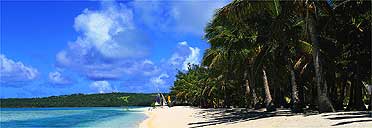
On the Monday morning here, we hired scooters to explore the island. We puttered past white-sand beaches and small settlements of clapboard house, well tended lawns, family graves in the front garden. Everyone we passed smiled broadly.
Then we saw the sign for Tauono's Garden Cafe. We stopped for coffee made with his own organic beans, coconut cake and papaya, guava and melon from the garden. Tauono, a grey-haired islander in his 60s, was working in the garden; he put down his fork to talk to us. "I came back from Auckland 10 years ago though my children still live away," he said.
"We wanted to look after ourselves, growing what we need. Too many people have left the island in the last two years but the western world is a troubled place," he added.
At the south end of the island, the paved road gave way to a rough track. We followed a sign down a bush track to find a marae, small standing stones marking a religious meeting ground that long pre-dated the European settlers.
At the small settlement of Vaipae, we turned down to the harbour where we found Antonia, a cheery middle-aged woman who sells crafts on her front lawn. As we chose a basket, she plied us with star fruits and lady's fingers, small sweet bananas. Her laughter belied her conversation. "Life can be hard. My husband's been under the ground for two years," she said pointing to a white grave in the side garden.
Several boatmen offer day-long cruises on the lagoon. We went with a swarthy good-humoured captain called Ke. "I'm the best boatman," he said modestly. First stop was BBC Island, as the locals have renamed this inhospitable volcanic outcrop where Castaway, the Channel 4 series was filmed. It was not difficult to see why - only five of the 16 youngsters survived the whole three months here (the director and crew stayed in a comfortable lagoon-side hotel).
We snorkelled off Honeymoon Island, more typical of the many uninhabited motus (islets) in the lagoon: a long sandbar covered in bleached shells and corals. Ke barbecued fresh tuna steaks with coconut sauce for our lunch on One-Foot Island where we swam off yet another white-sand beach.
As we slowly motored back to the harbour, he pointed out another palm-fringed island, called Akaiami. This was the base for the flying boats that flew the Coral Route in the 1950s from Auckland to Tahiti via Fiji and Samoa. The passengers used to swim in the lagoon while the aircraft was refuelled. They still talk about the day that an engine failed. The flying boat had to turn back to Tahiti for repairs, leaving 40 passengers to sleep in primitive beachside huts. They were furious at first but Aitutaki worked its magic: they were reluctant to leave when the plane returned eight days later.
Most visitors will share the feelings of those stranded passengers. The Rev Timothy Toku summed it up when he turned to the visitors during our Sunday morning visit to the church: "I hope you will remember the sweet hospitality of the Cook Islands people, and wherever you go you will take a little of Aitutaki with you."
Island guide
Tahiti
Bora Bora is the popular choice for its gorgeous lagoon and an ever-increasing number of five-star hotels with bungalows built over the turquoise sea. A good place to recover from jet-lag. Others will be drawn to Moorea, whose jagged peaks can be seen from Papeete; it has some simpler (and cheaper) resorts. The discerning head for mountainous Huahine, whose fertile interior can be explored on a Jeep safari.
The Bora Bora Lagoon Resort The Bora Bora Lagoon Resort, an Orient Express hotel on its own motu, has been refurbished this year. Rooms from £330 to £550 a night for an overwater bungalow. Te Tiare Beach, Huahine (Te Tiare Beach), a secluded resort with reception, restaurant and bar, all built over the water. Rooms from £200 a night. Hotel Les Tipaniers, Moorea, a simpler Polynesian beachside hotel. Rooms from £80 a night. See also: Tahiti tourisme.
Cook Islands
Rarotonga, dominated by a high mountain peak with lush rain forests, is a laid-back island that can be explored along its two main roads; one along the coast, the other through the plantations and farmlands in the interior.
But the main draw is Aitutaki. Air Rarotonga offers daytrips taking in a lagoon cruise, but better still to spend some time slowing down here. If this seems too slow, try one of the tiny outer islands such as Atiu or Mauke.
Crown Beach Villas, Rarotonga Crown Beach Villas, a new beach resort on the western shores with lovely sunsets. Rooms from £130 a night. Pacific Resort, Aitutaki (Pacific Resort), a new property set in 17 acres of tropical forest beside a beach. Opens in October. Rooms from £200 a night (with breakfast). See also: Cook Islands.
Fiji
International flights come into Nadi on Viti Levu, the main island, which has a batch of big hotels. But visitors quickly scatter to a range of resorts, from luxurious to simple, in the various island groups.
The Yasawa Island resort, on one of the remoter islands, is a special place, combining exclusivity with a rare chance to visit a traditional village.
There are regular catamaran transfers from Nadi to the Mamanuca islands where Castaway Island has Fijian-style thatched bungalows with alfresco dining under the stars.
Yasawa Island Resort Yasawa Island Resort, rooms from £500 including all meals, internal flight £100. Castaway Island Resort Castaway Island Resort, rooms from £160. See also: www.bulafiji.com.
Samoa
The people of Samoa still hold to a traditional culture, fa'a Samoa, which is based on village and family loyalties. There is little privacy in their open-sided oval fales (homes) - bamboo shutters are only drawn down supporting poles when it is time to sleep.
Apia is a slightly down-at-heel Pacific capital but its famous hotel, Aggie Grey's, is in good shape after a rebuilding programme that hasn't destroyed its colonial character. This is a country for the curious traveller rather than the dedicated sunseeker.
Aggie Grey's Aggie Grey's, rooms from £100. See also: Visit Somoa.
Tonga
The smallest and most traditional of the Pacific island groups is perhaps best-known for its king-sized monarchs - and for being the first country on Earth so see the sun rise (the islands straddle the international dateline). Visitors will discover the most culturally intact of the Pacific nations.
Fafa Island Resort Fafa Island Resort; rooms from £60. See also: www.vacations.tvb.gov.to
Vanuatu
These islands, which lie north-east of New Caledonia, are best reached via Australia because there are few direct transport links with the more easterly Pacific islands.
The beach resorts around the capital Port Vila are popular with tourists from Australia but intrepid travellers will seek out the fascinating smaller islands.
Tanna has a live volcano, Mount Yasur, whose molten centre still spits out red-hot debris. The people have had an equally volatile history. Christianity made inroads into local culture; perhaps a third of the islanders are still active Christians. But a further third belong to the John Frum cult; they wait for a more materialistic messiah to return bringing them all the goods that they need.
Le Meridien Port Vila (<a href="http://www.lemeridien-portvila.com), a four-star international resort on the lagoon opposite Port Vila. Rooms from £140. White Grass (White Grass is a new small resort on Tanna. See also: www.vanuatutourism.com.
South Pacific pointers
1 Take it easy. You can ruin a romantic itinerary by moving on too often.
2 Fares are lowest in April and May. June to August has the most temperate weather. December to February is hot but rainy.
3 Take advice: the airline timetables are complex and inter-island connections can be tricky (not to mention the 'lost day' crossing the dateline).
4 Go to church. It is often a more authentic insight than folkloric 'island nights' put on for tourists.
5 Beware of falling coconuts.
Way to go
Getting there: Air New Zealand (0800 0284149) flies to all the main islands via Los Angeles or Auckland. Fares to Fiji, the Cook Islands, Tahiti, Samoa and Tonga start at £689 plus taxes. All-Ways Pacific (01494 432747, All-Ways pacific) has a wide range of hotels across the Pacific. Austravel (0870 1662100, Austravel) will arrange stopovers or dedicated trips to the islands. Tailor Made Travel (01386 712005, Tailor Made Travel) has an 'Ultimate Fiji' brochure. Other operators include Sunset Faraway (020-7498 9922), Transpacific (01293 567722) and Elegant Resorts (0870 3333380).
