
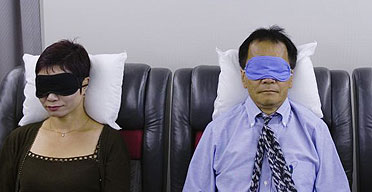
It really shouldn't be that difficult. Nice meal with a few drinks, then a comfy reclining chair in a blacked-out room with nothing to do or worry about for the next 10 hours or so.
Sleep, you'd think, would be guaranteed. Unfortunately, for many of us flying and sleeping just don't mix, no matter what we do, resulting in us arriving at our destination feeling cranky and tired and then losing precious time from our holidays trying to catch up.
Such is the scale of the problem that British Airways, in an industry first, has appointed a 'sleep doctor' in the shape of Dr Chris Idzikowski - an expert in the field who has been hired to research and improve the information the carrier has about maximising passengers' in-flight sleep.
'A lot of the same tips I would give to insomniacs apply to trying to sleep while flying,' says Idzikowski. 'People should try focusing on something simple, carefully and slowly. Deep breathing and earplugs and eye masks are all good, too, and neck cushions can stop you waking yourself up with a painful head jolt.'
To avoid lower backache disturbing sleep, the small pillows supplied on most airlines, Idzikowski says, are better used in the small of the back than behind the head.
When it comes to jetlag, holidaymakers can learn from the habits of frequent business flyers, says the sleep doctor. On a short trip, say up to three days, you should try not to adjust to a new time zone and stay in your own clock. This could mean eating meals and sleeping at the same time as you would at home, even if it results in you eating breakfast at 3am, dinner at lunchtime and going to bed at teatime!
It is also not necessary to force yourself to stay awake to fit with a new time zone in a new place, or on your return home. Idzikowski says it is much better to follow your needs and nap to cope with time differences. However, sleep cycles mean that these naps should never last longer than an hour and a half, unless it is night-time.
As for the customary advice to drink a lot of water, the doctor is not convinced. 'There is no evidence of a big loss of hydration in flying, so it may be a psychological thing,' he says. 'Air crews do report it, though, so we will do more research. Crews say they rehydrate around the eyes with moisturiser or by spritzing.'
BA has spas run by Molton Brown in some of its first-class lounges offering relaxing treatments that can be copied by those of us stuck in economy.
Cleansing, moisturising and even a little massage from a friend just before a night flight can be beneficial.
For parents flying with toddlers, Idzikowski has some specific advice. 'We sometimes reassure insomniacs that we know people can survive without much sleep because we have all had to be able, as a species, to look after our children,' he explains. The aim would be to keep an infant in tune with its normal domestic rhythms and to recreate familiar triggers for sleep, such as a cuddly toy or a blanket and a bottle of milk.
All flyers are advised to eat little and to eat foods that do not cause gas or indigestion. Better still, on a night flight, eat a light meal before you get on the plane rather than on it, says Idzikowski, and ask the cabin crew not to disturb you when they bring round the food.
