
In its bid to attract more British visitors, the Picardy tourist board faces some deeply ingrained Channel-crossing habits. The persuasive skills of Cicero would probably fail to tempt booze-run daytrippers into venturing further inland than Calais' giant supermarket, and even the most Francophile travellers still tend to be attracted to the breezy cool of Paris, the familiar charm of Brittany or the relaxing glow of the Mediterranean south. All of their journeys will usually involve passing through the less famed north-east region, but the ease and speed of the Eurostar and the impressively smooth A1 autoroute hardly encourage tourists to stop and make a closer inspection.
Sensibly, however, Picardy is now being sold as a low-key weekend destination, requiring endurance neither of the metropolitan bustle nor the longer drives to the west and south. Its most appealing sites are all located within an hour or two of each other, and most can be appraised and enjoyed during a fleeting stay. So whether the focus of your visit is the cathedral city of Amiens, or, as in our case, Chantilly, the proud centre of French horse-racing, it's no grind to squeeze half-a-dozen excursions into just a few days.
Though renowned for its equestrian and architectural heritage, Chantilly's primary function is as home to a 12,000-strong population. Admittedly, we're here on one of the 10 annual race weekends, but the narrow roads are jammed with cars and to take coffee on the pavement is to put your life in the hands of the notoriously erratic French motorists.
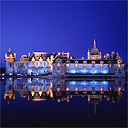
Nevertheless, the Chateau Condé is magnificent. The first castles were built on Chantilly between the 10th and 14th centuries, but the earliest incarnations of the present structure - built on a rock surrounded by water - date from around 1560. The development of the site was steady until the French Revolution, when, like most things aristocratic in origin, its history became turbulent. Its paintings were seized and moved to Paris, while the chateau itself was initially used as a prison and then - in 1799 - largely demolished. Restoration of the buildings and gardens took almost 100 years, most of it carried out under the supervision of Henri d'Orleans, Duke of Aumale. The duke also dedicated himself to assembling the works of art that are now on display at the Chateau - he built up his collection during a 24-year period of exile in London following the 1848 revolution, and the gallery is the second largest in France, eclipsed only by the Louvre.
Equally as impressive as the Chateau Condé are the Great Stables of Chantilly, which stand a few hundred metres away. Its 18th-century commissioner, Louis-Henri, the Duke of Bourbon, apparently believed in metempsychosis and hoped to be reincarnated as one of its long-faced residents. He certainly would have felt comfortable in his next life - with its balustrade and imposing sculptured front, the 186m-long building bears closer resemblance to a state parliament than a home for horses. Indeed, it comes as a shock today to learn of its purpose, so God only knows how furious it made the uppity French peasantry in the latter days of the ancien regime. Since 1982, the stables have also functioned as a museum, dedicated to all aspects of equine life.
As well as exhibits ranging from Goan merry-go-round horses, horses as represented on silk scarves and photographs of first world war cavalry, there are more than a dozen living breeds on show, and dressage demonstrations take place daily. Having always been convinced that making a horse dance on tiptoes must be one of the most pointless sporting endeavours man has yet devised, I'm intrigued to learn that although the skill was most popular in the circuses of the 19th century, it was first invented for practical purposes by riders in war, whose nimble steeds could save them from attack with their displays of lightfootedness.
There is less of an excuse however, for the show of human vanity taking place in front of the racecourse pavilion by early afternoon. Our visit coincides with the annual Prix De Diane race, and roughly 20,000 punters have congregated for the prestigious spectacle. Surprisingly in a nation which so brutally did away with its royal traditions, the aristocratic influence so obvious among the clientele at great English racing events is just as pronounced here.
In a word, that means hats. Laughable headgear is perched atop hundreds of well-deported female racegoers, although three in particular repeatedly catch the attention of the cameramen feeding pictures through to the big screens: a teenager sporting a bonnet adorned with a selection of garden vegetables (led at the front by a giant yellow pepper), the minimalist approach as paraded by a self-conscious twentysomething who wears a three-inch transparent plastic square affixed just above her left ear, and, most ostentatiously of all, a heavily made-up elderly woman whose blue rinse is capped by a precariously balanced birdcage, complete with live twittering captive.
The official programme of events is just as diverting, and a good deal more elegant. Each race is interspersed with tournament-style entertainments - military brass bands, whip-cracking dressage masters, and men who can control whole packs of horses at speed while standing on their backs - all performed in period dress.
Meanwhile, the eight races of the day are lent extra flair and dignity by the splendid backdrop of the chateau and stables. The course dates back to the 1830s, when a band of nobles decided to stage an impromptu race and enjoyed it so much they came back the next year for a rerun. Within 40 years, the programme had become sufficiently well established to warrant construction of the grandstand that remains in place today.
Knowing that Chantilly is less than four hours by land and sea from the south coast of England, the organisers, France Galop, are careful to cater for the British contingent in attendance. Several UK-based riders (including Frankie Dettori and Pat Eddery) are among the jockeys vying to win the Prix De Diane, and results are announced in both French and English. It's a long afternoon - the last start is after 6pm - but the leisurely pace leaves enough time for trotting back and forth to the betting windows or for round trips to the bar, which sells fine espresso.
On race weekends, Chantilly provides enough distractions to keep tourists occupied for the duration of a short stay. At other times, the affected pomp of high society can be found at the Abbaye Royale de Chaalis, located a few miles to the south-east, in the Ermenonville forest. The Abbey was bought in 1902 by a wealthy heiress, Nélie Jacquemart-André, who filled her new home with an eclectic assortment of memorabilia, including works by Giotto, Houdon, Boucher and Pajou, and artefacts from her travels across the globe.
But the real insight to be gained from her collection is not so much to do with the objects themselves as their indiscriminate quality. The lady's acquisitiveness clearly had an imperial bent - strolling past the cabinets of Hindu, Buddhist and Egyptian trinkets, it's easy to imagine her dismissively flashing wads of local currency as she snatched the items from bemused natives. Our impossibly cheery guide seems to realise his task is an uphill one and requires embellishment - at one point he tries to convince us, with an entirely straight face, that the reason Mme Jacquemart-André's bed is so short is because French men and women of the period slept sitting up, for fear that a horizontal kip would somehow kill them.
The highlight of the tour is the collection of artefacts relating to Jean-Jacques Rousseau, although these, too, will disappoint serious students of the philosopher - its centrepiece is the chair in which he sat while eating his final dinner. As with many of Picardy's attractions, it is the architecture - which includes the remains of the original 12th-century abbey, and the carefully tended grounds - that make the Abbaye a worthwhile detour.
Heading back towards Calais, our final stop is the medieval port of Saint-Valery-sur-Somme. Although the eerie lack of activity gave it the air of a specially constructed model village (Saint-Valery's annual festival was held the night before our arrival, so residents were presumably indoors nursing sore heads), the town provides an alternative insight into Europe's warring past to that of the more frequently visited first world war battlefields. It was from Saint-Valery that William of Normandy sailed for England in 1066, while the ancient ramparts of the old town bear testament to the last southward journey of Joan of Arc in 1430.
Viewed from the top of the ramparts, the Baie de Somme is also an impressive sight - stretching over 40sq km, the sea ebbs approximately 14km at low tide and can sometimes come crashing back in at a furious rate of 60kmph.
As is often the case on such trips, the most enduring memories are created by those experiences not featured on the itinerary. On the evening before race day, we eat at Le Gril Des Barbares restaurant in the town of Senlis. The centre of Senlis boasts an imposing set of towering Gothic buildings, while Le Gril Des Barbares itself is a converted crypt, creating a serene dining atmosphere to complement the excellent cuisine (the food at every one of our four-course sittings lived up to and beyond the Gallic reputation).
And yet, to top off this balanced combination of beautiful brickwork and artful cooking, the managers had paid a barely competent pub singer to string together a network of cheap disco lights, belt out almost unrecognisable versions of crooning classics (Could It Be Magic?, Return To Sender), and perspire heavily into a cream anorak that clung to his back throughout a lengthy performance. As the tourist board slogan correctly surmises, Picardy really can be "the unexpected at your doorstep".
Way to go
Getting there: Seafrance European Life (08702 424455) offers two nights in the four-star Dolce Chantilly and two in the four-star Chateau de Bellinglise with ferry crossings for £315pp.This year's Prix de Diane race is on June 9 and entry costs €8.
Further information: Call the Picardy tourist board on 020-7836 2232 or visit picardypauses.co.uk. Ferry time: Dover to Calais, 90 mins Country code: 00 33 Time difference: +1 hour. £1=€1.61.
Vive La France, an exhibition of French lifestyle and travel with over 350 exhibitors, takes place at Olympia, London from January 18-20. Tickets can be booked in advance (0870 9020444, vivelafrance.co.uk) for £10.50 or bought on the door for £12.50.
