
Kenneth Branagh’s finest achievement in Shackleton was convincing himself, and us, that the North Pole - where the recent Channel 4 film was shot - was in fact the South Pole (where the real Shackleton went). Somehow, Branagh had to ignore all the polar bears in Greenland and imagine he was surrounded by penguins instead.
Or you could just head south. In early December I flew halfway round the world with a bagful of longjohns, through simmering Buenos Aires to Tierra del Fuego, where South America tails off into the sea. Here, a Russian ice-breaker, the Kapitan Dranitsyn, a marvel of engineering disguised as a prison ship, was waiting to take 5 7 tourists and all our high hopes to the coldest, whitest, purest, loneliest, most alluring place on earth - Antarctica.
The Dranitsyn was home for a 10-day round-trip that would barely impinge on this vast, unowned emptiness which the Ancient Greeks sensed was there. From Ushuaia over the Southern Ocean to the Antarctic peninsula, past mountains, icebergs and glaciers, through the Antarctic Circle to 24-hour daylight, or not, depending on ice and weather (the itinerary really would change with the wind; we’d have to go with the floe). Five Zodiacs (inflatable dinghies with engines) and two helicopters on the back deck would allow us to land along the way and commune with penguins, seals, the odd scientist. We would be ‘rapt in wonder totally’, said Melanie, one of our onboard lecturers, irrepressible on the subject of krill. And, unlike Shackleton, we’d be travelling in some comfort, with a sauna, Austrian pastry chef and David Attenborough on video.
But first we had to cross the Drake Passage. This is where Atlantic and Pacific collide, and lively weather, unimpeded by land, howls around the globe picking up speed. The stomach-churning results may be more effective than any international treaty in protecting Antarctica from the ravages of tourism; about which there was much debate on this expedition (among us, two dentists, a retired spy, Eminem’s tour manager and a Brooklyn lawyer turned executive coach who helps people find their inner bliss).
The Dranitsyn has a round hull, the better to crack ice with, and not only pitched into huge waves but frequently swung through 50 degrees as she rolled from side to side, the sky emptying out of windows, water racing into view, waiters trying to catch soup dishes. We were told to hold on at all times, abandon ship if we heard seven short blasts and one long one. Things seemed much less alarming up on the bridge, with its sweeping bird’s-eye view of the horizon. Here, the calm, quiet business of the day was attended to by a couple of officers taking the odd glance at a radar screen, answering various bakelite phones and drinking tea over a lamplit map desk with a big teacher’s pencil sharpener clamped to the side.
With no land in sight, the ship was our world. We divided into those passengers who rose with the albatross for ‘earlybird coffee’ (three in total) and those of us pale and prone in our lurching beds when Lena the cleaner burst in. The Americans favoured anti-seasickness patches that gave them slightly wild eyes, whereas everything depended on acupuncture bracelets for the lovely Irish honeymooners (a vet and a farmer). But we all still turned up at mealtimes – the food was great – and for geology lectures (probably a social thing), during which Art Ford, blessed with a voice like homogenous granite, would plunge us into darkness and flick his little red lightstick over slides of continents squashed together 200 million years ago, when marsupials from South America hopped over Antarctica – a mere stepping stone – to Australia. Everyone slept a lot, often in Art’s lectures. Expedition leader Laurie Dexter, a sprightly Scot who has skied over both poles and from one to the other, said it was because we were in an environment over which we had no control; we were shutting down.
Not for long. ‘Good morning, ladies and gentlemen.’ Laurie again, this time on the cabin intercom. ‘It’s Saturday 8 December and the temperature outside is zero degrees.’ As a young man, Laurie had preached to the Inuit: he knew how to work a captive audience. ‘We’re doing 36 knots at 62 degrees south and we have a fine snow shower. It’s a wild and true welcome to Antarctica. The Russian word for today is spaseeba.’ Thank you, indeed: outside it was all white.
We had reached the South Shetland islands in no time, on three engines, doing 16 to 17 knots, and would make our first landing by lunch. This still left several hours for Feathered Flightless Friends of the Far South with Delphine, our French ornithologist; and Kim’s photography briefing (Kim was Krill-Melanie’s husband). He advised us to ‘Take advantage of the magic that may be coming your way.’ All hell then broke loose as we were summoned to the mud room, a rustling corridor of private struggles with thermal underwear, waterproof trousers, two pairs of long wool socks, wellies, gloves, sunglasses, sunblock. In identical complimentary parkas - bright red in case we wandered off in a blizzard - we all eventually lined up at the top of the gangway for our first Zodiac ride to shore. We were off to Half Moon Bay.
It took a moment to see them on the snowy gravel beach - penguins! (you smell them first) - just stood there taking no notice whatsoever of the red things climbing out of the water. They were gentoo penguins; ‘gentle gentoos’, cooed Delphine in her capacity-crowd lecture (something to do with the way she teetered elegantly across the stage in a force five gale emitting the call of a lovesick albatross, ‘Eergghh’, or describing how emperors perform ‘ec-static dee-splay’). The gentoos, meanwhile, were hanging round a decorous old washed-up boat as if they’d been briefed earlier. We were less sure what to do, having been told to give them space, and never block their path to the water - a bit difficult when they’re blocking your path to the land. The gentoos looked out to sea; we, grinning, looked at the gentoos. Cameras clicked and whirred. As soon as it had started the stand-off was over; the penguins had lives to run, snow slopes to bellyslide down, boulders to jump off with their wings stuck up in the air. And we fanned out too, over to our first glacier and an apocalyptic bit of sky, plunging into waist-deep snow, red against white, nearly tripping over seals who lounged around on cold pebbles, big-eyed and sad with their flippers crossed as if to comfort themselves.
Deception Island was next (which genius named these places?), Chris the Australian ship doctor’s favourite bit of Antarctica: ‘Cos it has looks, history, everything.’ It’s the ultimate natural harbour, a collapsed volcano that ships squeeze into through a gap in the rocks called Neptune’s Bellows. (Our moustachioed captain, Ivan, a fabulous flirt, didn’t spend much time on the bridge but always appeared for these steering showpieces.) For history here you’ve got Whalers Bay - one big blubberfest until the volcano itself put a stop to proceedings in 1931, though the evidence is strewn all over the beach - whalers’ huts and their boats and big rusty cylinder tanks once full of premium whale oil - everything now sinking slowly into black sand. Awfully, the effect is picturesque, like something by Frank Gehry. Laurie disappeared inside one of the tanks and sang Amazing Grace. Everyone else stripped to their swimwear and ran in and out of the icy sea screaming, before taking the plunge in a blissfully hot thermal pool dug out of the beach. Penguins tootled past in the surf looking the other way.
The next few days were a blur of mud-room activity as we left the ship up to three times a day: meeting more penguins (chinstraps and beautiful adélies); cruising through a sculpture park of giant turquoise bergs shaped like cheese, a corkscrew, the Arc de Triomphe; seemingly unable to resist sliding en masse down any bit of snow we came across. The best social call was by helicopter through a whiteout to Vernadsky, a small Ukrainian research base sold to them by the British for £1. Here 11 men cooped up for months on end regard the ozone layer from small striplit rooms with snow right up the windows; exercise a lot; and serve free home-made vodka to any passing female willing to donate her bra to the bar. More usefully, you can send postcards from Vernadsky to anywhere in the world, via Ukraine.
The worst moment by far came when one of our Zodiac drivers, Peter, a naturalist who farms alpaca in New York, almost died while hoisting the final dinghy back on deck one afternoon in rough seas. We saw him fly past the window, standing on the Zodiac, which was swinging and spinning wildly on the end of a cable which then snapped, plunging him 10ft on to the metal deck below. He broke several bones, including both elbows, but might easily have gone overboard.
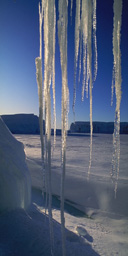
Our perfect day began with a 6am berg alert. If we didn’t move now we were mad, suggested Laurie, politely. We had optimum weather: sun, no wind; penguins leaping ahead of us; and there was ice - buckets of it. We were frozen-water paparazzi: all over the bow and bridge, everyone smiling at everyone else, unable quite yet to believe in these growlers (small chunks undetectable by radar) and bergy bits (up to five metres out of the water) – floating islands of icing sugar shadowed by their electric-green dark sides. They appeared at regular intervals, like they might be related. We heard one crash into being from some distant, groaning glacier (it’s even called ‘calving’). Later we flew over Paradise Harbour and cruised it in Zodiacs, right up to glaciers that glowed deep blue from within, where you can pick yourself a popsicle of pure 20,000-year-old water.
The perfect day never really ended; we were so far south by now the sun didn’t set. The Dranitsyn was driving towards the virtual finishing line of the Antarctic Circle; if we made it there’d be a party. Though just three ice junkies stayed up on the bridge till 4am watching the bow of the ice-breaker push noiselessly (from up here) through huge floes that stepped on and on into yellow, pink and purple nothing. Cracks ran like lightning away from us; the odd penguin too. Brian said it was like watching a screen-saver, and tried to drag himself away. ‘The problem is,’ said Fiona, exhausted, ‘is it ever not going to be this interesting?’ In the end we never made it to the Circle – even our ship was forced to give up later that night - though hardly anyone seemed to mind.
Factfile
Carol McDaid travelled on the Kapitan Dranitsyn Russian ice-breaker on an 11-night Antarctic peninsula trip with polar cruise specialist Quark Expeditions (01494 464080). The company is offering 30 Antarctic voyages between November 2002 and the end of February 2003 on a choice of three different vessels. Prices range from $3,295 (£2, 280) per person for an 11-day Classic Antarctic Voyage around the Antarctic peninsula to £24,194 per person for a 66-day circumnavigation of the continent on an ice-breaker. Prices include all food and land excursions. Flights are not included.
Carol flew courtesy of natural history tour specialists Wildlife Worldwide (020 8667 9158) with United Airlines (0845 844 4777) to Buenos Aires, and to Ushuaia with Aerolineas Argentinas.
Useful websites: www.coolantarctica.com is great on what to take and has a very detailed section on photography. The official website of the British Antarctic Survey is full of news and information. antarcticconnection.com for penguin mouse mats.
Further reading: The Worst Journey in the World by Apsley Cherry-Garrard (Picador, £8.99): the best polar book there is; an account of Scott’s last expedition by one of the survivors. Endurance: Shackleton’s Incredible Voyage by Alfred Lansing (Weidenfeld and Nicolson, £10.99): the story of Shackleton’s incredible attempt to cross the Antarctic continent. South by Ernest Shackleton (Penguin, £5.99): the original account of Shackleton’s journey as documented by himself, illustrated with classic black-and-white photographs. Lonely Planet: Antarctica by Jeff Rubin (£12.99): a treasure, first because guidebooks on Antarctica are still very rare; second because it is exhaustively comprehensive in its detail - yet so readable. It makes fascinating bedtime reading on the region, even if you know you’ll only go there in your dreams. Cadogan’s Antarctica, The Falklands and South Georgia by Sara Wheeler (£12.99): sparky, intelligent guidebook from a woman’s perspective, and the only funny one.
Where to go: There are more than 20 vessels plying Antarctic waters, ranging from small yachts to large cruise ships. Most itineraries include the Antarctic peninsula region and depart from the Argentine port city of Ushuaia. The average length of a cruise is 14 days. Occasionally there are departures from Australia, New Zealand and, more rarely, South Africa. It’s important to remember that itineraries are at the mercy of the weather and ice movements and subject to change.
When to go: Antarctic cruises run between November and March. The best time to go is December or January, in the middle of the Antarctic summer when the temperature is between -6C and 10C.
What to expect: Rough seas at times. You will certainly see icebergs , penguins, seals and albatrosses, and possibly whales. Most cruises offer the chance to see the wildlife close-up on daily land excursions using Zodiacs or, in the case of Russian ice-breakers, a helicopter.
