
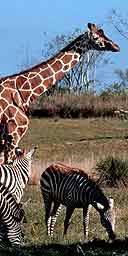
Brian is excited. Very excited. "Look there. A giraffe. What's that hanging down from its stomach?"
"That's a penis, Brian."
"Oh."
It would be a reasonable enough question - were Brian a toddler at London zoo. Unfortunately he's not. He's in his late 30s, and he's standing in the heart of the African bush. More remarkably, Brian's training to be a game ranger. He's a potential Daktari. Clearly he has some work to do.
At least he's in the right place, which bodes well for his navigation class. It's just one of the skills we're learning at the Sabi Sabi reserve on the border of South Africa's Kruger National Park. The four-day 'Ranger Experience' offers a taste of the intense, sun-scorched life of the game warden: as well as giraffes' penises, we'll get the lowdown on bush survival, tracking, orienteering, plants, birds, natural medicine and, of course, wild animals.
True, I can't imagine it being that much use back in Clapham, although crossing the common may become a little less intimidating. It does, however, promise to provide some amazing pub trivia. After all, it's not every night you sip your pint while receiving an explanation of how to cure that irritating sinus problem by inhaling smouldering elephant dung. The locals will think me positively enigmatic.
Our instructor Ed Farrell, one of 15 rangers at the reserve, is assisted by a man called July, a "spotter" who sits on a chair attached to the bonnet of our Land Rover. Having survived most of the Mozambique civil war alone in the bush, he has razor-sharp eyesight and intuition - on our first night, using a handheld spotlight to penetrate the darkness, he spots a two-inch-long chameleon sleeping on a leaf.
Equally impressive is Ed's encyclopaedic knowledge of animals, plants and birdlife. Tiny dots of feathers are instantly identified as Blue Waxbills or Forktailed Drongos. By day three I find myself uttering extraordinary statements such as "What a superb Longtailed Shrike!"
We also get a comprehensive course in bird calls. It might come from the Teletubby school of ornithology, but I can now reveal that the Brobu sounds like a ringing telephone, the Redchested Cuckoo like a stuck car alarm and the Red-billed Wood Hoopoe like the cackle of a Tupperware party. PC is clearly not big in these parts.
Interesting - but not life-saving. It's the knowledge of animal tracks that's more likely to save our skin if we're stranded in the bush. Being on foot adds a sense of anticipation to Ed's talks, particularly when we find lion prints and see July pick up a rock.
As well as learning the basic paw patterns - ruminants (cud chewers) like impala have an even number of toes; ungulates (leaf eaters) like rhino have an odd number; cats' paws have three lumps, dogs' two - we delve deeply into piles of dung.
If it's steaming, or has recently been raked by hooves, your quarry is probably nearby. While buffalo dung looks like a cow pat, rhino scrape theirs around and impala stamp their pellets into the ground (where Afrikaners collect them, soak them in brandy and hold distance-spitting contests. Do you gentlemen get out much?). Elephant crap, on the other hand, looks like broken-up bales of straw, and can be burnt and inhaled to clear a headache, or have water strained through it to produce a drink that is claimed to induce labour in pregnant women.
We get to use our new Crocodile Dundee skills following a particularly brutal attack on the camp kitchen. Vandals have broken in, smashed every single one of our 60 breakfast eggs, trashed the room and left numerous piles of - well - shit lying around. The give-away isn't the dung, however - it's the paw prints in the egg yolk. Curled knuckles and a thumb? They might as well have sprayed "Baboons Woz 'Ere" on the walls.
We also fit in a crash-course in handling a four-wheel drive vehicle - our steering wheel has chunks missing after being attacked by a hyena - before moving onto alternative uses for trees and plants. Taught on a four-hour walk at 5.45am, this is when the pub trivia soars into the Premiership. For starters there's the Thieveberry tree, whose leaves are eaten by elephants as a laxative (mental note: use with caution), while those of the Shampoo bush can be boiled, worked into a bar and used a soap.
All of which is useful, but not in the same league as Buffalo Thorn leaves. As well as making a nice salad, locals mush them into a paste to treat snake bites - effective when held in place over the wound by a palm leaf bandage. After three days they eat the soiled paste for instant immunity, a cure not presently available on the NHS. They're also used as an aphrodisiac - strain water through them several times, leave the liquid for a fortnight and then take with bedtime cocoa, lie back and think of Africa.
Next day, hiking well away from out tented camp - the ranger course is a non-luxurious safari that's both economic and atmospheric - we follow Ed to within 40 yards of rhino. In expert hands it's perfectly safe. The two-ton animals may charge at 40km an hour, but handily suffer from chronic myopia (and laser eye treatment isn't available in this neck of the woods). But it's a slightly different matter when we disturb a seriously large elephant as we walk along a riverside path. He clearly isn't happy, and advances towards us flicking his head from side-to-side. He is, if I'm not mistaken Mr Attenborough, charging.
"Walk away now," says Ed, calmly. "Walk slowly... slowly... OK, run!"
We vanish in a blur of heart-pumping khaki. Only Ed remains, never taking his eyes off the animal, until it turns off into the bush. "It was just a mock charge," he observes matter-of-factly.
His apparent cool reveals a quality that can't be taught: bravery. Doing "the knowledge" is one thing, the dangerous reality of the bush is quite another. Still in his years at the camp, Ed has never fired his rifle in anger. A Czech-made .458, the sort of weapon Colonel Bufton Tufton would take pot shots at the servants with after a hard night on the single malt, it fires brass-tipped bullets that can drop a charging elephant.
The key word is "can". The ranger training lets us shoot several rounds at a paper animal target in a dried-up river bed. Unaccustomed to the unwieldy rifle's vicious kick, I hit the buffalo in the shoulder, hoof and, most unwisely, the testicles. He'd not be dead and he'd not be happy.
Handy as they are, rifles don't feature on the final day when we are taught survival tactics. After learning how to find water, eat safe fruit (avoid the bright ones), work out bearings using a watch and the sun or stars, kill warthogs and, crucially, make cocktail straws, I'm now less fazed by the idea of a plane crash in the bush. Not only might I survive, but I'd be guaranteed some amazing stories to roll out at the bar in the Prince of Wales.
Ways to go
Sabi Sabi's four-day 'Ranger Experience' is no longer available, but Travelbag Adventures (01420 541007) offer a longer 10-day course in the Timbavati area on the north-west border of the Kruger Park, with accommodation in private tented camps, which also includes carcass skinning, reptile conservation and sleeping out under the stars. Cost is £776 per person all-in (excluding flights). Travelbag can also book flights with South African Airways for around £514 plus tax (£46), including connections to Hoedspruit.
