
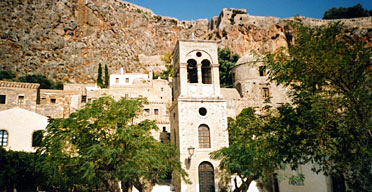
Standing on the starlit walls of the medieval rock-fortress of Monemvasia, watching waves passing far below like an army of migrating birds, you notice one thing above all else: near-silence. Listen carefully and you can hear the water breaking gently on the stone. Behind you, a door rattles in the breeze. There is nothing else to be heard.
Just a couple of years ago, this jewel in the Mediterranean was alive with visitors. A Flying Dolphin hydrofoil began making the trip from Athens in just over three hours - and the tourists, hearing of its cobbled alleys, twisting and vanishing as in a medina, its red-tiled roofs and chimneys, and its domes and bell towers, all perched on a tiny rock off the south-east limb of the Peloponnese - well, they arrived in swarms. With them came money: pensions and hotels, all upmarket places to stay, with views of the roofs scattered down toward the sea. The perfect place for an Athenian's weekend break.
Come the Olympics, though, the hydrofoil has been diverted to serve islands nearer Athens - and Monemvasia's tourists have vanished. From autumn to spring, much of the remarkable accommodation will be empty. My advice: enjoy the peace while you can.
From the mainland, the rock is impressive enough. Monemvasia (its name means "single entrance") rises out of the sea like a Greek Mont St Michel, linked to the mainland town of Gefyra by a causeway. Eleven years ago, when I first came here, I slept on the beach in midsummer and watched the sun rise red over the rock. An unforgettable view, but nothing compared to what it hides.
Cross the causeway, climb the road and you enter via a fortress gate, barely wide enough for one, into the first of two medieval towns. This lower part of Monemvasia, clinging to the south of the rock, is a candidate for the most perfect picture-postcard village in Greece.
Cars are left at the gate and once inside, the alleys wind, Victorian lanterns hang from the arches, crumbling staircases disappear below you, moggies slink round corners behind giant urns. There is something bohemian about the locals too: the manager of the Malvasia Hotel wandered around all day wearing a thin, flowing, blue jellabah and a catlike grin. Inside, the buildings have been restored with artistic flourish, and in the best taste: and the rooms have traditional fireplaces to take the chill off those cold winter nights.
Once you have worked out how to get there, the square is where to watch the world - or what there is of it - go by. Here is the marble-floored, 13th century church of Christos Elkomenos ("Christ in chains"); here also Monemvasia's small museum, which houses a few local finds - and helps you gen up on the Byzantine history. But most people just sit under the plane trees and bougainvillea with the locals, watch the sea and forget the time.
Monemvasia's upper town is for the more energetic, but it is worth the effort to see it, as it holds the key to the rock's past. Wandering around the paths that crisscross its ruined walls and foundations, its earth a Moroccan red, the only life you are likely to see are the lizards and grass snakes darting into the scrub. But at the top of a thigh-wrenching climb stands the 13th century church of Ayia Sophia. This church's name - and its squat cruciformity, like so many others in Greece - is an echo, perhaps deliberate, of its former capital: the cathedral of Ayia Sophia in Constantinople, modern-day Istanbul.
Standing on this peak, watching a yacht making its way around the eastern edge of the rock, Monemvasia seems distant from Constantinople in both nautical miles and time. But climbing up to the furthest ramparts, and looking back to the land, you realise its strategic purpose. Sixty miles inland, and at constant risk of invasion, lay the imperial city of Mystras.
Mystras is, of course, one of the highlights of Greece: a Unesco world heritage site, well known to package tourists and backpackers alike. Take a daytrip there, and the similarities to Monemvasia are striking. Unlike its port, though, this city does not hide its glory. The first view of this airy, medieval pinnacle, its 30 churches seeming to grow out of the rock, will stop you in your tracks.
You can spend all day wandering the ruins of Mystras and although you won't be alone, that only serves to remind you how busy the medieval city was. Even the nuns, who live in the garden convent of Pantanassa, don't seem to mind the crowds: they only ask you to cover your legs with a sari (cue Beckham gags, and not just from the English). At the base of the city is the great church of Metropolis, in whose marble floor is set a double-headed eagle (the ensign of empire), evoking Constantinople's claims to control both the eastern and western worlds. Here, you are aware, stood a Byzantine despotate that ruled this corner of the Peloponnese for close to 1,000 years.
When night falls on Mystra, its once-busy streets are closed to visitors, its ruins and frescoes left to the nuns. Yet back at Monemvasia, life goes on. Restaurants are open for business in shaded courtyards; a hidden bar overlooks the black sea below. Perhaps this is because of the rock's history: it fell to the Venetians first - not the Turks - and by the time it became part of the Ottoman empire, it was almost as an afterthought. The gods of east and west were celebrated side by side in the central square until the 19th century.
The key to Monemvasia is not its languor, the ouzo on the terrace, even the tumbling rooftops - you can get those anywhere in Greece - but its unrelenting focus on the Aegean. The Byzantine alleys may hide an imperial history, but this is a seaward town, shielded from the land and its troubles by the rock on which it stands. Somewhere over that horizon, though, another hydrofoil is preparing to set sail: get there before the next invaders do.
Way to go
· Monemvasia's best hotels are the Hotel Malvasia, which has attractive and artistic rooms with flagstones, fireplaces, beamed ceilings and sea views from €55 to €96; and the Hotel Byzantino, which has similar but more contemporary rooms with views of the sea and the bell towers, at €120. Ardames has large, rustic apartments, one in a converted tower, for €110 to €140.
· To reach Monemvasia, fly to Athens or Kalamata and hire a car. Chris hired a car from Athens with Auto Europe. Buy a good map of Athens before you go, and establish how much of the terrifying Attiki Odos ring road has been built. Hiring a car from Nafplio, two hours' drive south of Athens, would be a less scary option. For more information visit Hermes Travel.
· With the suspension of the Flying Dolphin hydrofoil, only one ferry now calls at Monemvasia from Athens: the Myrtioditissa. But the Greek Island Hopping website recommends avoiding this boat, as it has failed two safety inspections since 1998.
