
We left at dawn, swaying through the dark mountains above the city. The driver, Ahmed, bearded and stiff, clutched the steering wheel nervously, his Kalashnikov tinkling like a teaspoon in the shadows beside the handbrake.
"What does this one know about algebra?" I wondered, as we twisted up through the pink light. On the verge, a grey donkey pitched like a rocking-horse, its forelegs lashed together with cloth; above it, stone towerlets balanced on razor ridges. The old Yemeni architects certainly understood geometry. There is still something disconcerting to Western eyes about those proud pinpricks of pure architecture. They declare: "We can bind stone in places you can only dream of, and organise our lives and die up here without needing you at all."
At a rusty oildrum, thin soldiers fingered our papers cautiously then shook hands and waved us through. Zabid lay four hours to the south. Yemen, intoxicating, impoverished Yemen, laid the foundations for modern civilisation: high-rise buildings, irrigation technology, and roasted coffee beans all emerged from the southern crust of the Arabian peninsula. And in Zabid, almost a millennium ago, the scholar Ahmad abu Musa al-Jaladi dazzled students from the new enquiring world of Islam with the resurrected intricacies of "al-Jabr" or algebra.
The air suddenly became hazier and the road swooped down into a wooded gorge where bamboo was stacked like giant wheat sheaves against the rock. Three coachloads of men were paddling cheerfully in a river and we helped them heave upright a crumpled olive-coloured truck which had tumbled over on its side, spilling sacks and glass and cardboard boxes across the road. The passengers, though, had all survived and chatted round the wreck as if such catastrophes were commonplace.
Africa was just across the Red Sea now, and the stone stockades became huts of matted straw, bulging above tall grass like termite mounds. Black children crouched barefoot on the hot roadside.
After 40 minutes, Ahmed stopped to ask the way, and two dusty infants jumped on to the tiny running boards and led us bumping down a track to stop in a large square overhung by a crenellated decaying citadel.
We found a café shaded by acacia trees where Ahmed curled up on a mat and slept while three schoolboys walked me through a maze of whitewashed alleyways interrupted now and then by stuccoed courtyards, stocky minarets and decrepit Ottoman mansions. Zabid was founded in 820AD and was destroyed four times before, in the 13th century, becoming, briefly, Yemen's capital under the brilliant Rasulids whose architects invented, among many other things, the cupola. Its university rivalled Cairo's al-Azhar and, through al-Jaladi, reconnected medieval Europe with the brainwork of the early Greeks. "Al-jabr" is Arabic for "restoration".
Zabid's 14,000 inhabitants still have five schools, but the university died in 1950 when Yemen's despotic ruling Imam grabbed its endowment funds for himself. Nevertheless, the pulse of its past glory can still be detected in 86 thriving mosques and the intricate interiors of outwardly mundane residences. I was taken to a large brick cabin where the family watched television from thinly-strung divans in an exquisite, shaded room indented floor to ceiling with abstract patterns a finger deep.
Pier Paolo Pasolini came to Zabid to film The Arabian Nights and was so entranced by what he found here, and in San'a, he later made a documentary that demanded action from Unesco "in the name of simple men whom poverty has kept pure, in the name of the grace of obscure centuries, in the name of the scandalous revolutionary force of the past".
Thanks to his crusade, Zabid, like exquisite San'a and Shibam, now has world heritage status, though so far only four of 34 scheduled regeneration projects have been completed.
Money is the obvious problem. Patching up Zabid's 1,000-year-old Ashair mosque alone will cost $97,000. Yemen, its public image vaguely, if unfairly, linked with Marxism and Muslim fundamentalism, is not first in the queue for Western largesse.
Sayed, a self-confident local schoolmaster of African descent, joined our group and began organising the distribution of tips. I asked him how he thought the outside world viewed Yemen. "France is OK, and also Germans and the English," he declared quickly, "but the Americans don't like Arabs." In fact, annual arrivals from all quarters have slumped from an already meagre 100,000 to a calamitous 30,000 as travellers flee the perceived possibility of kidnappings and worse.
At Marib, 170 miles north-east of Zabid, the Bilquis Hotel was a stylish oval enclosing a palm garden and an hour-glass swimming pool, but its 66 luxurious rooms were occupied only by myself and four Scrabble-playing Swiss.
"It has been like this since 1998," sighed the young receptionist, an allusion to the four tourists killed in a shoot-out between their captors and Yemeni soldiers. In the vast foyer, the lonely staff checked empty ledgers and swept gleaming floors with surreal diligence. Three thousand years of desert civilisation have taught Yemenis to take the long-term view. Battered by Roman, Ethiopian, Persian, Egyptian, Ottoman and British occupations, their country was still a feudal fiefdom when the imams were swept away in 1962. Now it is the only democracy on the Arabian peninsula.
The Foreign Office still advises against non-essential travel to Yemen, but over 10 days I sensed no hostility and received only courtesy and kindness. One night, I ended up, accidentally, in a seething roadside café, one eye on the grey chicken stew, the other on the machine guns heaped like scarves on every plastic table top. But when one of the hawk-faced tribesmen finally turned towards me it was just to offer an orange he had quartered with his hunting knife.
Many Europeans have settled and live undisturbed and happily in the honeycomb of old San'a, besieged for 70 days only 33 years ago by UK-backed royalists loyal to the deposed imams.
Pasolini's poignant 13-minute travelogue was called The Stones of San'a and the exhausted director creditably filmed it the day after he finished The Decameron in which Yemen's capital represented medieval Cabia. "Theoretically, I should not have had the energy ...(but) I really cared about shooting this," he said later.
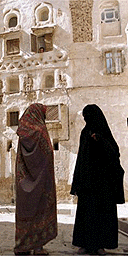
San'a has that effect on you. The old city is one of the most magical places on earth. The tower houses swarm over a square half mile, the grander frames picked out in white gypsum lines.
Climbing to the top of the National Arts Centre, formerly a 17th-century merchant's palace, I watched a family feeding armfuls of cannabis to two goats tethered on the opposite roof. Below, turbanned shadows forced barrowloads of salt through a gorge to the 1,370-year-old Grand Mosque, built when the Prophet was still alive. San'a is said to have been founded by Shem, one of Noah's sons. Home-hunting Yemenis are sensitive to the antiquity of the soft brown monoliths, breaking windows to let the djinns escape before they will risk a letting.
Further east, at Old Marib, the ghostliness was almost overpowering. The imperial metropolis from which, 3,000 years ago, the Queen of Sheba set forth "with camels bearing spices and very much gold and precious stones" to visit Solomon was a rambling ridge of fawn blockhouses reduced to perforated shells by poverty and air raids in the fractious 1960s.
A nut-faced woman crept from the ruins to unlock an ancient door and we climbed up an empty tower past a roomful of blue and yellow plastic water bottles to a rooftop terrace. From here, we could glimpse fragments of the giant dam, the technical wonder of antiquity, which had once contained and channelled the flood waters that turned the desert into a prosperous oasis for 1,500 years.
A mile south, a young Berlin archaeologist Nicole Roring showed off the newly-exposed complex where the Queen of Sheba offered prayers to her moon god Almaqah before heading north for Jerusalem.
The desert is littered with half-buried, enigmatic pre-Islamic structures like this; no doubt greater riddles lie beneath the sand. In San'a, a World bank official estimated that cultural tourism could be worth $300m a year to Yemen's still oil-dependent economy, if it ever gets under way. The Germans' painstaking 12-year excavation of this temple represents a start.
Eerily, the scent of fresh paint hung around a site dominated by five 27ft-high square pillars. Nicole explained that their engineering was so precise that the bases were only set two centimetres into the supporting rock. It seemed a decent metaphor for Yemen itself. Despite Pasolini's foreboding, the grace of obscure centuries clings on: desperately, improbably, and a little heroically.
Way to go
Yemen Airways (020-7491 7186) offer twice-weekly direct flights by A310 Airbus between Heathrow and Sana'a, departing Wednesday (9.15pm) and Saturday (8.15pm), for £410 return (first class £1,460). Visas are essential; £30 from the Yemeni embassy, London (020-7584 6607), £42 at San'a airport. The independent and moderately intrepid traveller will find a wide range of sleeping facilities, with prices to match. A single room in Marib's splendid Bilquis Hotel costs $80; conversely, the unmissable atmosphere of San'a's Old Palace Hotel will only cost you $10 - with breakfast and ear-splitting muezzin calls from nearby minarets thrown in. Yemen now has many companies geared up to introducing the cautious visitor to its archaeology, hill villages, deserts and coastline. Among the biggest are Universal (009671 272861/2/3) and Almamoon Travel and Tourism (009671 276299). Summer Tours at summer-yemen.com offers eight-day trips featuring desert camping, camel-riding, 4x4 excursions, internal flights and visits to San'a, Seyun, the Marib dam, and the astonishing tower-city of Shibam for $829 (minimum eight people). Note that the Foreign and Commonwealth Office advises against all holiday and other non-essential travel to Yemen, due to incidents of kidnapping, terrorism and violence. See fco.gov.uk for latest details. For information on Yemen including regularly updated reports on kidnappings, see al-bab.com/yemen.
