
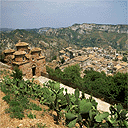
Calabria used to be remote, a place you might pass through on your way to Sicily, but nowhere you would stop and stay. For one thing there were no hotels. Then there were wolves and bandits in the hills, malaria, cholera and earthquakes in the cities, and organised crime in the shape of the n'dragheta. The inhabitants were reputed to be an untrustworthy mix of Greek, Italian, Saracen, Norman and Spanish who spoke an unintelligible dialect. When the Italian writer Carlo Levi wrote that Christ Stopped at Eboli, he meant that benighted barbarism began 50 miles below Naples.
When the essayist Norman Douglas wandered through the region before the first world war, Levi's analysis, was, to some extent, still valid. Though the banditti had gone, the Bourbon legacy of disease, poverty, flea-ridden bedding and disgusting food discouraged all but the most enterprising. It discouraged the local youth, too, who emigrated en masse to the United States.
The latter-day traveller will quickly discover, on the winding roads through the mountains between the Ionian and Tyrrhenian seas, an Italy unchanged by the advancing years and the influx of tourists. It is what Tuscany and Umbria must have been like 100 ago. But things are beginning to change. Money is pouring in, new towns are springing up, and the shabby hearts of the old cities that we, rather guiltily perhaps, find so picturesque, are about to go the swept and garnished way of Cortona and San Gimignano.
Calabria is the ball and toe of Italy, part of Magna Graecia in the days when ancient Greece spread from Athens to Naples. This heritage is reflected in the ruins at once prosperous Sybaris, which gave the world the word "sybaritic" but so little of which survives because in 510BC its jealous neighbour Croton, home of Pythagoras, destroyed it. These days a courteous guide provides a much more friendly welcome, and there is an excellent new museum, too.
Further echoes of the region's turbulent past are encapsulated in the museum in Reggio di Calabria, which exhibits Greek, Hellenistic and Roman finds of every sort, the most spectacular of which are the two magnificent Riace bronzes, discovered off the coast 30 years ago, and restored. They are larger than life in more ways than one, possessing superb physiques.
North and east of Reggio, along the Gulf of Taranto, are 250 miles of beaches, with modern resorts based next to ancient Greek sites. Though the season is short, the demand for accommodation is unending, and, as along so much of the Mediterranean littoral, many of the buildings are still under construction. The tourists are almost all Italians - it is too hot here for northern Europeans (Germans excepted) in high summer so the time to come is spring and autumn. On the western Tyrrhenian side, the tradition of Sybaritic luxury lingers on in the area round Vibo Valentia, for instance, at the Porto Pirgos hotel at Parghelia. The rooms all have private balconies, there are swimming-pools at the top and bottom of the gentle steps down to the sea, and the island of Stromboli obligingly comes into view with the setting sun.
The new prosperity is partly financed by American émigrés. Their second cousins, who have been scraping an uncomfortable living in the mountains all these years, are now moving down to the plains. They left them 2,000 or so years ago, when they lost the Greek skill of drainage, and the combination of malaria and Barbary pirates made life impossible. The privateers were finally eliminated after the Napoleonic wars, and Benito Mussolini subsequently reintroduced drainage. Now European Union subsidies are hastening the emptying of the hills.
The hills are therefore the place to go, though you will probably need to come down at night because of the shortage of upland hotels, except on the Sila plateau between Cosenza and Catanzaro. Gerace, a morning's gentle drive from Reggio, is where the inhabitants of the ancient city of Locri retired when things became too unpleasant by the sea. They took with them pillars from their Greek and Roman buildings to furnish the elegant Romanesque cathedral, with its Byzantine crypt.
Edward Lear stayed in Gerace to enjoy the wonderful views from the "balconia", and you can lunch in either an expensive restaurant or more modest taverna. In the latter you will be waited on by a family who, from the six-year-old upwards, walk about belly-first with what is clearly a cherished, inherited slouch. Invariably, the cook is no slouch, and the pasta is heavenly. Wandering on, you can spend the night in the moderately priced San Giorgio hotel, in what was once a cardinal's palazzo in the equally delightful hill-town of Stilo.
The latter is beautifully sited under a mountain, and has a tiny five-domed Greek church overlooking the town called La Cattolica - an architectural gem from the days when Calabria was part of the Byzantine empire. The Sila plateau is well equipped for tourists, with riding, boating and walking, and in the spring its wild flowers are astonishing - whole fields carpeted with yellow and red and blue.
In Cosenza, to the north, it is another story: a magical medieval city hides behind the hyperactive modern face of the provincial capital, where the hotels are usually full. (There are appropriately hyper-modern and relatively expensive ones a few kilometres away in Rende, just off the autostrada).
Old Cosenza is a series of tiny alleys clinging to the cliff below the castle. It has a cathedral with the remnants of the tomb of Queen Isabella of Aragon, parts of which apparently were removed to the church of San Francesco.
In a nearby wine bar - a rare sight in these parts - we were the only customers. Enjoying the local wine and discussing our next day's trip, the proprietor heard us mention his native Longobucco. At once he sat down and not only showed us the best road to this dramatically lonely mountain town, but supplied us with a written introduction to a friend who could show us the sights.
Initially our journey to Longobucco was straightforward, but somewhere after Acri the directions supplied by our friend from the wine-bar sent us down a vertiginous road with a drop of what seemed like 4,000ft. The whole country, at one time completely forested, is scarred with deep chasms. Calabria has kept many of its trees, unlike the luckless province of Basilicata to the north, turned into a chemical moonscape by ruthless logging in the 19th century and subsequent erosion. When we stopped to eat our panini and admire the valley, it was loud with the chatter of blackcaps; there seemed to be one in every bush. You will need a large-scale map because the roads are complicated as well as slow, and the signs erratic. Arrows to the centro storico have an irritating habit of leading the unwary driver in to a modern suburb.
You certainly need a good map to find your way to Macchia and Vaccarizzo Albanese, and the other Albanian villages established by 15th century refugees in the beautiful hills behind Sybaris. The Albanians still have their own churches, half Greek Orthodox, half Roman, dedicated to saints such as Basil and Athanasius. In the church at San Demetrio Corone (restored in the 1950s thanks to donations from Italo-Albanians in New Jersey) you see a completely Greek altar in one aisle, a completely Roman one in another. There is also an Albanian College founded in 1791, and though everyone has spoken Italian for hundreds of years, occasional signs and notices are in a totally baffling script that is Albanian in origin.
Even after all this travelling, you will still have hardly begun to explore Calabria. And the more you explore, the more you'll be astonished that southern Italy has been neglected so long.
Way to go
Alitalia (0870 5448259, www.alitalia.co.uk) flies to Reggio di Calabria for £333 return inc taxes. The Hotel Porto Pirgos, Marina di Bordila, Parghelia (0039 0963 600351) has single rooms for £100, doubles for £150. In Stilo, Hotel San Giorgio, Via Citarelli, 8 (0039 0964 775047) has singles from £20, doubles from £30.
