
The tourist revival that is sweeping parts of former Yugoslavia - from the spas and mountains of Slovenia to the idyllic coastal resorts of Croatia - is resolutely passing Serbia by.
On first glance, it is not difficult to see why the country might not be the first choice of destination for travellers considering a Balkans holiday.
The capital, Belgrade, where I spent a tiring but thoroughly enjoyable weekend, is steeped in history. It has two rivers running through it, but lacks the picturesque charm of Ljubljana, or the attractive cafe-lined streets of Zagreb.
From the seventh floor of the five-star Intercontinental in New Belgrade - a vast glass-and-steel pyramid with black-and-chrome furnished rooms that look like interrogation chambers - the view is bleak.
Much of the surrounding architecture seems to be stuck in a Soviet-era time warp. It is by turns fascinating, ugly, and kitsch, and the devastation wrought by Nato bombs in 1999 is still clear.
So, unless you have a morbid fascination with bombed-out buildings or a penchant for vast socialist housing estates, sightseeing opportunities would appear limited.
But the historic heart of the city - a 1.5 mile, 200 dinar (roughly £2) taxi-ride from the hotel holds some real treasures; from the Ottoman-built fortress that overlooks Kalemegdan park to the cathedrals and palaces of Old Belgrade, built by Serbia's 19th-century monarchs.
There is plenty here to satisfy the culturally minded traveller, including renowned museums and theatres, and I hope to return and explore it all.
This weekend, however, was strictly about observing Belgraders doing what they do best: drinking and dancing with unmatched abandon. Here, I was warned on arrival, every day is treated like Friday - people think nothing of clubbing through the night and going straight into work the next morning.
That may sound unimaginably hedonistic to people from a nation where almost everything shuts at 11pm, but Belgrade's all-night bars and clubs - and cheap booze, with beer at 60p a pint - make it a dangerous possibility.
I timed my visit to coincide with Echo, the first major international music festival in the capital for as long as anyone here can remember. Belgraders may not need an excuse for a party, but they do tend to pull out all the stops for special occasions.
The £15-a-ticket, five-day, open air event featuring a range of artists - from bands such as Morcheeba and Sonic Youth to DJs Carl Craig and Justin Robertson - was staged on the Lido, a popular beach on an uninhabited island that sits at the intersection of the Danube and Sava rivers.
I arrived in Belgrade on Friday evening and soon met up with friends from London who were also in town for the festival. We made our way to the venue at about 10pm.
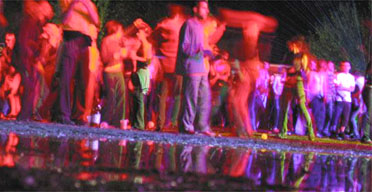
That was our first mistake - we were far too early. The muddy fields in front of the four music stages were practically empty, with big-name DJs playing their socks off to nobody in particular. By midnight, however, the Belgraders were arriving in their thousands, most of them having warmed up in the city's bars or at private parties.
I managed to keep going until about 5am, when I slipped away from the still up-for-it crowd in front of the popular London Xpress stage. The island is linked to the mainland by a pontoon bridge but luckily I managed to wangle a seat on the last speedboat across the river with the festival staff.
As the sounds of reggae, techno, and disco faded into the distance, the sun started rising over the city - creating the kind of blissful scene one rarely experiences on the night bus home.
The next evening we managed to convince Vera, a DJ on Belgrade radio station, Studio B, who was working on the festival, to let us come along to her friend's birthday party. The friend turned out to be a high-ranking government official, and his house a glorious timber-framed retreat on the banks of the Sava.
Despite the fact that we turned up empty-handed, the host welcomed us with a hospitality I came to discover was typical of Belgraders: he gave us bone-crushing bear hugs then plied us with food and drink and insisted we dance without pause.
At about 3am he reluctantly allowed us to leave ("but we are just getting started," he pleaded) - sending us back into the night with three big kisses on the cheek (the Serbian equivalent of a firm handshake), vows of friendship and more hugs. Then it was back to the festival for more dancing, drinking and another blissful boat ride back to the shore.
Sunday, our third and final night in the city, was spent with Goran, a Serbian friend from my university days who insisted on showing us the real "Beograd". This, we were to discover, is hidden in side streets and alleyways as if people are still afraid that the secret police will come and break up the party. Whatever the real reason, it certainly added to the excitement.
After some lazy afternoon drinks in a terrace bar beneath the bombed-out military headquarters, Goran took us to one of his favourite restaurants, hidden away in a quiet residential area of Old Belgrade.
After a short drive we stopped outside what appeared to be the entrance to someone's back garden, a large wooden gate in a high wall that ran between two houses.
It opened onto a cobbled courtyard and a pretty, country-style house that has been converted into one of Belgrade's best and most popular restaurants, Kod Dace (Patrisa Lumumbe 49), serving ethnic Serbian dishes to locals and the occasional foreign diplomat or businessman lucky enough to be told where to go. For about £10 each we had a superb meal: beginning with a shot of deliciously strong apricot brandy, served with soft bread, paprika-flavoured cheese and prunes, then a selection of succulent grilled meats - all organic and locally produced - washed down with wine from neighbouring Slovenia.
By now I was feeling pleasantly satiated and ready for bed, but Goran had other plans. Thirty minutes later, back in the centre of town, he was leading us down a narrow, foul-smelling alleyway into the basement-level entrance of a dingy apartment block.
We climbed a graffiti-strewn staircase and stopped outside the door to a flat. As it swung open, a few well-dressed young Belgraders walked out, waving goodbye to two burly bouncers with headsets, who then beckoned us in.
Goran appeared to relish our looks of dumb-struck awe as we stepped from the stark corridor into the plush lounge of Ben Akiba (Nusiceva 8) - a small but heaving bar serving classy cocktails to Belgrade's young shakers and movers.
This, like the restaurant we had just left, used to be someone's home. With metres of soundproofing to protect the neighbours from the considerable noise, it has been transformed into a cosmopolitan bar.
Works by local artists hang on the walls and there are shelves full of books everywhere - apparently part of an ingenious tax-avoidance scheme under which the owner has listed the place as a "literary club".
After introducing us to a few of his fellow regulars, Goran treated us to Thunder of God cocktails, a frightening mix of flaming Drambuie, absinthe and champagne downed in a frantic and quite hazardous ritual. By now, all thoughts of an early night had vanished.
We moved on to the nearby Academia, a once-famous underground punk venue where many of the Echo festival DJs had been forced to relocate for the night after a day of heavy rain.
Each of its many cavernous rooms were full to bursting with sweaty bodies, and at least one (English) dancer collapsed in the suffocating heat. I too had to throw in the towel within a couple of hours and returned to the hotel to catch a few hours' sleep - leaving the Belgraders, once again, in full flow.
Way to go
Where to stay: George Wright was a guest of the Echo festival and stayed at the Hotel Intercontinental, New Belgrade. It costs €175 per night for a standard single; €185 per night for a standard double; tel: 00 381 11 311 3333.
Getting there: JAT Airways (jatlondon.com) flies Heathrow-Belgrade return from £144.50, including airport tax.
