
It's a rare Saturday morning that begins with a journey through the fourth dimension, so it was with a certain trepidation that I prepared to be whisked back to AD975, to take a look at York as it was over a millennium ago.
In the event it took us only five minutes or so in the Jorvik Viking centre's time machine to confound the space-time continuum. We stepped out on slightly wobbly legs and were herded into capsules for the next stage of the journey.
From this point on, Jorvik turns into a fairground ride plus history - a winning combination, particularly if you have kids in tow. Commentary sets the scene as the carriages suspended from the ceiling move through the dark towards a recreated Jorvik, Viking capital of England, trading centre and ethnic melting-pot.
You're suddenly immersed completely in the sights, sounds and smells of a Viking street scene. With your eyes directed towards key aspects of the cityscape by the swinging carriage, you can hear the occasional guttural, Germanic voice rise above the general cacophony of grouse squawking, dogs barking, metal on metal and wood on wood. The odours (look out for the charming gentlemen sitting in a makeshift toilet) are overpowering.
On a visceral level it's compelling, but there's no suggestion that this is a case of style over content. The more you think about Jorvik, the more remarkable it appears. The articles retrieved in the 1976 archaeological dig were preserved in excellent condition; over 20,000 objects were cocooned in the mud, from jewellery, shoes, combs and utensils to (our guide took great relish in informing us) faeces. The scenes within the exhibition are based entirely on the evidence of daily life that was unearthed, accurate right down to the colour of the clothes (blue and yellow, but mostly red) and the ingredients of the breakfast porridge. This is how it was: a faithful depiction of the houses and streets that existed on this exact spot over 1,000 years ago.
Emerging from Jorvik into modern-day York, I took this sense of the past with me. The paths of many of the streets still in use today were laid out in Viking times, and you feel a connection with the people who have walked the same routes for hundreds of years before. We paid a brief visit to Clifford's Tower, on its steep, green mound, peaceful in the Saturday morning sunlight. In 1190 the city's Jews, threatened by an angry mob, sought sanctuary within its walls. Faced with the prospect of being killed or forcibly baptised, they chose instead to commit mass suicide. Walking around inside the tower's stone walls now, it was difficult to conceive that such a serene spot could have been the setting for one of York's most infamous events.
Step down from Clifford's Tower onto Castlegate, and you pass the elegant Georgian facade of Fairfax House. The interior of the 1750 house is beautifully restored and well worth a visit, particularly since knowledgeable volunteers divulge the history of each room, the furnishings and decor, and snippets of the history of the aristocratic Fairfaxes.
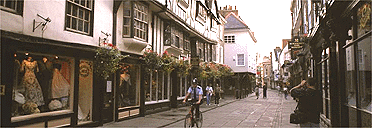
Even if you took a binding vow of abstinence from the countless museums and exhibitions to which York plays host, its past would be impossible to ignore: it presses in on you from every side. Take a walk through the Shambles, once home to the city's butcher shops and slaughterhouses. Although none of the original shop-fronts have survived, several properties still have exterior wooden shelves from the time when cuts of meat were served from open windows - quite a contrast to the expensive florists and delicatessens that vie for space along the street now.
On a bright Saturday morning in the centre of York, the cobbled streets were bustling, and you'd be forgiven for thinking that the city was as busy as it has always been, throughout its long history. In fact, visitor numbers in York are still languishing thanks to the long shadow cast by the foot and mouth crisis. While this has been disastrous for local businesses, if you're intending to visit, it makes now the best time to go. The streets around the Minster are easier to appreciate without too much competition from other tourists, all of the city's attractions are open, and there's so much to do there that you'll be hard pushed to find the time to head outside.
Should you feel the need for fresh air and bigger vistas, you'll find most of the outlying attractions are open too. We decided that lunch in the country would be a good idea, and we drove out past fields reassuringly full of cows and sheep.
Our destination was Castle Howard, a spectacular 18th century building set in over 1,000 acres of parkland. We wandered up the drive and were confronted with a view so Palladian that I half expected Capability Brown to jump out of the perfectly pruned foliage and start measuring off for his next temple. As the location for Brideshead Revisited, Castle Howard has emerged as the archetype for the English country house; but this wasn't a house, this was a palace. My jaw dropped to new lows as we were shown around the rooms that the family have opened to the public; the staff pointed out a Rubens in this room, a Gainsborough in that, until we all reached saturation point.
After a brief visit to the lovely rose gardens, it was time to head back. The afternoon was running out, and we still had to pay our respects to those two famous Yorkshire landmarks: the Minster and Betty's Tea Room. We settled ourselves in an upstairs window seat in Little Betty's (there are two branches in York) on Stonegate, and enjoyed the view of one of the most beautiful streets in Britain. After sharing a raspberry tart and thinking ourselves decadent, we meandered through Coffee Yard and Grape Lane to the day's final destination.
The first impression on seeing York Minster is one of sheer immensity. Reputedly the largest Gothic cathedral in northern Europe, its bulk crouches like a guard dog over the city. If you struggle up the tower's 275 steps, the higgledy-piggledy streets seem tiny and newly comprehensible when viewed from above. Plunging down into the crypt, via the south transept for a look at the famous Rose Window, we recrossed the boundary from present into past. Descending the steps into the crypt is like slicing through an onion: you can see all the layers of history one on top of another, from the spot where Constantine the Great stood when he was declared Emperor, to the remains of the Norman church, to the concrete collars which are keeping the Minster upright today. A weekend is a very brief time to consider a city's life over two millennia - which is why I'll be coming back for another look.
Useful links
York Minster
Clifford Tower
Castle Howard
Fairfax House
Jorvik
• Sarah Crown travelled to York with GNER. She stayed at the newly opened Quality Hotel (53 Piccadilly, York, Y01 9PL, tel. 01904 559000, fax 01904 559001, email enquiries@qualityhotelyork.com). Accommodation is £80 per room (for up to four people sharing). A continental or full English breakfast is £7 per person. The restaurant serves a Mediterranean menu, is reasonably priced and very good.
• For a free guide to where to stay and what to do in York, call 01904 621 756, visit the York Tourism website or email tic@york-tourism.co.uk.
